

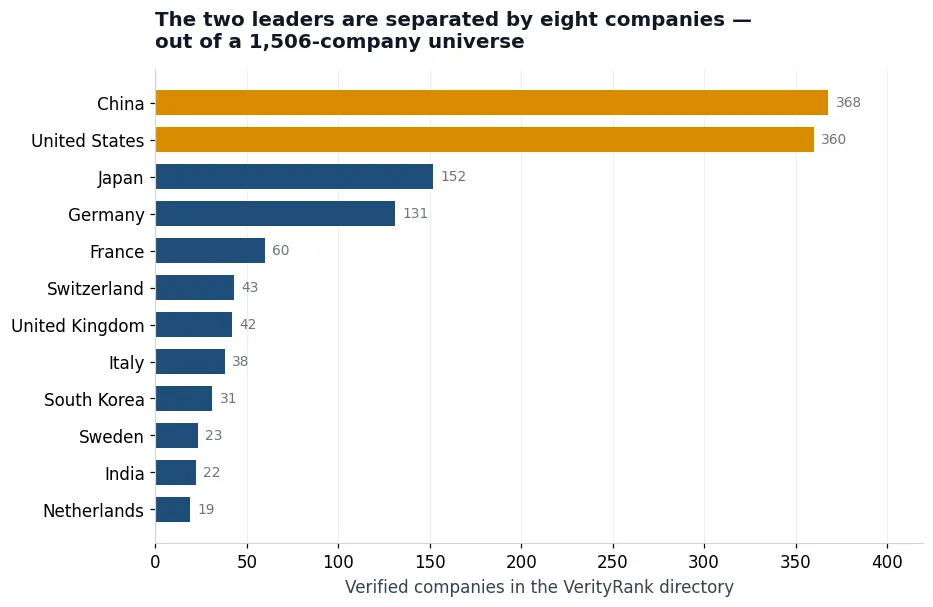
China contributes 368 companies to our verified database. The United States contributes 360. The two are separated by 8 entries — less than one percent of the 1,506-company universe, and a far narrower margin than the usual narrative of Chinese manufacturing dominance would predict. But the aggregate hides a sharper story: the two countries barely compete in the same industries at all.
What the Verified Universe Contains
Our directory covers companies that have been individually researched and assigned to at least one industry ranking. It is not a scrape of a business registry — inclusion requires a documented market position, a verified headquarters, and a category assignment. That makes it a reasonable proxy for globally competitive manufacturers rather than all manufacturers.
Company Distribution by Headquarters
| # | Country | Verified companies | Share of universe |
|---|---|---|---|
| 1 | China | 368 | 24% |
| 2 | United States | 360 | 23% |
| 3 | Japan | 152 | 10% |
| 4 | Germany | 131 | 8% |
| 5 | France | 60 | 3% |
| 6 | Switzerland | 43 | 2% |
| 7 | United Kingdom | 42 | 2% |
| 8 | Italy | 38 | 2% |
| 9 | South Korea | 31 | 2% |
| 10 | Sweden | 23 | 1% |
| 11 | India | 22 | 1% |
| 12 | Netherlands | 19 | 1% |
The top four — China, the United States, Japan, and Germany — account for 1011 of 1506 companies, or 67% of the entire verified universe. Every other manufacturing nation combined fits into the remaining fifth.
The Two Countries Rarely Compete Directly
Where China’s presence concentrates is consumer-facing and electronics-adjacent: home textiles, small appliances, consumer electronics, pet products, and building finishes. Where the United States concentrates is industrial and regulated: power transmission, fluid handling, medical devices, and aerospace components.
The overlap zones are instructive. In construction equipment, Chinese and American companies both clear 39 or more rankings — SANY and XCMG on one side, John Deere and Caterpillar on the other. In medical imaging, Mindray appears in 41 rankings alongside GE HealthCare, Philips Healthcare, and Siemens Healthineers. These are the industries where procurement teams genuinely have a choice between the two origin markets, and where supply-chain diversification decisions actually bite.
The Middleweights Are Not Small
Japan’s 152 companies and Germany’s 131 are frequently described as declining industrial powers. Our data does not support that. Both countries are over-represented in the industries with the highest barriers to entry — machine tools, precision instruments, automotive systems — where a company can hold global relevance without holding global scale.
Explore the full country breakdown through our all-industries company index and verified enterprise list.
Beyond the Top Four: What the Tail Shows
Concrete examples make the split visible. In home textiles and small appliances, Chinese companies such as Midea, Xiaomi, and Roborock dominate our category listings, with European and American names appearing mainly at the premium end. In surgical and diagnostic equipment, the reverse holds: Abbott Laboratories, Danaher Corporation, GE HealthCare, Philips Healthcare, and Siemens Healthineers occupy the top positions, with Mindray as the only consistently ranked Chinese challenger.
Construction and agricultural machinery is where the two markets genuinely meet. SANY Group and XCMG Group both appear in 43 rankings; John Deere in 44 and Caterpillar in 42. Komatsu and Hitachi Construction Machinery add a Japanese pole to the same category. A buyer sourcing excavators today chooses between four origin markets, not two.
The companies ranked fifth through fifteenth — France, Switzerland, the United Kingdom, Italy, South Korea, Sweden, the Netherlands, Taiwan, India, and Canada — total a smaller headcount than Japan alone, yet they are disproportionately represented at the top of individual rankings. Switzerland’s 43 verified companies include names that lead entire categories in fluid handling, pharma, and commodity trading. Sweden’s small cohort is concentrated in industrial tooling and heavy vehicles.
This pattern — small country, high concentration in high-barrier industries — has a practical consequence for sourcing strategy. Alternative suppliers are not distributed proportionally to manufacturing output. They cluster in countries that built deep specialisations decades ago and have defended them since.
Why the Tied Headline Number Is the Wrong Conclusion
A procurement team that reads "China 368, United States 360" and concludes the two markets are interchangeable has misread the data. The count is close; the overlap is not. For most of the 213 industries we cover, a buyer choosing between a Chinese and an American supplier is not choosing between two comparable offers — they are choosing between two different capability sets, delivery models, and regulatory postures.
There is a second reason the headline count misleads. Company counts weight a five-person specialist and a two-hundred-thousand-employee conglomerate identically. Measured by ranked positions rather than company count — 10933 positions in total — the United States and China separate more sharply, because American entries cluster in industries with deep supplier hierarchies while Chinese entries cluster in industries with fewer, larger participants.
The productive use of this dataset is the opposite of a league table. It is a map of where genuine substitution exists. Our all-industries manufacturer index lets you hold origin markets constant within a single industry and see how thin — or how deep — the alternative supply actually is.
Questions Buyers Actually Ask
Which country has the most verified manufacturers in the VerityRank database?
China, with 368 companies, followed closely by the United States with 360. Japan (152) and Germany (131) are third and fourth. The top four countries account for roughly 80% of the 1,506-company verified universe.
Are Chinese and American manufacturers direct competitors?
Less often than commonly assumed. Their verified company concentrations sit in different industry clusters — China in consumer goods, textiles, and electronics; the United States in power transmission, fluid handling, medical devices, and aerospace. Direct competition shows up mainly in construction equipment and medical imaging.
How does VerityRank decide which companies to include?
Inclusion requires a documented market position in at least one specific industry, a verified headquarters, and a category assignment. Companies are maintained separately as brands and as manufacturers, since a brand owner and its contract manufacturer are different suppliers to a procurement team.