

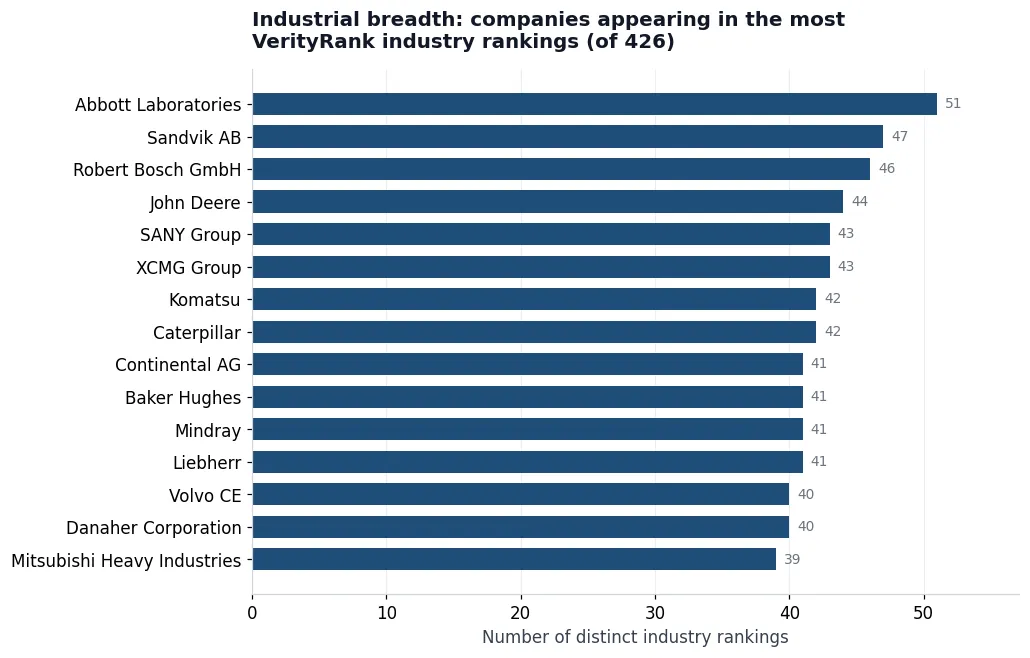
Abbott Laboratories appears in 51 of the 426 industry rankings we maintain. Sandvik shows up in 47. Robert Bosch, in 46. None of them are the largest company in any single one of those industries — and that is precisely the point. Industrial breadth, it turns out, is a different competitive axis from industrial scale, and our ranking data makes it measurable for the first time.
How We Measured Industrial Breadth
VerityRank publishes 426 industry rankings covering 1506 verified companies across 213 industries, totalling 10933 ranked positions. Each position is a company’s placement in one specific industry list — for example, hydraulics, medical imaging, or construction equipment. Counting how many distinct rankings a single company appears in produces a straightforward proxy for how many separate supply chains it sells into.
We restricted the analysis to companies appearing in at least 20 separate rankings. That threshold returns 144 companies — roughly one in ten of our verified universe — and the resulting list is strikingly different from a revenue ranking.
The Companies That Operate Everywhere
| # | Company | Headquarters | Rankings appeared in |
|---|---|---|---|
| 1 | Abbott Laboratories | United States | 51 |
| 2 | Sandvik AB | Sweden | 47 |
| 3 | Robert Bosch GmbH | Germany | 46 |
| 4 | John Deere | United States | 44 |
| 5 | SANY Group | China | 43 |
| 6 | XCMG Group | China | 43 |
| 7 | Komatsu | Japan | 42 |
| 8 | Caterpillar | United States | 42 |
| 9 | Continental AG | Germany | 41 |
| 10 | Baker Hughes | United States | 41 |
| 11 | Mindray | China | 41 |
| 12 | Liebherr | Germany | 41 |
| 13 | Volvo CE | Sweden | 40 |
| 14 | Danaher Corporation | United States | 40 |
| 15 | Mitsubishi Heavy Industries | Japan | 39 |
| 16 | JCB | United Kingdom | 39 |
| 17 | Siemens Healthineers | Germany | 39 |
| 18 | Philips Healthcare | Netherlands | 39 |
| 19 | Hitachi Construction Machinery | Japan | 39 |
| 20 | Yamaha Motor | Japan | 38 |
Abbott’s position at the top is not an accident of healthcare being a fragmented category. It sells diagnostics, nutrition, and medical devices into hospital procurement, retail pharmacy, and food-safety testing — three supply chains with almost nothing in common except that Abbott competes in all of them. Sandvik’s 47 placements split between metal cutting tools, mining equipment, and materials technology. Bosch’s 46 span automotive components, power tools, building technology, and industrial automation.
The construction cluster is equally revealing. John Deere, SANY, XCMG, Komatsu, Caterpillar, Liebherr, JCB, and Hitachi Construction Machinery all clear 39 rankings. Earthmoving equipment is a single product category, but it is bought by agriculture, mining, forestry, landscaping, and municipal infrastructure — five buyer groups that our category structure treats as distinct industries.
Where Breadth Concentrates
| Headquarters | Companies with 20+ rankings |
|---|---|
| China | 33 |
| United States | 22 |
| Japan | 18 |
| Germany | 17 |
| France | 7 |
| Sweden | 6 |
| Switzerland | 6 |
| Netherlands | 5 |
| South Korea | 5 |
| Italy | 4 |
China leads on count (33), but the gap over the United States (22) is far narrower than headline manufacturing statistics would suggest. Germany’s 17 companies and Japan’s 18 punch well above their population weight — both countries specialise in the kind of diversified industrial conglomerate that this metric rewards.
The Netherlands is the outlier worth studying. Five Dutch companies clear the threshold, and four of them are in healthcare or semiconductor equipment — two industries where a single platform technology is resold into many end markets. See our power transmission and fluid handling rankings for examples of how quickly a component maker accumulates placements.
Why Breadth Matters More Than It Used to
For procurement teams, the practical implication is supplier concentration risk. A company that appears in 40 rankings is not 40 vendors — it is one vendor with 40 commercial relationships, which changes how a disruption propagates. For investors, breadth correlates with revenue resilience but rarely with margin: diversified industrials trade at a discount to pure plays in almost every market.
Browse the full set of 144 multi-industry companies through our all-industries manufacturer index and verified enterprise directory.
The Counter-Example: Narrow Leaders
Breadth is not universally rewarded, and our data contains a clear counter-group. ASML appears in a comparatively modest set of rankings, yet it holds a near-monopoly in extreme ultraviolet lithography. Microsoft, Apple, and Nvidia — all far above the US$250 billion revenue mark — appear in very few of our industrial rankings at all, because their revenue comes from software, services, and platform economics rather than from supplying components to many separate industries.
That distinction matters when reading any "most diversified company" list. Breadth is a property of physical supply chains. A software platform can serve every industry without appearing in any industry ranking, because it does not manufacture anything those industries procure.
What This Metric Does Not Capture
Three limitations are worth stating plainly. First, a company accumulates placements partly because of how a directory classifies its products — a single hydraulic pump might qualify for hydraulics, fluid handling, and power transmission lists simultaneously, which inflates breadth without implying three separate businesses.
Second, we count positions, not revenue share. A company ranked 90th in twenty industries scores the same as one ranked 3rd in twenty. Third, the threshold of twenty rankings is a reporting convenience, not a natural boundary — the distribution is continuous, and companies with fifteen placements behave much like those with twenty.
Despite those caveats, the ranking is a genuinely useful screening tool. It answers a question procurement teams ask constantly and rarely get a clean answer to: how many other buyers already depend on this supplier? The higher the number, the more likely a capacity crunch at that company becomes a shared problem rather than a private one.
Questions Buyers Actually Ask
What does it mean for a company to appear in multiple industry rankings?
Each of our 426 rankings covers one specific industry list. A company appears in every ranking where it holds a meaningful market position — so a count above 20 means the company sells into 20 or more separate procurement categories. Abbott Laboratories leads with 51 placements across diagnostics, nutrition, and medical devices.
Is industrial breadth the same as company size?
No. Breadth measures how many distinct supply chains a company participates in; size measures revenue. The two lists overlap only slightly — of the 144 companies appearing in 20 or more rankings, only a fraction clear US$32.2 billion in revenue, and several of the largest companies by revenue appear in fewer than ten rankings.
How many companies and rankings does VerityRank maintain?
As of October 2026 we publish 426 industry rankings across 213 industries, covering 1,506 verified companies and 10,933 individual ranked positions. Each ranking is maintained separately for brands and manufacturers.