


Table of Contents

The global Building & Construction Materials sector serves consumers worldwide with diverse solutions.
1. Industry Overview
What happens when a $1.68 trillion industry faces tariff shocks, interest rate headwinds, and a climate-driven reinvention of its core products? The building and construction materials sector enters 2026 in a state of forced evolution. Since 2022, the divergence between demand and profitability has been stark: higher borrowing costs crushed private residential investment, while infrastructure spending held steady. By 2024, operating margins at major producers like CRH and Cemex had compressed by an average of 150 basis points according to company filings. Yet the market is not contracting — it is restructuring. The global construction materials market is estimated to reach USD 1.68 trillion in 2026, driven by non-residential projects and renovation in mature economies. The core of this industry — cement, aggregates, tiles, stone, flooring, windows, doors, plumbing, electrical, fireproofing, adhesives, and tools — forms the literal foundation of modern economies. What makes this sector distinctive is its weight-to-value ratio: transporting a ton of cement can cost more than the material itself, meaning regional production and local supply chains dominate. But that geographic fragmentation is now colliding with global tariff policies. Lumber tariffs, for example, have added 15–20% to framing costs in the U.S. market since 2024, pushing builders toward alternative materials. The historic shift underway is the race to decarbonise while managing costs: low-carbon cement, smart glass, and prefabrication are no longer niche experiments but competitive necessities.
Industry Scope & Characteristics
Broad Product Portfolio
Products span cement, tiles, stone, flooring, wall coverings, doors, windows, plumbing, electrical, fireproofing, adhesives, construction tools, serving diverse consumer needs from everyday essentials to premium specialized offerings.
Complex Global Supply Chains
Integrated international networks spanning multiple continents ensure year-round product availability across diverse markets.
Quality & Compliance Standards
Rigorous regulatory frameworks and quality certifications ensure product safety, consistency, and consumer trust worldwide.
Continuous Innovation
Heavy R&D investment drives formulation breakthroughs, processing technologies, and novel product development cycles.

Key market segments and growth drivers in the Building & Construction Materials sector.

Key market segments and growth drivers in the Building & Construction Materials sector.
2. Market Analysis
The headline figure is unambiguous: the construction materials market is valued at USD 1.68 trillion in 2026 and is projected to grow to USD 2.5 trillion by 2033, representing a compound annual growth rate (CAGR) of 6.9%. A second forecast — from a different source — pegs a CAGR of 3.91% from 2026 to 2035, reflecting uncertainty in long-term demand projections. Both agree that growth is not evenly distributed. The biggest driver is public infrastructure investment, particularly in North America under the IIJA (Infrastructure Investment and Jobs Act) and in Europe’s REPowerEU programme. These stimulus packages have locked in demand for cement, aggregates, and concrete through at least 2028. A second driver is the renovation wave in aging building stock: in the U.S., the median home age hit 42 years in 2025, triggering a surge in window, roofing, and insulation replacements. Europe faces a similar retrofit imperative to meet energy efficiency targets. The third driver is the rapid urbanisation of secondary cities in Asia and Africa. Asia-Pacific alone contributed more than 38% of global revenue in 2025, with India and Vietnam leading residential and commercial builds. Consensus forecasts for 2026 point to slight gains in total construction spending — flat to low single-digit growth — as private investment remains constrained by interest rates above 4% in most developed markets. The tariff factor adds another variable: higher costs for imported lumber and steel could redirect spending toward domestic alternatives, benefiting local cement and block producers.
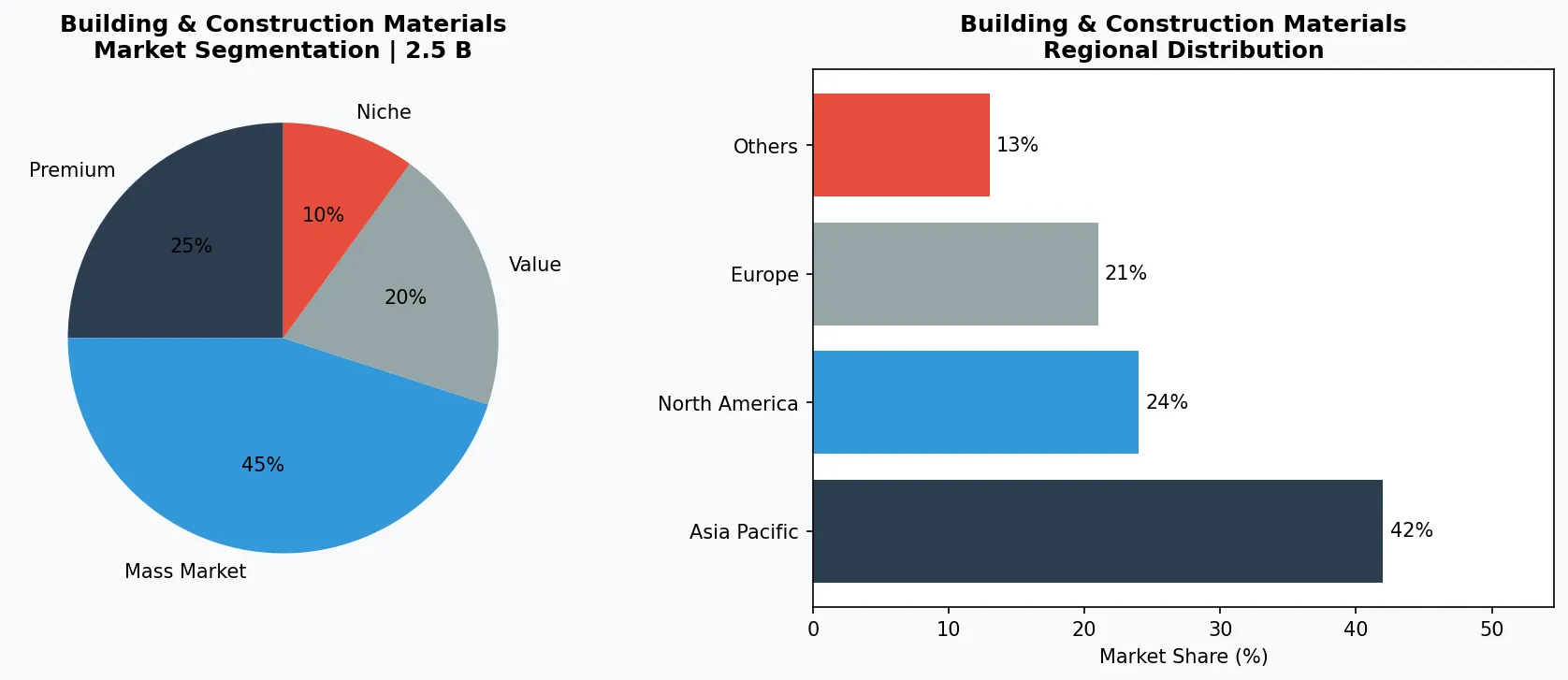
Market segmentation and regional distribution analysis for Building & Construction Materials.
3. Product Categories
CEMENT AND CONCRETE – The backbone of the industry. Cement production alone accounts for roughly 5–7% of global CO₂ emissions, which is why low-carbon variants are the fastest-growing sub-segment. LafargeHolcim’s ECOPact range, for example, reduces CO₂ by at least 30% compared to standard Portland cement. Blocks, precast concrete, and ready-mix continue to dominate infrastructure projects, with demand for high-performance mixes that cure faster and resist sulfate attack rising in coastal markets.
TILES, STONE, AND FLOORING – This category spans ceramic tiles, porcelain slabs, natural stone, and luxury vinyl tile (LVT). Porcelain remains the preferred choice for commercial high-traffic areas because of its durability and low water absorption (<0.5%). Mohawk Industries and Grupo Lamosa are key names in tile, though the leading players list includes Saint-Gobain through its Weber and CertainTeed brands for flooring underlayments. Natural stone, especially granite and marble, is seeing a comeback in premium residential renovation in Europe and North America.
DOORS, WINDOWS, AND SMART GLASS – The fenestration segment is undergoing a technology upgrade. Saint-Gobain’s SageGlass electrochromic glazing adjusts tint automatically, cutting HVAC energy use by up to 20%. Aluminium and uPVC frames dominate commercial specification, while timber is preferred in high-end residential. Fire-rated doors and windows have become a regulatory requirement in multi-family buildings across the EU after the Grenfell-inspired revisions to the Construction Products Regulation.
PLUMBING, ELECTRICAL, ADHESIVES, AND TOOLS – These MEP (mechanical, electrical, plumbing) products are often specified by contractors rather than architects. Sika leads in construction adhesives and sealants, while Knauf supplies gypsum-based plasters and fireproofing boards. Electrical products include wiring, switchgear, and conduit from Eaton and Schneider Electric. The tools sub-segment — power tools from Hilti, DeWalt, and Makita — is driven by the need for cordless, battery-powered solutions on jobsites.
Premium & Artisanal Tier
High-margin specialty products targeting affluent consumers who prioritize quality, craftsmanship, and unique attributes.
Mass Market Mainstream
Volume-driven products serving price-conscious mainstream consumers with reliable quality at accessible price points.
Functional & Niche Segment
Targeted products addressing specific health concerns, dietary requirements, or lifestyle preferences beyond basic needs.
4. Leading Players
SAINT-GOBAIN – The French giant is repositioning itself as a light and sustainable construction specialist. In 2025, it generated over €46 billion in revenue, with roughly 25% from its high-performance materials division (glass, ceramics, plastics). Saint-Gobain’s strategy hinges on two pillars: decarbonising its own operations (targeting net zero by 2050) and selling solutions that reduce building energy use, such as its SMART glass and continuous insulation systems. It has also aggressively acquired regional distributors in North America and India to secure last-mile delivery channels.
LAFARGEHOLCIM – The world’s largest cement producer completed its separation into two publicly traded entities in 2025: Holcim Ltd for the cement and aggregates business, and a new company focused on solutions and products. Holcim’s net sales exceeded CHF 27 billion in 2025. Its flagship product, Susteno, is a recycled cement containing 20% construction demolition waste. The company is investing heavily in carbon capture at its plants in Belgium and Canada, targeting a 25% reduction in CO₂ per ton of cement by 2030.
CRH – The Irish building materials giant is the largest in North America by revenue, with 2025 sales of approximately $39 billion. CRH’s integrated model — owning quarries, asphalt plants, and concrete batch plants — gives it a cost advantage in local markets. Its recent acquisitions of American infrastructure companies (e.g., the $3.8 billion purchase of a Texas-based aggregates firm in 2024) show a bet on U.S. highway and bridge spending. CRH is also piloting warm-mix asphalt that reduces energy consumption by 20%.
SIKA – The Swiss specialist in adhesives, sealants, and waterproofing reported CHF 11.2 billion in sales in 2025. Sika’s strategy is to sell higher-margin, application-specific products directly to contractors rather than through distributors. Its expansion in Africa and Latin America has been rapid, targeting the growing demand for concrete repair and protection in aging infrastructure. Sika’s SikaForce technology for bonding rebar in precast elements is gaining traction in modular construction.
Global Market Leader
Multinational player commanding significant market share. Revenue exceeding $50B with operations across 100+ countries, diversified portfolio spanning all major price tiers.
Regional Champion
Dominant force in Asia Pacific with deeply localized product lines, extensive distribution networks, and strong regional retailer relationships.
Innovation Disruptor
Fast-growing challenger disrupting incumbents through breakthrough product innovation, direct-to-consumer models, and data-driven marketing in the building & construction materials space.
5. Market Trends
1. GREEN BUILDING MATERIALS
The demand for materials with verified environmental product declarations (EPDs) is no longer optional for major projects. In the U.S., the Inflation Reduction Act tied tax credits to the use of low-embodied-carbon materials, directly benefiting Saint-Gobain’s glass wool insulation and Kingspan’s recycled-content insulation panels. Kingspan reports that its GreenGuard line now accounts for over 40% of its North American sales, with specifiers willing to pay a 5–8% premium for products that contribute to LEED points.
2. LOW-CARBON CEMENT
Cement accounts for 8% of global CO₂ emissions, making decarbonisation a competitive differentiator. LafargeHolcim has invested CHF 1.2 billion in its Go Clean projects, including a carbon capture facility at its Retznei plant in Austria that will capture 100,000 tonnes of CO₂ annually by 2027. Meanwhile, Cemex has launched Vertua, a low-carbon concrete range that cuts emissions by up to 40% compared to standard CEM I. Vertua is now specified in over 500 projects globally, from airports in Mexico to data centres in Germany.
3. PREFABRICATION AND MODULAR CONSTRUCTION
Off-site manufacturing reduces waste and shortens project timelines. CRH has invested in modular bathroom pods for multi-family housing through its Oldcastle Infrastructure division, delivering fully finished bathroom units that cut on-site installation time by 40%. Similarly, Kingspan’s insulated panel systems are used in modular data centres, where the speed of assembly — weeks instead of months — is critical for hyperscale cloud providers like Meta and Amazon.
4. SMART GLASS
Electrochromic and thermochromic glazing is shifting from luxury to mainstream commercial specification. Saint-Gobain’s SageGlass is now installed in over 1,000 buildings worldwide, including the new headquarters of the European Central Bank. The glass reduces solar heat gain by 60% while maintaining natural light, cutting cooling loads by up to 25%. The company expects the smart glass market to grow at 18% CAGR through 2030, driven by tightening energy codes in Europe and California.
6. Regional Markets
ASIA-PACIFIC – This region contributed over 38% of global building materials revenue in 2025 and is expected to maintain its lead through 2030. India’s infrastructure push — National Infrastructure Pipeline worth $1.4 trillion — is driving demand for cement and aggregates, with UltraTech Cement and Ambuja Cement expanding capacity. In China, residential construction has slowed, but the government’s ‘new infrastructure’ programme (5G towers, EV charging, inter-city rail) is boosting demand for specialised concretes and electrical conduits. Southeast Asian markets like Vietnam and the Philippines are seeing a surge in factory and warehouse construction as supply chains shift out of China.
Asia Pacific — The Growth Engine
The world's largest and fastest-growing region, led by China, India, and Southeast Asia. Urbanization, rising middle class, and digital retail adoption are primary catalysts.
North America — Premium & Wellness Driven
A mature market with strong health-and-wellness orientation, sustainability commitments, and robust demand for premium and functional products.
Europe — Quality & Regulatory Leadership
A developed market with stringent quality, safety, and environmental regulations. Strong demand for organic, locally sourced, and ethically certified products.
NORTH AMERICA – The U.S. market is defined by a split between private and public projects. Single-family home starts are still 25% below pre-2020 levels due to high mortgage rates, but non-residential construction — data centres, factories, and road work — is booming. The CHIPS and Science Act has spurred $50 billion in semiconductor fab construction, each requiring vast quantities of high-performance concrete and fireproofing materials from companies like Knauf and Sika. Canada’s Housing Accelerator Fund is pushing provincial governments to adopt prefabrication, benefitting suppliers of modular building systems like Kingspan.
EUROPE – Renovation and energy efficiency dominate. The EU’s Renovation Wave aims to double annual energy renovation rates by 2030. This creates demand for insulation, smart glazing, and heat-pump-compatible plumbing systems. Saint-Gobain has a strong position in France and Germany for external thermal insulation composite systems (ETICS). Germany’s building permit numbers fell 15% in 2025, but renovation spending rose 9%, indicating a shift from new build to retrofit. Eastern Europe, particularly Poland, is a growth hotspot due to EU cohesion fund investments in rail and road infrastructure.
7. Investment Outlook
Two opportunities stand out. First, the retrofit and renovation market in Europe and North America is structurally under-invested. Companies that offer integrated solutions — combining insulation, smart glass, and low-carbon concrete — can capture a premium as building owners seek to comply with tightening energy codes without full demolition. Second, the digitalisation of supply chains presents a margin-improvement lever. Platforms like VerityRank that verify supplier credentials and track material certifications will become indispensable as specifiers demand transparency on embedded carbon and source compliance.
The biggest risk remains tariff escalation. The U.S. has floated a 25% tariff on all imported construction materials, which would immediately raise costs for any project using Canadian lumber, Chinese drywall, or European steel. This could stall non-essential private construction in 2026, particularly in the multi-family housing segment where margins are already thin. Companies with local quarry and plant capacity, like CRH and LafargeHolcim, will weather this better than import-dependent distributors.
Strategic Considerations:
- Technology & AI Integration: Artificial intelligence and IoT are revolutionizing production efficiency, quality assurance, and demand forecasting across the supply chain.
- Sustainability as Business Strategy: Regulatory pressure and consumer expectations are making environmental commitments essential, not optional.
- Transparency & Traceability: Consumers demand increasingly granular information about product origins, ingredients, and production methods.
- Emerging Market Penetration: Africa, Latin America, and second-tier Asian cities represent the next wave of volume growth.
Frequently Asked Questions
Data Sources
- Deloitte Insights – 2026 Engineering and Construction Industry Outlook
- Grand View Research – Construction Materials Market Size & Analysis, 2026-2033
- CRH plc Annual Report 2025
- Saint-Gobain Investor Presentation 2026
- Mordor Intelligence – Global Construction Materials Market Report
Make Informed Decisions in the Building & Construction Materials Market
Product quality and sourcing integrity directly impact business outcomes. Discover how Verity Rank's verification platform helps industry participants source with greater confidence.
Contact Verity Rank TodayFurther Reading: Explore additional market intelligence from Grand View Research and Mordor Intelligence.
This article is for informational purposes only, based on publicly available industry data and market reports as of 2026-07-29. All market figures are estimates and may vary from actual results.