

Table of Contents

The global Cordless Vacuum Cleaner sector serves consumers worldwide with diverse solutions.
1. Industry Overview
By 2026, cordless vacuum cleaners are no longer a niche convenience—they are the dominant force reshaping the $16.38 billion vacuum cleaner industry. With the global market projected to surge to $35.37 billion by 2033 at a CAGR of 10.1%, the shift from corded to cordless is accelerating faster than most analysts predicted just three years ago. What makes cordless vacuums distinctive is not merely the absence of a power cord; it is the convergence of lithium-ion battery density, brushless motor efficiency, and smart sensor integration that has finally closed the performance gap with traditional corded models. In 2025, a premium cordless stick vacuum can match the suction power of a $400 corded upright, while offering the flexibility to clean a car interior or a ceiling fan. This sub-topic within Home Cleaning Appliances sits at the intersection of consumer demand for convenience and industrial advances in energy storage. The cordless segment now accounts for over 40% of all vacuum cleaner unit sales in developed markets, and that share is climbing. For B2B buyers—from hotel chains sourcing housekeeping fleets to e-commerce retailers stocking inventory—understanding the cordless vacuum cleaner ecosystem is critical to capitalizing on this structural shift.
Industry Scope & Characteristics
Battery-Powered Freedom
Cordless vacuum cleaners rely on high-density lithium-ion batteries, enabling runtime of 40-90 minutes. Stick vacuums with removable batteries allow users to swap packs for continuous cleaning—a key advantage over corded models.
Motor Miniaturization
Brushless DC motors now deliver 150+ air watts in a form factor smaller than a soda can. This allows cordless vacuums to achieve suction parity with corded uprights while weighing under 6 pounds.
HEPA and Washable Filtration
Premium cordless models feature HEPA H13 filters capturing 99.97% of particles. Washable filters reduce replacement costs, with some brands offering lifetime warranties on filter media.
Smart Mapping and Navigation
Robotic cordless vacuums use LiDAR and SLAM algorithms to create real-time floor plans. iRobot’s PrecisionVision navigation avoids obstacles like pet waste and charging cables, reducing intervention by 40%.

Key market segments and growth drivers in the Cordless Vacuum Cleaner sector.
2. Market Analysis
The cordless vacuum cleaner market is expanding at a compound annual growth rate that outpaces the broader vacuum cleaner industry. While the global vacuum cleaner market is projected to grow from $54.33 billion in 2026 to $109.7 billion by 2034 at a CAGR of 9.20%, the cordless sub-segment is growing even faster, with a projected market share increase of 25% in the coming years. Three major growth drivers are fueling this acceleration. First, urbanization in Asia-Pacific is creating dense living environments where cordless maneuverability is a necessity. The Asia-Pacific cordless vacuum market is projected to grow at a 13% CAGR through 2030, driven by rising disposable incomes and smaller apartment footprints in cities like Shanghai, Mumbai, and Jakarta. Second, battery technology improvements have eliminated the 'range anxiety' that plagued early cordless models. Modern lithium-ion packs deliver 60+ minutes of runtime on a single charge, making them viable for whole-home cleaning. Third, the commercial sector—including offices, retail spaces, and hospitality—is increasingly adopting cordless vacuums for their reduced trip hazards and faster changeover between shifts. In the United States, the wireless vacuum cleaner market is projected to grow at a CAGR of 7.3% from 2026 to 2033, reflecting robust demand even in a mature market. For B2B buyers, these numbers signal that cordless is not a passing trend but a permanent category that demands serious supply chain attention.
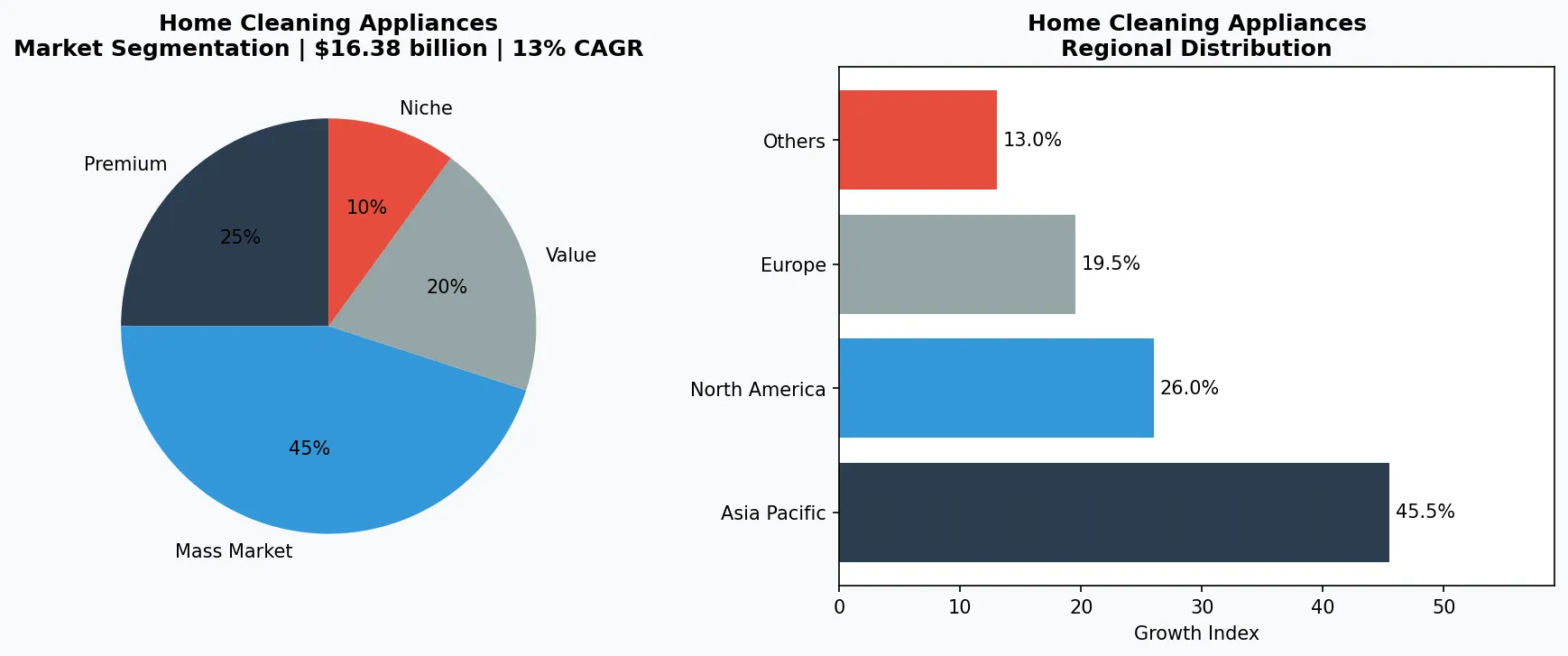
Market segmentation and regional distribution analysis for Cordless Vacuum Cleaner.
3. Product Categories
The cordless vacuum cleaner market breaks into three primary product types, each serving distinct use cases. Stick vacuum cleaners are the fastest-growing segment, combining the form factor of an upright with the portability of a handheld. Dyson's V15 Detect and Shark's Vertex Pro are benchmark examples, featuring laser dust detection and real-time particle counters that appeal to tech-savvy consumers. Handheld vacuum cleaners remain a staple for quick cleanups and automotive use, with models like the Black+Decker Dustbuster and the Milwaukee M18 Cordless Compact Vacuum dominating the professional trades segment. Robotic vacuum cleaners—now almost exclusively cordless—have evolved from novelty to necessity. iRobot's Roomba j9+ and Roborock's S8 Pro Ultra offer self-emptying bases and LiDAR navigation, making them the fastest-growing sub-category within cordless. For B2B buyers, the key differentiator is not just price but battery ecosystem: suppliers that offer interchangeable battery platforms (e.g., DeWalt, Makita) reduce total cost of ownership for commercial fleets. Filtration type is also a critical specification—HEPA filtration is now standard in premium models, while washable filters dominate the mid-range to lower consumable costs.
Stick Vacuum Cleaners
The dominant cordless form factor, combining upright cleaning with detachable handheld units. Examples: Dyson V15 Detect (laser dust detection) and Shark Vertex Pro (self-cleaning brush roll).
Handheld Vacuum Cleaners
Compact, battery-powered units for cars, stairs, and spot cleaning. Examples: Black+Decker Dustbuster (pivoting nozzle) and Milwaukee M18 (compatible with job site battery system).
Robotic Vacuum Cleaners
Autonomous cordless units with self-emptying bases and smart home integration. Examples: iRobot Roomba j9+ (PrecisionVision navigation) and Roborock S8 Pro Ultra (LiDAR mapping and mopping combo).
4. Leading Players
Three strategic archetypes define the competitive landscape in cordless vacuum cleaners. The technology-first innovators, led by Dyson, invest heavily in R&D to maintain premium pricing. Dyson’s digital motor V12 and Hyperdymium motor technology deliver class-leading suction-to-weight ratios, and the company holds over 3,000 patents globally. Their strategy is to constantly raise the performance bar, forcing competitors to either match or compete on value. The ecosystem expanders, such as SharkNinja and Tineco, leverage broad home appliance portfolios to cross-sell cordless vacuums alongside floor scrubbers and steam mops. Shark’s Detect Pro line features self-cleaning brush rolls and anti-hair-wrap technology, targeting pet-owning households—a demographic that spends 30% more on cleaning appliances annually. The commercial-grade specialists, including Nilfisk and Kärcher, focus on B2B channels with ruggedized cordless models that feature hot-swappable batteries and IPX4 water resistance. Kärcher’s VC 6 Cordless series is designed for daily use in hotels and schools, with a 10-year parts availability guarantee. For B2B buyers, the choice between these archetypes depends on whether the priority is brand prestige, ecosystem compatibility, or long-term serviceability.
Technology-First Innovators
Companies like Dyson invest heavily in proprietary motor and sensor technology, commanding premium pricing. Dyson holds over 3,000 patents and its V15 Detect uses a Piezo sensor to count and display particle sizes.
Ecosystem Expanders
SharkNinja and Tineco leverage broad home appliance portfolios to cross-sell cordless vacuums. Shark’s Detect Pro series features anti-hair-wrap technology and self-cleaning brush rolls, targeting pet owners.
Commercial-Grade Specialists
Nilfisk and Kärcher focus on B2B channels with ruggedized cordless models. Kärcher’s VC 6 series offers hot-swappable batteries and IPX4 water resistance, backed by a 10-year parts availability guarantee.
5. Market Trends
1. Lithium-Ion Advancements
Next-generation lithium-ion battery technology now offers run times exceeding 60 minutes on a single charge, effectively eliminating range anxiety for commercial cleaning crews.
2. Autonomous Navigation
AI-driven mapping and obstacle avoidance systems are becoming standard in B2B models, allowing for hands-free operation in office buildings and hotels during off-hours.
3. Hygiene-First Filtration
HEPA-grade filtration with self-cleaning cyclones is a top procurement criterion, driven by post-pandemic demand for certified allergen and pathogen removal in healthcare and hospitality.
4. Fleet Management Integration
Cloud-connected devices with real-time usage analytics and maintenance alerts are enabling facility managers to optimize cleaning schedules and reduce total cost of ownership across large property portfolios.
6. Regional Markets
Asia-Pacific: Fastest Growing Market at 13% CAGR
Urbanization and rising disposable incomes in China, India, and Southeast Asia are driving demand for compact cordless vacuums. Local OEMs like Roborock and Dreame are gaining share with feature-rich models at competitive price points.
North America: Mature Market with 7.3% CAGR Growth
The U.S. wireless vacuum market is expanding steadily, driven by replacement demand and commercial adoption. Consumers prioritize runtime and filtration, with HEPA-certified models commanding a 20% price premium.
Europe: Regulatory Push Toward Energy Efficiency
EU Ecodesign regulations are driving adoption of cordless models with replaceable batteries and lower standby power. Brands like Bosch and Miele are emphasizing repairability and modular design to comply with upcoming Right to Repair laws.
7. Investment Outlook
Two specific opportunities stand out for B2B buyers in the cordless vacuum cleaner market. First, the Asia-Pacific expansion, growing at 13% CAGR through 2030, offers a prime window for sourcing partnerships with regional OEMs in China and Vietnam that specialize in lithium-ion battery integration and cost-efficient assembly. Second, the commercial adoption curve is still early: only 15% of U.S. hotels and 20% of European office buildings have switched to cordless fleets. Suppliers that offer bundled service contracts—including battery replacement programs and on-site training—can capture sticky, high-margin revenue. One concrete risk is battery raw material volatility: lithium carbonate prices fluctuated by over 200% between 2022 and 2025. B2B buyers should diversify battery suppliers and consider models with LFP (lithium iron phosphate) chemistry, which offers longer cycle life and lower fire risk, albeit at slightly higher weight. The cordless vacuum market is not just growing—it is restructuring. Early movers who lock in reliable supply chains and understand regional certification requirements (e.g., UL in North America, CE in Europe) will be best positioned to lead.
Strategic Considerations:
- Asia-Pacific Sourcing Opportunity: B2B buyers should partner with regional OEMs in China and Vietnam to capitalize on 13% CAGR growth and lower manufacturing costs, while ensuring compliance with local certification standards.
- Commercial Fleet Adoption Gap: Only 15% of U.S. hotels and 20% of European offices have switched to cordless. Suppliers offering battery replacement programs and training can capture high-margin service contracts.
- Battery Raw Material Volatility Risk: Lithium carbonate prices swung 200% from 2022 to 2025. Diversify battery suppliers and consider LFP chemistry for longer cycle life and lower fire risk.
- Regulatory Compliance Complexity: Different regions require different certifications (UL, CE, CCC). B2B buyers must verify that cordless vacuum suppliers meet all applicable standards to avoid customs delays and liability.
Make Informed Decisions in the Cordless Vacuum Cleaner Market
Product quality and sourcing integrity directly impact business outcomes. Discover how Verity Rank's verification platform helps industry participants source with greater confidence.
Contact Verity Rank TodayFurther Reading: Explore additional market intelligence from Grand View Research and Mordor Intelligence.
This article is for informational purposes only, based on publicly available industry data and market reports as of 2026-05-26. All market figures are estimates and may vary from actual results.