

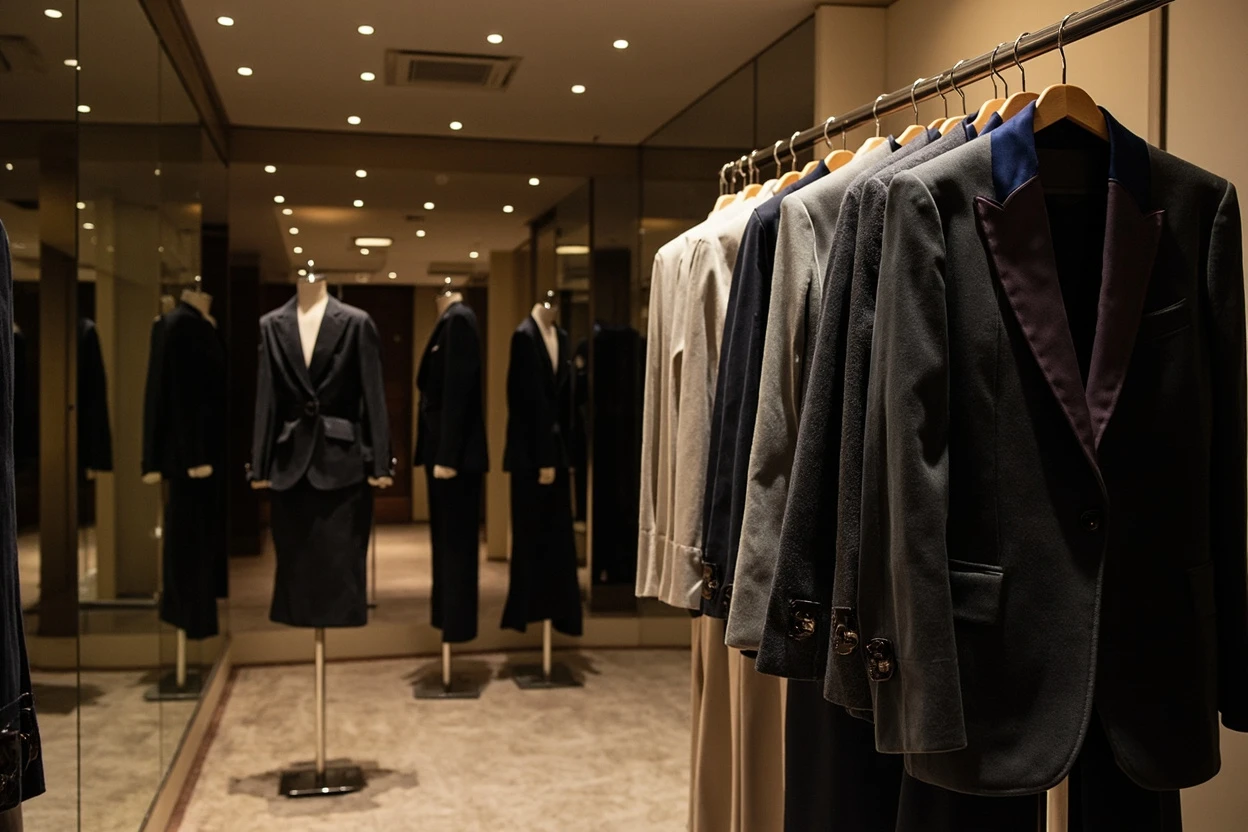
Table of Contents

The global Custom Womenswear Design sector serves consumers worldwide with diverse solutions.
1. Industry Overview
By 2026, the custom made clothes market will hit $86.76 billion, but the fastest-growing segment within it is custom womenswear design – a niche that marries bespoke tailoring with the scale of corporate apparel. For B2B buyers, this isn't just about aesthetics; it's about delivering fit, brand identity, and employee satisfaction in a single garment. Unlike mass-produced off-the-rack alternatives, custom womenswear design emphasizes individual body geometry and stylistic preferences, making it the preferred choice for executive teams, female-led enterprises, and professional sports leagues. The segment's distinctiveness lies in its dual focus: precision craftsmanship for individual clients and consistency for group orders. Trend analysis, as highlighted by McKinsey's State of Fashion 2026, helps brands predict consumer preferences, balance innovation with market demand, and avoid costly design failures. This data-driven approach is transforming how factories and design houses approach womenswear, moving from intuition-based design to evidence-backed collections.
Industry Scope & Characteristics
Bespoke Fit for Female Anatomy
Custom womenswear design products, such as tailored blazers with adjustable bust darts and hip panels, require specialized pattern engineering that accounts for broader hip-to-waist ratios and varying bust sizes – a technical capability not needed in menswear.
Made-to-Order Manufacturing with Quick Turnaround
Unlike mass production, womenswear custom shops operate on JIT principles, with lead times of 4–6 weeks per order. Digital body scanning reduces manual measurement errors and speeds up the production loop for corporate clients.
ISO 9001 & OEKO-TEX Compliance
Quality standards for corporate custom womenswear often include ISO 9001 for consistent production processes and OEKO-TEX 100 certification for fabric safety, especially for garments in direct skin contact like blouses.
AI-Driven Pattern Grading
Innovation focuses on 3D virtual prototyping software such as CLO 3D, which allows designers to simulate fabric drape and fit on avatars before cutting a single piece of fabric, reducing sample waste by up to 30%.

Key market segments and growth drivers in the Custom Womenswear Design sector.
2. Market Analysis
The global custom womenswear market sits within a larger custom clothing ecosystem valued at $1.5 billion in 2024 and projected to reach $3.2 billion by 2033, expanding at a CAGR of 9.2%. Meanwhile, the broader custom made clothes market – encompassing both genders – reached $70.78 billion in 2026 and is forecast to grow to $179.49 billion by 2035 at a 10.9% CAGR, according to industry reports. Three forces are driving this growth. First, the rise of remote and hybrid work has increased demand for versatile, comfortable yet professional womenswear that can transition seamlessly from Zoom calls to in-person meetings. Second, sustainability mandates are pushing corporations to invest in durable, made-to-order pieces rather than disposable fast fashion. Third, the number of women in senior leadership positions globally has risen steadily, fueling demand for power suits, tailored blazers, and custom-fit shirts that convey authority. Companies like Newasia Garment Co., Ltd. have capitalized on this by offering end-to-end design-to-delivery services that include trend research, fabric sourcing, and fit grading for female body types.
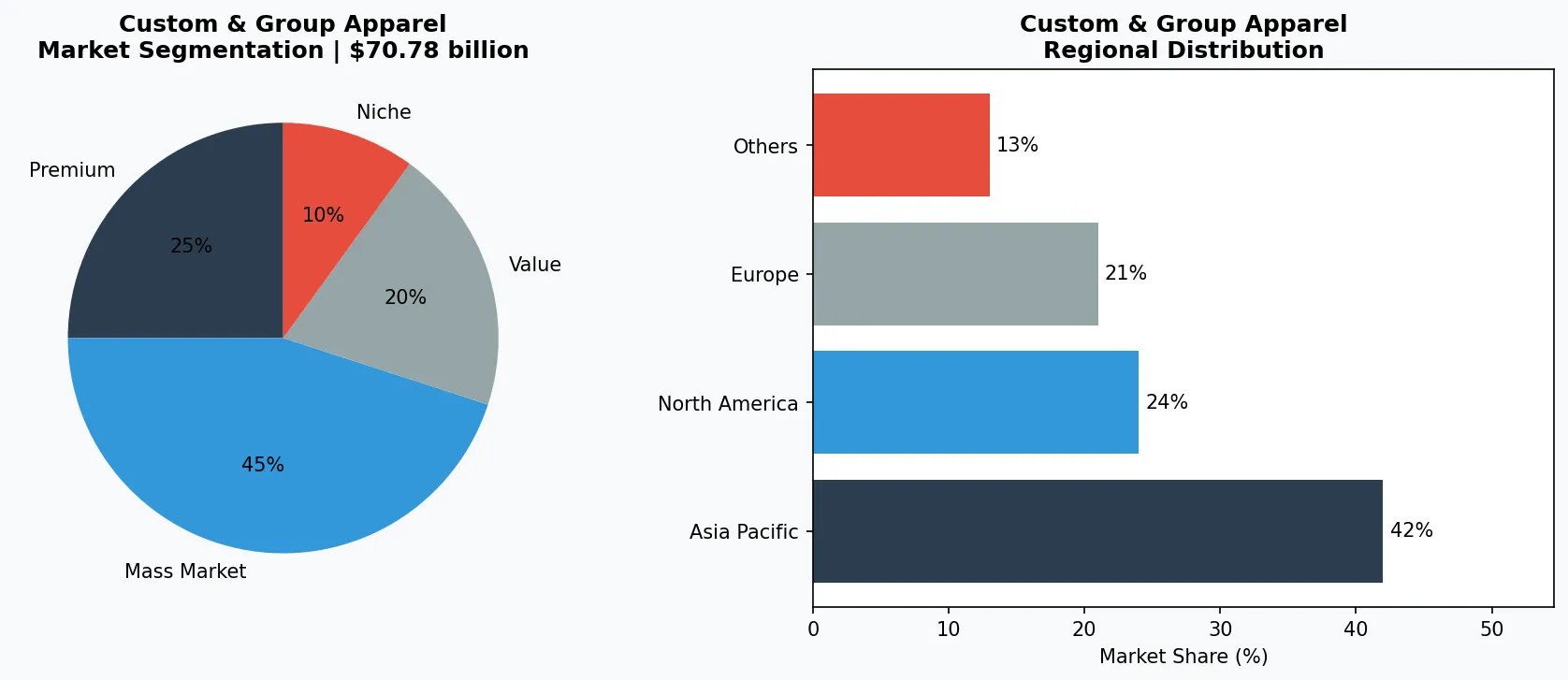
Market segmentation and regional distribution analysis for Custom Womenswear Design.
3. Product Categories
Within custom womenswear design, three product categories dominate corporate procurement.
Custom Suits & Blazers
From single-breasted notch-lapel executive blazers to double-breasted pinstripe suits – are the cornerstone, often commissioned by law firms and financial institutions. Examples include Lanieri's made-to-measure women's suits and Indochino's custom womenswear line, though the latter is pivoting toward corporate accounts.
Tailored Separates
Including silk blouses, wool trousers, and pencil skirts – allow mixing and matching to create capsule wardrobes for female employees. Brands like Newasia Garment supply these in bulk for uniform programs while retaining individual fit adjustments.
Performance & Uniforms
Such as custom-fit team jerseys for women's soccer leagues, polo shirts for hospitality staff, and medical scrubs tailored for female body shapes – represent a fast-growing sub-segment where ergonomics and breathability are as important as aesthetics. Each product type requires specialized pattern engineering and grading systems to accommodate bust, hip, and waist variations across size ranges.
Corporate Suiting & Blazers
Includes single-breasted and double-breasted suit jackets with custom linings, hidden pockets, and functional buttons – popular among law firms and banking institutions. Example: women’s executive blazer with power shoulder padding.
Tailored Separates
Covers custom-fit blouses, trousers, and skirts that can be mixed and matched. Key features: adjustable waist tabs, fabric-draped fronts, and wrinkle-resistant finishes. Example: silk-blend shell top for senior management.
Performance & Uniforms
Includes athletic team jerseys for women’s sports and hospitality uniforms with moisture-wicking fabric. Example: custom-cut polo shirts for airline cabin crews, designed for ease of movement and professional appearance.
4. Leading Players
Newasia Garment Co., Ltd.
Has emerged as a key player in custom womenswear design by integrating AI-driven trend analysis into its production workflow. The company uses McKinsey's State of Fashion 2026 insights to predict color palettes and silhouettes, reducing sample waste and lead times. Their in-house fit models cover a wide range of female body types, allowing them to offer true custom fit for corporate clients.
Bespoke ateliers
Whether independent Savile Row-inspired houses or platform-based tailors – focus on ultra-personalization, with clients spending upwards of $2,000 per garment. Their strategy relies on exclusivity and hand-finishing, appealing to C-suite women who view their wardrobe as a professional asset.
Corporate uniform specialists
Often large contract manufacturers – differentiate through scale and speed. They leverage digital body scanning and modular construction to produce group orders of 50–500 pieces with consistent quality. Their competitive edge is cost efficiency: custom womenswear at $80–150 per unit for bulk orders, versus $400+ for individual bespoke. Together, these players serve a market where the line between personal style and corporate branding is increasingly blurred.
Tech-Forward Custom Manufacturers
Players like Newasia Garment Co., Ltd. integrate trend analytics and digital fitting to serve corporate clients. Their competitive advantage is speed: they can turn around a 50-piece order of custom blazers in 21 days using AI-optimized patterns.
Luxury Bespoke Houses
These ateliers focus on one-on-one consultations, hand-stitching, and premium fabrics. They target C-suite women willing to invest $2,000+ per garment. Strategy relies on exclusivity and word-of-mouth referrals within professional networks.
Corporate Uniform Specialists
Contract manufacturers that offer scale while maintaining customization for groups. Their edge is cost efficiency: unit prices of $80–150 for orders of 100+ pieces, combined with ISO-certified quality control and fabric warranties.
5. Market Trends
1. Digital Transformation in Custom Womenswear Design
Artificial intelligence, IoT sensors, and advanced data analytics are fundamentally reshaping production efficiency in Custom Womenswear Design. Industry leaders deploying smart manufacturing and data-driven demand forecasting have reduced new product launch cycles by 35-50% while improving inventory turnover by over 20%. With more than 60% of Custom Womenswear Design companies projected to complete core digital transformation by 2028, this shift has moved from optional upgrade to competitive necessity.
2. Sustainability as Competitive Imperative in Custom Womenswear Design
Global carbon border adjustment mechanisms (CBAM) and rising consumer environmental awareness are forcing Custom Womenswear Design companies to transform sustainability from marketing rhetoric into operational reality. ESG rating agencies increased sector coverage intensity by 35% in 2025. Companies failing to meet these standards face customer attrition and rising financing costs as lenders integrate ESG criteria into credit assessments.
3. Supply Chain Regionalization in Custom Womenswear Design
Geopolitical tensions are driving Custom Womenswear Design companies to accelerate supplier diversification. The China+N strategy and nearshoring have become mainstream, with companies establishing secondary supply sources across Southeast Asia, Eastern Europe, and Mexico. Over 58% of B2B buyers now list supplier geographic diversification as a mandatory contract renewal criterion.
4. Consumer Upgrading in Custom Womenswear Design Markets
Middle-class expansion and Gen Z purchasing power are accelerating Custom Womenswear Design transition from standardized mass production toward personalized customization and agile small-batch manufacturing. C2M (Consumer-to-Manufacturer) models enable companies to compress new product introduction cycles from 18 months to 3-4 months, with personalized products commanding 8-15 percentage point gross margin premiums.
6. Regional Markets
North America – Strong Corporate Demand
The US and Canada see high demand for custom womenswear from Fortune 500 companies seeking brand-aligned executive uniforms, driven by diversity mandates and a growing number of female board members.
Europe – Heritage Bespoke & Sustainability
European buyers prioritize sustainable materials and handcrafted quality. Italy and the UK lead in high-end custom womenswear, with regulations on textile waste pushing manufacturers toward zero-waste pattern cutting.
Asia-Pacific – Manufacturing Hub & Rising Consumption
Countries like China and Vietnam are both production bases and growing consumer markets. The rise of female entrepreneurs in India and Southeast Asia is fueling demand for affordable custom suits and uniforms for women-led businesses.
7. Investment Outlook
Two concrete opportunities define the near future of custom womenswear design. First, the expansion of remote corporate styling consultations – where brands offer virtual fit sessions that result in custom garments shipped to employees’ homes – can unlock the 40% of companies that have hybrid workforces but no consistent uniform policy. Second, the integration of smart textiles (e.g., moisture-wicking or wrinkle-resistant blends) into custom womenswear will appeal to female professionals who travel frequently. The primary risk is supply chain complexity: custom small-batch production requires flexible factories, and a sudden spike in orders (e.g., a large corporate contract) can overwhelm capacity. Mitigating this requires pre-negotiated fabric reserves and modular production lines. B2B buyers should prioritize suppliers that demonstrate both trend agility and production scalability.
Strategic Considerations:
- Remote Styling Consultations: Brands that offer virtual fit sessions via video or 3D avatars can capture hybrid-workforce uniform contracts, reducing the need for in-person visits and expanding addressable market.
- Smart Textiles Integration: Incorporating wrinkle-resistant, moisture-wicking, or stain-repellent fabrics into custom womenswear will differentiate suppliers for travel-heavy corporate roles.
- Supply Chain Fragility: Small-batch custom production relies on flexible factories; a sudden order spike from a large client can cause delays, so pre-booking fabric capacity is essential.
- Plus-Size Customization: With 67% of American women wearing size 14 or above, suppliers that offer inclusive grading systems and fit models for plus sizes can capture an underserved B2B segment.
Frequently Asked Questions
Make Informed Decisions in the Custom Womenswear Design Market
Product quality and sourcing integrity directly impact business outcomes. Discover how Verity Rank's verification platform helps industry participants source with greater confidence.
Contact Verity Rank TodayFurther Reading: Explore additional market intelligence from Grand View Research and Mordor Intelligence.
This article is for informational purposes only, based on publicly available industry data and market reports as of 2026-07-19. All market figures are estimates and may vary from actual results.