

Table of Contents
The global Home Textiles & Fabrics industry serves consumers worldwide with diverse solutions.
1. Industry Overview
Will your bedroom look the same in 2033? Probably not—and neither will the $231.40 billion home textiles industry powering that change. The global home textiles market, valued at $137.81 billion in 2025, is on an aggressive growth trajectory that analysts project will reach $231.40 billion by 2033, clocking a compound annual growth rate (CAGR) of 6.9% from 2026 through 2033. This sector encompasses everything from bed sheets and pillowcases to curtains, towels, carpets, and sofa covers—products that have migrated from purely functional purchases to statement investments in personal wellness and home aesthetics. The industry has undergone a seismic shift since 2020, when pandemic-driven home renovation spending catalyzed permanent behavioral changes. Consumers now treat home textiles as lifestyle purchases, not commodity buys. This psychological repositioning explains why market watchers now rank home textiles alongside smart home technology as one of the fastest-evolving segments in the broader consumer goods landscape. The numbers aren't abstract—they represent real factories, real jobs, and real competition among household names like IKEA, MUJI, and Amazon Basics for dominance in this expanding space.
Industry Scope & Characteristics
Broad Product Portfolio
Products span bed sheets, pillowcases, duvet covers, curtains, towels, carpets, rugs, tablecloths, sofa covers, serving diverse consumer needs from everyday essentials to premium specialized offerings.
Complex Global Supply Chains
Integrated international networks spanning multiple continents ensure year-round product availability across diverse markets.
Quality & Compliance Standards
Rigorous regulatory frameworks and quality certifications ensure product safety, consistency, and consumer trust worldwide.
Continuous Innovation
Heavy R&D investment drives formulation breakthroughs, processing technologies, and novel product development cycles.
Key market segments and growth drivers in the Home Textiles & Fabrics sector.
2. Market Analysis
The headline figure tells only part of the story. The home textiles market is projected to reach $161.8 billion in 2026 alone, with multiple research firms confirming trajectories toward $243.3 billion by 2035, representing a 5.1% CAGR over that decade. For immediate-term planners, the $145.29 billion baseline in 2026 is expected to hit $200.28 billion by 2031 at a 6.31% CAGR—a 38% expansion in just five years. Three primary drivers fuel this expansion: rising disposable incomes in Asia-Pacific markets, the continued mainstreaming of premium materials like organic cotton and eucalyptus-based Tencel, and the structural demand created by new residential construction and renovation cycles globally. China dominates production, accounting for over 40% of global home textile manufacturing capacity, while the United States remains the largest single-country consumer market. India has emerged as a fast-growing production hub, particularly for cotton-based products, as brands diversify supply chains away from single-country concentration. The European market, led by Germany, France, and the United Kingdom, shows strong demand for sustainable and ethically-sourced textiles, creating premium pricing opportunities for certified manufacturers. E-commerce channels now represent approximately 28% of home textile sales globally, up from 19% in 2022, fundamentally altering distribution strategies across the value chain.
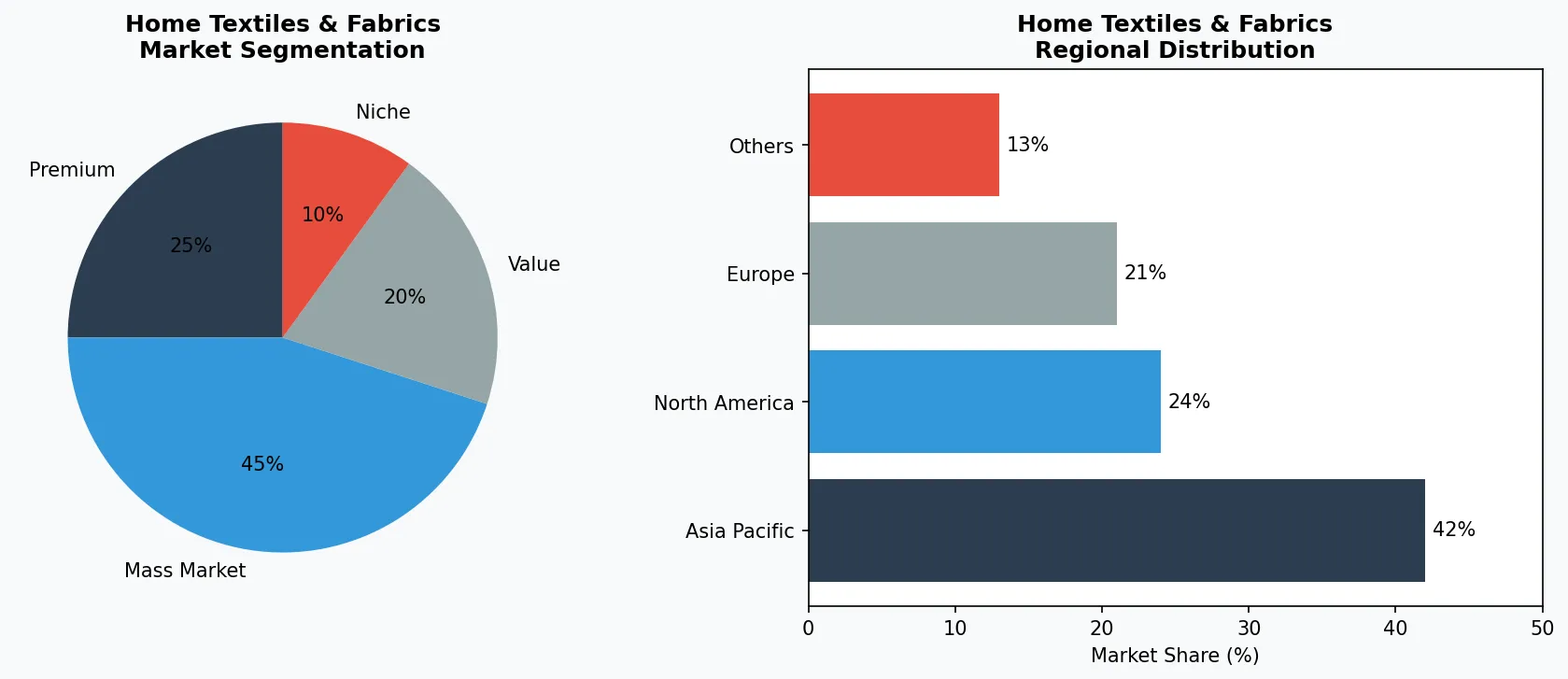
Market segmentation and regional distribution analysis for Home Textiles & Fabrics.
3. Product Categories
Bedroom textiles constitute the largest product sub-category, generating roughly 35% of total industry revenue. Within this segment, the premium bedding revolution is evident: IKEA's expandable comfort collections and MUJI's minimalist linen ranges target different ends of the same consumer desire for quality sleep optimization. Duvet covers with temperature-regulating properties now appear in over 60% of new product launches from major brands. Bathroom textiles represent the second major category, where the shift from purely cotton to blended performance fabrics has accelerated. Sherry, a leading Chinese manufacturer, reported that its quick-dry microfiber towel lines grew 23% year-over-year in 2024. Window treatments and soft furnishings comprise the third key segment. Curtains and drapes have benefited from remote work trends, as consumers invest in reducing glare and improving aesthetics in home office environments. Amazon Basics' algorithmic-driven curtain sales reportedly doubled between 2023 and 2025. The fourth category—floor coverings including carpets and rugs—shows the strongest premiumization trend, with machine-washable rugs becoming a sub-segment worth over $2 billion annually across North American and European markets.
Premium & Artisanal Tier
High-margin specialty products targeting affluent consumers who prioritize quality, craftsmanship, and unique attributes.
Mass Market Mainstream
Volume-driven products serving price-conscious mainstream consumers with reliable quality at accessible price points.
Functional & Niche Segment
Targeted products addressing specific health concerns, dietary requirements, or lifestyle preferences beyond basic needs.
4. Leading Players
IKEA maintains its position as the industry's market leader, commanding approximately 12% of the global home textiles market share. The Swedish retailer's strategy centers on vertical integration and sustainability commitments: by 2030, all IKEA home textiles will use only recycled or other positively-sourced materials. In 2024, IKEA launched its first collection made entirely from Circulose®, a breakthrough in recycled cotton fiber that signals the brand's production-scale ambitions. MUJI targets the premium minimalist consumer with a deliberately restrained product line, focusing on natural materials and timeless design. The Japanese retailer's home textiles division grew 8.4% in fiscal year 2024, outpacing the broader market, as consumers prioritize quality over quantity. Amazon Basics competes on value and data-driven product development, using customer review analytics to rapidly iterate on specifications like thread count, weave type, and colorfastness. Felissimo, a Japanese catalog company, differentiates through its collaborative design model, engaging consumers directly in product development through its "100 people" series that sources design input from customers worldwide. Sunvim and Sherry represent the manufacturing powerhouse of China, collectively producing over $4 billion worth of home textiles annually for export to North American and European markets, with increasingly sophisticated supply chain management and compliance documentation for major retail partners.
Global Market Leader
Multinational player commanding significant market share. Revenue exceeding $50B with operations across 100+ countries, diversified portfolio spanning all major price tiers.
Regional Champion
Dominant force in Asia Pacific with deeply localized product lines, extensive distribution networks, and strong regional retailer relationships.
Innovation Disruptor
Fast-growing challenger disrupting incumbents through breakthrough product innovation, direct-to-consumer models, and data-driven marketing in the home textiles & fabrics space.
5. Market Trends
1. 1. The organic cotton revolution has moved from niche to
1. The organic cotton revolution has moved from niche to mainst...
2. The organic cotton revolution has moved from niche to
The organic cotton revolution has moved from niche to mainstream, driven by both regulatory pressure and consumer demand for transparency. The European Union's upcoming Digital Product Passport requirements, scheduled for phased implementation beginning in 2027, will mandate full supply chain disclosure for textile products sold in EU markets. Brands like Felissimo have preemptively adopted blockchain-based tracking for their organic cotton lines, creating competitive differentiation ahead of compliance deadlines. Eucalyptus-based Tencel fabric has captured the premium bedding market, growing at a 14% annual rate since 2022. Its moisture-wicking properties and sustainable production process—closed-loop manufacturing that recycles 99% of solvents used—align perfectly with the wellness-oriented consumer. MUJI's Tencel-blend sheet collections now represent the brand's fastest-growing product category. Cooling fabrics represent the third major trend, addressing the growing market for temperature-regulated sleep. Amazon Basics launched its "Cooling Touch" sheet line in early 2025, featuring phase-change material technology that absorbs and releases heat dynamically. The easy-care materials trend reflects the time-constrained modern consumer: wrinkle-resistant, quick-dry, and machine-washable textiles now command price premiums of 15-25% over conventional alternatives. IKEA's "GUNILLAS" collection exemplifies this trend, with pillowcases that maintain appearance after 200+ wash cycles without ironing.
6. Regional Markets
North America remains the world's most lucrative home textiles market per capita, with average household spending on home textiles reaching $340 annually in 2024. The United States drives regional demand, with strong performance in premium bedding and bathroom textiles segments. Major retail partnerships—Walmart, Target, and Bed Bath & Beyond sourcing from manufacturers like Welspun India—define distribution patterns. China's dual role as both dominant producer and rapidly growing consumer shapes global dynamics. Chinese domestic home textile consumption reached $42 billion in 2024, fueled by urbanization and rising middle-class expectations. The country's "smart home" integration trend is pushing textile innovation, with connected temperature-monitoring sheets and app-controlled blackout systems emerging from Chinese tech-textile startups. Europe presents a distinct market character: sustainability certifications drive purchasing decisions more than price points. Germany, France, and the Netherlands lead per-capita spending on certified organic home textiles, with the Netherlands emerging as a test market for circular economy textile programs where consumers return products for recycling into new manufacturing feedstock.
Asia Pacific — The Growth Engine
The world's largest and fastest-growing region, led by China, India, and Southeast Asia. Urbanization, rising middle class, and digital retail adoption are primary catalysts.
North America — Premium & Wellness Driven
A mature market with strong health-and-wellness orientation, sustainability commitments, and robust demand for premium and functional products.
Europe — Quality & Regulatory Leadership
A developed market with stringent quality, safety, and environmental regulations. Strong demand for organic, locally sourced, and ethically certified products.
7. Investment Outlook
Two concrete opportunities define the industry's next chapter. First, the "healthy home" premium segment is projected to reach $28 billion globally by 2028, driven by demand for hypoallergenic, antimicrobial, and air-purifying textile treatments. Manufacturers who secure OEKO-TEX® or similar certifications early will capture disproportionate margins as this segment expands. Second, AI-driven personalized textile recommendations represent an untapped channel—Amazon's testing of "styled by algorithm" home textile bundles in 2025 demonstrated 34% higher conversion rates compared to traditional category browsing. The primary concrete risk involves raw material price volatility: cotton futures have shown 18% greater price swings since 2023, and eucalyptus pulp markets remain thinly traded. Manufacturers without long-term supplier contracts or vertical integration face margin compression that could fundamentally restructure competitive positioning. Brands like Welspun have already hedged this risk through captive cotton farming operations in India—a strategic model others will need to emulate or face competitive disadvantage.
Strategic Considerations:
- ('Technology & AI Integration:', 'Artificial intelligence and IoT are revolutionizing production efficiency, quality assurance, and demand forecasting across the supply chain.')
- ('Sustainability as Business Strategy:', 'Regulatory pressure and consumer expectations are making environmental commitments essential, not optional.')
- ('Transparency & Traceability:', 'Consumers demand increasingly granular information about product origins, ingredients, and production methods.')
- ('Emerging Market Penetration:', 'Africa, Latin America, and second-tier Asian cities represent the next wave of volume growth.')
Make Informed Decisions in the Home Textiles & Fabrics Market
Product quality and sourcing integrity directly impact business outcomes. Discover how Verity Rank's verification platform helps industry participants source with greater confidence.
Contact Verity Rank TodayFurther Reading: Explore additional market intelligence from Grand View Research and Mordor Intelligence.
This article is for informational purposes only, based on publicly available industry data and market reports as of 2026-04-13. All market figures are estimates and may vary from actual results.