

Table of Contents

1. Industry Overview
The intimates and hosiery industry, once defined by rigid categories of allure and utility, is undergoing a profound identity shift. No longer confined to the lingerie drawer or the sock bin, this sector now represents a dynamic nexus of fashion, wellness, and personal technology. From the wireless bras that power a workday to the thermal layers that enable an outdoor lifestyle, these foundational garments are critical to modern apparel. The market's significance is amplified by its direct connection to consumer identity and daily comfort, making it a bellwether for broader apparel trends. Today, it's an industry where billion-dollar valuations for segments like erotic lingerie coexist with massive demand for everyday essentials, driven by a consumer who demands both performance and meaning from every layer they wear.
Key market segments and growth drivers in the Intimates & Hosiery sector.
2. Market Analysis
The numbers paint a picture of robust, segmented growth. The overall hosiery market—encompassing socks, tights, and leggings—is projected to reach USD 71.21 billion in 2026, on a path to USD 92.87 billion by 2031. Within that, the pantyhose and tights niche alone is valued at USD 20.13 billion in 2026, expected to grow to USD 23.98 billion by 2030. Parallelly, the lingerie market is growing at a steady 4.6% CAGR. This expansion isn't uniform; it's fueled by powerful, sometimes divergent, drivers. The pronounced premiumization trend sees consumers trading up for superior quality and experience, while the erotic lingerie segment's projected leap from USD 27.46 billion in 2026 to USD 40.29 billion by 2033 reveals a sustained focus on specialized categories. The market is less a monolith and more a collection of high-value niches, each with distinct growth trajectories and consumer psychographics.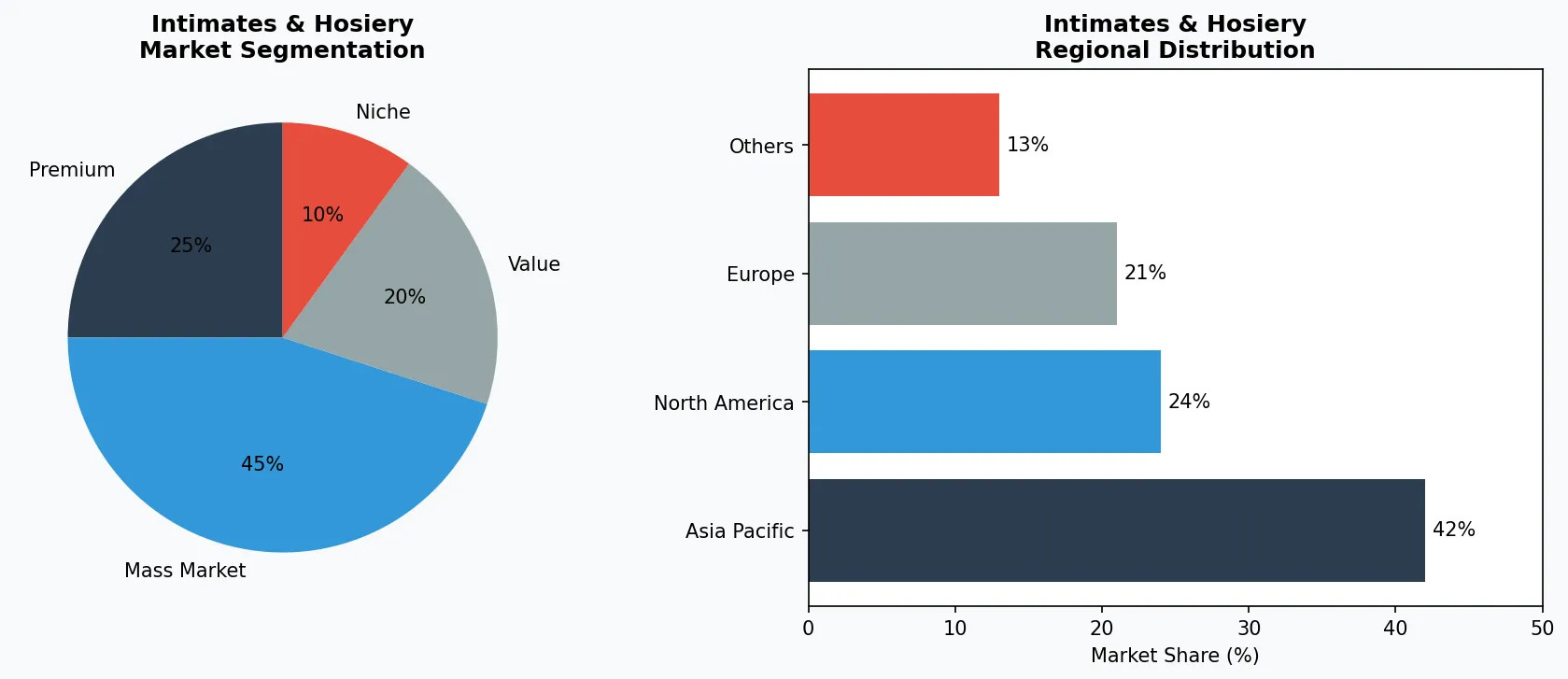
Market segmentation and regional distribution analysis for Intimates & Hosiery.
3. Product Categories
Product innovation is segmenting the market into highly specialized categories. Core essentials like bras and panties from leaders like Hanes and Triumph form the volume backbone, but are rapidly evolving with fabrics that offer moisture-wicking and odor control. The rise of shapewear, pioneered by brands like Victoria's Secret, has blurred the line between foundation garments and outerwear, creating a category focused on silhouette enhancement. In hosiery, the shift is from sheer pantyhose to performance-driven tights and leggings designed for athletic recovery or all-day comfort, moving beyond fashion into functional apparel. Sleepwear and thermal underwear, from companies like Aimer and Warmwind, have also shed their basic image, incorporating temperature-regulating technologies and designs suitable for both the bedroom and the living room, reflecting the work-from-home era.4. Leading Players
The competitive landscape is a study in adaptation. Legacy giants like Victoria's Secret are aggressively pivoting from their heritage of overt glamour to embrace inclusivity, comfort, and diverse marketing, attempting to reclaim relevance. In contrast, companies like Hanes and Septwolves dominate through scale, supply chain mastery, and deep penetration in mass-market channels for basics and socks. Asian powerhouses such as Triumph and Aimer leverage sophisticated manufacturing and a deep understanding of regional fit preferences to command significant market share, particularly in Asia. Meanwhile, the market's premiumization and sustainability trends have opened doors for a wave of direct-to-consumer insurgents and niche brands. These players compete not on volume but on brand storytelling, material innovation (like recycled fabrics), and hyper-specific catering to underserved demographics, keeping the established leaders in a constant state of strategic response.5. Market Trends & Innovations
1. Sustainability & Eco-Friendly Innovation
Sustainability has become a core competitive priority. Companies like Victoria's Secret (L Brands) and Hanesbrands are investing in eco-friendly materials, carbon-neutral production, and circular economy initiatives to meet growing consumer demand for responsible products.
2. Digital Transformation & E-Commerce Growth
The shift to digital sales channels continues to accelerate. LVMH and Calvin Klein (PVH Corp) are leveraging data analytics, AI-driven personalization, and omnichannel strategies to enhance customer engagement and streamline distribution.
3. Premiumization & Product Innovation
Rising consumer expectations are driving premiumization across the market. Wacoal has introduced high-end product lines, while Triumph International focuses on innovative features and superior quality to capture value-conscious yet quality-seeking customers.
4. Health, Wellness & Functional Benefits
Health-oriented consumer preferences are reshaping product development. Jockey International and Spanx are pioneering functional products with demonstrable benefits, commanding premium pricing and driving category expansion.
6. Regional Markets
Regional appetites dictate vastly different strategies. North America remains a key driver of the premiumization and comfort trends, with a strong DTC brand ecosystem and high spending on specialized segments like shapewear. Europe, with its fashion-forward legacy, shows sustained strength in designer hosiery and lingerie, while also leading in the adoption of stringent sustainability regulations that impact supply chains. The Asia-Pacific region, however, is the engine of volume growth and manufacturing innovation. Markets like China, home to leaders like Aimer and Septwolves, exhibit massive domestic demand fueled by rising disposable incomes and a growing middle class. Here, trends blend, with a simultaneous appetite for affordable everyday essentials from Hanes, luxury international brands like Victoria's Secret, and local designers adept at catering to regional body types and style preferences.7. Investment Outlook
The path to 2026 and beyond is lined with both clear opportunities and inherent risks. The sustained growth across nearly all segments—from everyday hosiery to erotic lingerie—indicates a resilient industry. The greatest opportunity lies in synthesizing the key trends: creating premium, sustainable, and supremely comfortable products that cater to a global yet nuanced audience. Brands that can leverage technology for perfect fit (via AI and body scanning) and material science for next-generation fabrics will capture disproportionate value. The primary risk is stagnation in brand narrative. Companies that fail to move beyond outdated marketing tropes or that cannot authentically engage with demands for inclusivity and environmental responsibility will lose share to agile newcomers. In this market, the winners will be those who understand that intimates and hosiery are no longer just garments; they are essential, expressive components of contemporary life.Make Informed Decisions in the Intimates & Hosiery Market
Product quality and sourcing integrity directly impact business outcomes. Discover how Verity Rank's verification platform helps industry participants source with greater confidence.
Contact Verity Rank TodayThis article is for informational purposes only, based on publicly available industry data and market reports as of 2026-04-13. All market figures are estimates and may vary from actual results.