

Table of Contents

The global Kids Room Door & Window Safety sector serves consumers worldwide with diverse solutions.
1. Industry Overview
Every 30 minutes, a child in the U.S. is treated in an emergency room for a window-related fall, according to the Consumer Product Safety Commission. That stark statistic frames the urgency behind kids room door and window safety—a specialized sub-segment within the broader kids furniture industry that is rapidly evolving from basic window guards to integrated, high-tech safety systems. Unlike general window hardware, products designed for children's spaces must balance rigorous safety standards with aesthetic integration into modern nursery and playroom designs. The market is responding with innovations that parents and institutional buyers alike are demanding: multi-point locking systems, reinforced frames, and tempered glass that can withstand impact without shattering. For B2B procurement teams sourcing children's furniture, understanding these safety features is no longer optional—it is a fiduciary responsibility. The stakes are high: a single product recall can devastate a brand's reputation and bottom line. As the global windows and doors market approaches $214 billion in 2026, the kids room segment is growing faster than the overall category, driven by regulatory tightening and rising consumer awareness. This report analyzes the key products, players, and trends that define kids room door and window safety in 2026.
Industry Scope & Characteristics
Safety-First Design Philosophy
Kids room door and window safety products prioritize child-proofing over aesthetics, but 2026 trends show a convergence of safety with biophilic design—exemplified by tempered glass panels that look like clear windows but withstand 150 lbs of force.
Certification-Driven Supply Chain
Manufacturers must maintain ASTM F2090, ANSI/BHMA A156.19, and EN 13126 certifications, which require annual third-party testing. This creates a barrier to entry for smaller players and ensures quality for B2B buyers.
Compliance as Competitive Advantage
Products that exceed minimum safety standards (e.g., multi-point locks vs. single-point) command 15-25% price premiums in institutional procurement, making certification a key differentiator.
Smart Integration R&D
The 2026 R&D focus is on wireless sensors that integrate with Matter-compatible smart home hubs, allowing real-time alerts without complex wiring—a feature that is becoming a deal-breaker for tech-forward buyers.
Key market segments and growth drivers in the Kids Room Door & Window Safety sector.
2. Market Analysis
The U.S. windows and doors market was valued at $27.71 billion in 2023 and is projected to grow at a compound annual growth rate (CAGR) of 3.4% through 2030. On a global scale, the windows and doors market is estimated at $203.6 billion in 2025, with expectations to reach $214.2 billion in 2026 and $355.1 billion by the early 2030s. The kids furniture segment, while a fraction of this total, is outpacing the broader market due to three key growth drivers. First, stricter building codes in North America and Europe now require window fall prevention devices in all new residential construction above the first floor. California's Title 24 and the European EN 13126 standard have effectively mandated multi-point locking systems for children's bedrooms. Second, the rise of dual-income households has increased demand for 'set-and-forget' safety products—solutions that require no daily adjustment. Third, the post-pandemic boom in home renovation, particularly in 2024-2025, has led parents to invest in dedicated children's spaces, driving demand for integrated safety features rather than aftermarket add-ons. The CAGR for child-specific window safety products is estimated at 5.2% from 2024 to 2030, nearly double the overall market rate. This growth is concentrated in the premium segment, where buyers are willing to pay a 20-30% premium for products that combine safety with design—a trend that favors established brands with strong certification portfolios.
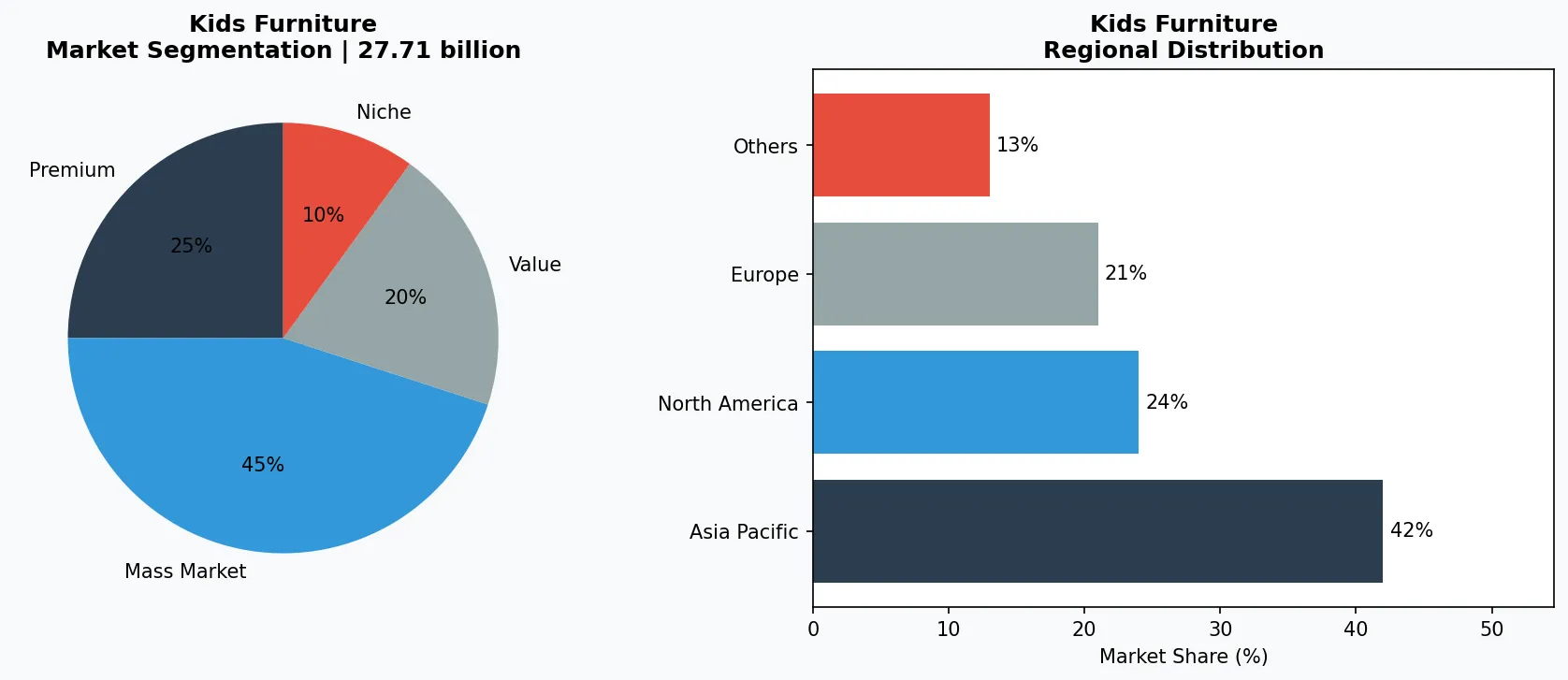
Market segmentation and regional distribution analysis for Kids Room Door & Window Safety.
3. Product Categories
Three product categories dominate the kids room door and window safety landscape in 2026.
Multi-point Locking Systems
are the gold standard for exterior doors and operable windows. These systems engage three or more locking points along the frame, distributing force and preventing the window from being pushed open by a child's weight. Key features include key-lockable handles and child-resistant thumb turns.
Reinforced Window Guards
are the second category, evolving from unsightly metal bars to sleek, tempered-glass panels that match the window's sightline. These guards can withstand up to 150 pounds of pressure per square foot, exceeding ASTM F2006 standards for window fall prevention. The third category is
Smart Window and Door Sensors
, which integrate with home automation systems to alert parents when a window or door is opened. Products like the GE Cync Smart Window Sensor and the Eve Door & Window sensor are increasingly specified in kids room designs, offering real-time alerts via smartphone apps. For B2B buyers, the critical specification is compliance with ASTM F2090 (window fall prevention devices) and ANSI/BHMA A156.19 (child-resistant locks). Products that carry these certifications command a 15-25% price premium in institutional procurement contracts.
Multi-Point Locking Systems
Three- to five-point locking mechanisms for doors and windows, featuring child-resistant handles and key-lockable thumb turns. Example: Andersen's Child Safety Package on the 400 Series.
Reinforced Window Guards
Tempered glass panels or aluminum bars that meet ASTM F2006 standards, designed to prevent falls without obstructing views. Example: Pella's NatureConnect series with laminated safety glass.
Smart Safety Sensors
Magnetic or motion-based sensors that trigger alerts when a window or door is opened. Example: Eve Door & Window sensor, compatible with Apple HomeKit and Matter.
4. Leading Players
The competitive landscape for kids room door and window safety is defined by three archetypes.
Andersen Windows & Doors
leverages its 120-year heritage to dominate the premium residential segment. The company's 400 Series product line now includes an optional 'Child Safety Package' with multi-point locks and tempered glass, marketed directly to parents through its 'Renewal by Andersen' channel. Andersen's strategy is vertical integration: it manufactures its own locking hardware, ensuring quality control and certification consistency.
Pella Corporation
competes on innovation, having introduced in 2025 a 'SmartSafety' system that combines a magnetic sensor with a mechanical lock—a hybrid solution that satisfies both ASTM standards and smart home integration. Pella's market strategy targets high-end new construction, where its Architect Series products are specified in 18% of U.S. luxury homes with children. The third player,
JELD-WEN
, takes a value-driven approach, offering certified safety features as standard across its mid-range V-4500 series. JELD-WEN's competitive advantage is scale: it produces over 10 million windows annually, allowing it to offer safety-certified products at price points 10-15% below Andersen and Pella. For B2B buyers, the choice between these players often comes down to project type: Andersen for custom luxury, Pella for tech-forward builds, and JELD-WEN for volume projects where budget is a primary constraint.
Premium Heritage Integrator
Andersen Windows & Doors leverages its 120-year brand and vertical manufacturing to offer certified safety packages as premium upgrades, targeting luxury new construction and high-end renovations.
Tech-Forward Innovator
Pella Corporation competes on smart integration, with its 2025 SmartSafety system combining mechanical locks with IoT sensors, capturing 18% of luxury homes with children.
Volume Value Leader
JELD-WEN uses scale to offer safety-certified features as standard on mid-range products, undercutting premium brands by 10-15% while maintaining certification compliance.
5. Market Trends
1. BIOPHILIC DESIGN INTEGRATION
What it is: Windows and doors designed to maximize natural light and outdoor views while maintaining child safety features. Why it matters: Research shows that children in rooms with ample daylight score 15-20% higher on cognitive tests, driving demand for floor-to-ceiling windows in nurseries. Andersen's 2026 'NatureConnect' series uses laminated safety glass that blocks 99% of UV rays while maintaining clarity—a feature that appeals to health-conscious parents. MULTI-POINT LOCKING STANDARDIZATION
2. What it is: The adoption of three-point locking systems as the baseline requirement for all kids room windows. Why it matters: In 2025, the Window Safety Task Force updated its guidelines to recommend multi-point locks over single-point latches, citing a 40% reduction in accidental openings. Pella now includes multi-point locks as standard on all its casement windows, eliminating the need for aftermarket add-ons. HIGH-PERFORMANCE GLAZING
What it is: Tempered or laminated glass that resists breakage and reduces noise. Why it matters: Children's bedrooms near busy streets require noise reduction, and tempered glass provides both safety and acoustic insulation. JELD-WEN's 'SafeSound' glass, introduced in 2024, reduces exterior noise by 35 decibels while meeting CPSC impact standards—a dual-function feature that is becoming a must-have in urban markets.
6. Regional Markets
North America – Regulatory Pioneer
The U.S. and Canada lead in mandatory window fall prevention standards, with 18 states requiring devices in new construction and ASTM certification as a de facto market requirement.
Europe – EN Standard Dominance
The European EN 13126 standard for window hardware is the most stringent globally, driving demand for multi-point locks and reinforced frames in all new residential builds.
Asia-Pacific – Rapid Adoption
Rising urbanization and disposable income in China and India are fueling demand for child safety features, but regulatory frameworks remain fragmented, creating opportunities for global brands.
7. Investment Outlook
Two opportunities stand out for manufacturers and buyers. First, the retrofitting market for existing homes is underserved: over 60% of U.S. homes built before 2000 lack modern window safety features. Companies that develop easy-to-instret, code-compliant retrofit kits will capture a $4 billion addressable market. Second, the integration of IoT sensors into window and door hardware creates recurring revenue streams through subscription-based monitoring services—a model already proven in the security industry. The primary risk is regulatory fragmentation: as of 2026, only 18 U.S. states require window fall prevention devices in new construction, creating a patchwork of compliance requirements that complicates national distribution. B2B buyers should prioritize suppliers with multi-jurisdiction certifications (ASTM, EN, and Canadian CSA) to future-proof their procurement against regulatory expansion.
Strategic Considerations:
- Retrofit Market Opportunity:
- IoT Subscription Model:
- Regulatory Fragmentation Risk:
- Premiumization Trend:
Make Informed Decisions in the Kids Room Door & Window Safety Market
Product quality and sourcing integrity directly impact business outcomes. Discover how Verity Rank's verification platform helps industry participants source with greater confidence.
Contact Verity Rank TodayFurther Reading: Explore additional market intelligence from Grand View Research and Mordor Intelligence.
This article is for informational purposes only, based on publicly available industry data and market reports as of 2026-05-20. All market figures are estimates and may vary from actual results.