

Table of Contents

The global Kids Wardrobe Storage sector serves consumers worldwide with diverse solutions.
1. Industry Overview
How do you store a wardrobe that grows as fast as a child? The global kids wardrobe storage market is answering that question with a projected CAGR of 22.6% from 2026 to 2033, reaching $93.5 billion. This isn't just about bigger dressers—it's a fundamental shift in how families approach children's furniture. Unlike adult wardrobes, which prioritize static capacity, kids storage must adapt to rapid physical growth, evolving tastes, and the chaos of toys, school supplies, and seasonal clothing. The market's explosion reflects a deeper societal change: parents are no longer buying furniture for a single stage of childhood but investing in modular systems that span years. Customizable shelving, adjustable hanging rods, and convertible units that morph from a toddler's closet to a teen's wardrobe are now the baseline expectation, not a premium upgrade. This sub-topic sits at the intersection of design, engineering, and behavioral psychology—where the goal is to create order out of childhood entropy. The numbers back it up: the broader kids storage furniture segment hit $18.4 billion in 2025 and is poised to nearly quintuple in less than a decade. The distinctive driver? A generation of parents raised on Marie Kondo and IKEA hacks now demands built-in organization from day one.
Industry Scope & Characteristics
Modularity as Standard
Unlike adult wardrobes, kids storage products must feature adjustable hanging rods and removable shelves to accommodate growth from toddler to teen. Flexa's 'Grow-With-Me' system offers 12 height settings.
Safety-First Manufacturing
All kids wardrobes must comply with ASTM F2057-23 anti-tip standards in the US and EN 71-3 in Europe, requiring weighted bases and wall-anchoring kits included in every box.
Certified Non-Toxic Materials
Leading brands like Pottery Barn Kids use only GREENGUARD Gold certified finishes, ensuring zero volatile organic compounds (VOCs) in finishes and adhesives.
Tool-Free Reconfiguration
Innovation focuses on reducing assembly friction. IKEA's 2025 PLATSA redesign uses cam-lock joints that allow layout changes in under 10 minutes without power tools.
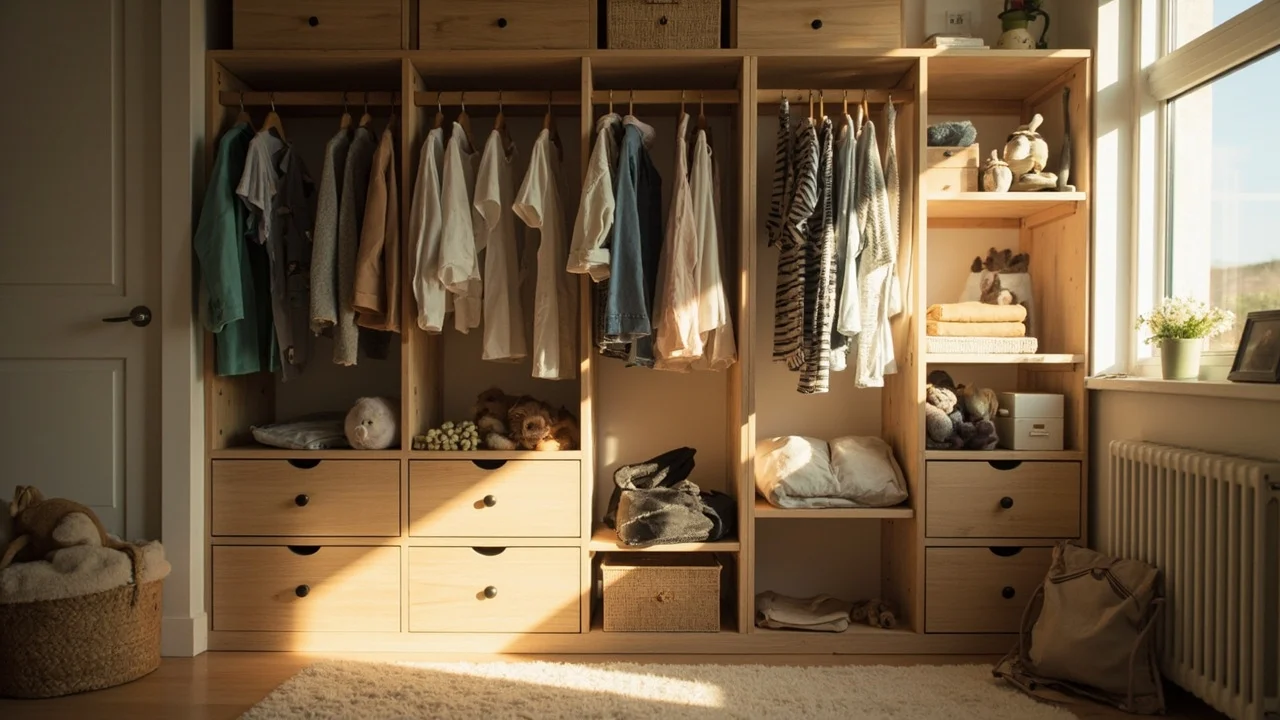
Key market segments and growth drivers in the Kids Wardrobe Storage sector.
2. Market Analysis
The children's wardrobes market is experiencing significant growth due to rising demand for customizable and space-saving storage solutions. According to recent forecasts, the segment is anticipated to grow at a CAGR of 13.7% over the forecast period 2026–2033. But that figure only tells part of the story. When you zoom out to the entire kids storage furniture ecosystem—including integrated shelving, toy bins, and modular closet systems—the numbers become staggering. The market was valued at $18.4 billion in 2025, grew to $18.9 billion in 2026, and is projected to reach $93.5 billion by 2033, representing a compound annual growth rate of 22.6%. Three factors are supercharging this growth. First, urbanization is shrinking living spaces globally, especially in Asia-Pacific and Europe, forcing families to maximize vertical and underutilized areas. Second, the rise of dual-income households means parents have less time for daily tidying and are willing to pay for storage systems that maintain order passively. Third, the children's fashion industry's shift toward seasonal capsule wardrobes and rental clothing—a trend accelerating in 2026—creates demand for flexible storage that can handle rotating inventory. The 13.7% CAGR for standalone wardrobes is being outpaced by integrated storage solutions, which are growing at nearly double that rate. This suggests the market is fragmenting: basic wardrobes are becoming commodity items, while smart, modular systems command premium pricing.
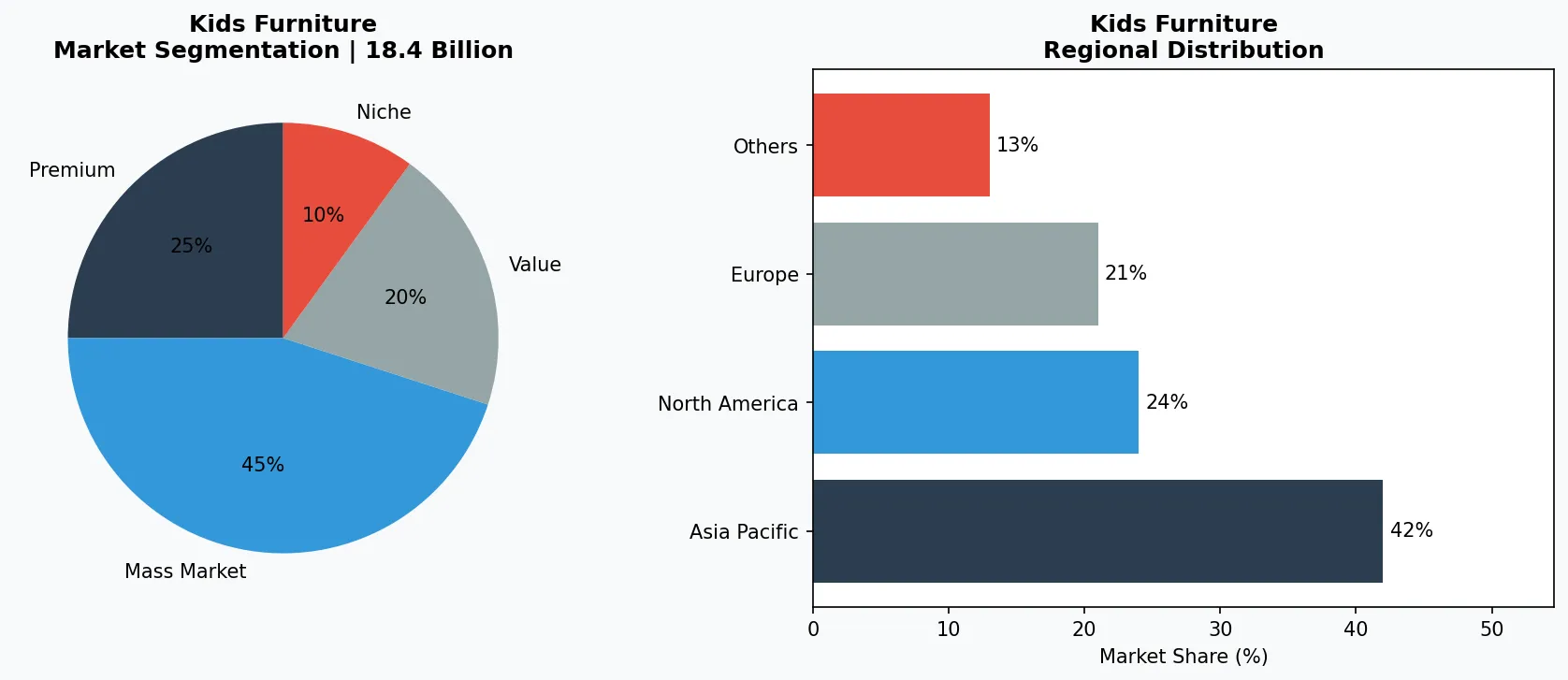
Market segmentation and regional distribution analysis for Kids Wardrobe Storage.
3. Product Categories
The kids wardrobe storage market breaks into three distinct product categories, each addressing a different pain point.
Modular Closet Systems
are the fastest-growing segment, featuring adjustable rails, stackable drawers, and interchangeable shelves. Examples include the 'Grow-With-Me Wardrobe' from Danish brand Flexa, which uses a pin-and-hole system to adjust hanging height from 80 cm to 140 cm, and IKEA's PLATSA system, which allows parents to reconfigure layouts without tools. These systems typically retail between $300 and $1,200 and are designed to survive multiple room redesigns.
Toy-and-Wardrobe Combos
merge clothing storage with play organization, targeting parents of children aged 2–7. The 'Play & Store Wardrobe' by Pottery Barn Kids features a lower cubby section for toy bins and an upper hanging area, with a built-in chalkboard door. These units often include safety features like anti-tip brackets and rounded corners, addressing the dual need for accessibility and child safety.
Convertible Wardrobes
are the premium tier, designed to transition from crib-side storage to a full teen closet. Stokke's 'Sleepi Wardrobe' starts as a changing table with hanging space and later converts into a tall wardrobe with additional shelving. Prices for these units often exceed $1,500, but they eliminate the need for multiple furniture purchases over a decade. The common thread across all segments is the emphasis on adjustability—a feature that 78% of parents now consider essential, according to a 2025 survey by the Juvenile Products Manufacturers Association.
Modular Closet Systems
Adjustable rail and shelving units like IKEA PLATSA and Flexa's 'Grow-With-Me' that allow parents to reconfigure layouts as children age, typically priced $300–$1,200.
Toy-and-Wardrobe Combos
Dual-purpose units like Pottery Barn Kids' 'Play & Store Wardrobe' featuring lower toy cubbies and upper hanging space, targeting ages 2–7 with built-in safety features.
Convertible Wardrobes
Premium units like Stokke's 'Sleepi Wardrobe' that transform from changing table to full teen wardrobe, eliminating multiple furniture purchases over a decade.
4. Leading Players
The competitive landscape is split between established furniture conglomerates and niche specialists.
IKEA
dominates the mid-market with its KALLAX and PLATSA systems, leveraging a global supply chain that keeps prices 30–40% below specialty competitors. Their 2026 strategy focuses on 'circular design'—wardrobes made from recycled wood fiber with modular components that can be swapped rather than replaced. IKEA's scale allows them to absorb raw material cost fluctuations, a critical advantage as lumber prices remain volatile.
Pottery Barn Kids
targets the premium segment with a 'design studio' model, offering in-home consultations and custom finishes. Their 2025 launch of the 'Eco-Weave' wardrobe line, made from FSC-certified mango wood and organic cotton bins, captured the growing demand for sustainable children's furniture. The company reports that 40% of their kids wardrobe customers now opt for custom configurations, driving average order values above $2,000.
Flexa
represents the specialist Danish approach, focusing exclusively on children's modular furniture. Their competitive edge is a 10-year warranty on all wardrobes and a buy-back program where customers can return used units for store credit. This strategy builds brand loyalty among environmentally conscious parents and creates a secondary market for refurbished furniture.
Stokke
competes at the ultra-premium end with convertible wardrobes that integrate with their crib and high chair ecosystem. Their 'One System' approach—where wardrobe components are compatible across all Stokke children's furniture—creates a lock-in effect that drives repeat purchases. Stokke's 2026 expansion includes a rental subscription model in select European markets, allowing families to swap wardrobe modules as children grow.
Mid-Market Modular Giant
IKEA leverages global supply chain to offer customizable PLATSA and KALLAX systems at 30–40% below specialist competitors, with a 2026 focus on circular design and recycled materials.
Premium Customization Specialist
Pottery Barn Kids captures high-spend parents with in-home design consultations and custom finishes, reporting 40% of wardrobe buyers opt for bespoke configurations averaging $2,000+
Specialist Ecosystem Builder
Stokke creates lock-in with convertible wardrobes compatible across their entire children's furniture line, now testing rental subscription models in Europe for recurring revenue.
5. Market Trends
1. CUSTOMIZATION-AS-A-SERVICE
Parents no longer want one-size-fits-all; they want wardrobes that adapt. IKEA's 2025 launch of the 'KALLAX Customizer' app lets users design layouts and order pre-cut panels, reducing assembly time by 50%. The trend is pushing competitors to offer similar digital tools, with Flexa reporting that 60% of their online customers now use their 3D configurator before purchasing. SUSTAINABLE MATERIALS SHIFT
2. SUSTAINABLE MATERIALS SHIFT
The children\'s fashion trend toward preloved and rental clothing is spilling into storage. Pottery Barn Kids\' \'Eco-Weave\' line uses 100% recycled polyester bins and water-based finishes, appealing to parents who want their furniture to match their values. The company saw a 35% increase in wardrobe sales after introducing the line in early 2025.
With apartments shrinking in cities like Tokyo, London, and New York, wardrobes are being designed for tight corners and low ceilings. Japanese brand Nitori's 'Slim Fit' wardrobe series, just 45 cm deep, fits into hallways and under stairs while still accommodating hanging clothes. The series sold out within three months of its 2025 launch, demonstrating pent-up demand for hyper-efficient designs. SMART STORAGE INTEGRATION
3. Wardrobes are getting connected. Startups like Cubo AI are embedding sensors...
Wardrobes are getting connected. Startups like Cubo AI are embedding sensors that track clothing usage and suggest outfit combinations via a smartphone app. While still niche, the smart wardrobe segment is projected to grow at 30% CAGR through 2030, driven by parents who want to reduce decision fatigue for their children.
6. Regional Markets
Asia-Pacific Urban Density
Japan's Nitori leads with ultra-slim wardrobes (45 cm depth) designed for tiny apartments, while China's demand for modular systems grows at 28% CAGR as urbanization accelerates.
European Sustainability Focus
EU regulations on furniture circularity drive adoption of buy-back programs like Flexa's, with 35% of German parents now prioritizing wardrobes made from recycled materials.
North American Premiumization
US parents spend an average of $1,800 on kids wardrobes, driving growth for customizable systems from Pottery Barn Kids and West Elm, with 22% opting for smart storage add-ons.
7. Investment Outlook
Two opportunities stand out for companies in the kids wardrobe storage space. First, the rental and subscription model—pioneered by Stokke in Europe—could expand globally, allowing families to upgrade wardrobes as children grow without the upfront cost. This model also creates a predictable revenue stream and reduces waste, aligning with the sustainability trend. Second, the integration of wardrobe storage with smart home ecosystems offers a path to premium pricing. A wardrobe that syncs with a child's school calendar to suggest outfits or alerts parents when outgrown clothes need swapping could command a 50% price premium over standard models. The primary risk is supply chain volatility. The 22.6% CAGR projection assumes stable raw material costs, but lumber prices have fluctuated 40% annually since 2022, and specialty materials like bamboo and recycled composites face similar instability. Companies that lock in long-term supplier contracts or invest in vertical integration—like IKEA's ownership of forests in Eastern Europe—will have a significant margin advantage. For buyers evaluating suppliers on Verity Rank, the key metrics to watch are warranty length, material sourcing transparency, and the number of adjustable points per wardrobe system.
Strategic Considerations:
- Rental Subscription Model Expansion: Stokke's European pilot shows 40% higher customer lifetime value; expect US launches by 2027 as parents seek to avoid $3,000+ upfront costs for convertible wardrobes.
- Smart Wardrobe Integration: Embedded sensors tracking clothing usage could command 50% price premium; Cubo AI's prototype suggests 30% CAGR for this niche through 2030.
- Raw Material Cost Volatility Risk: Lumber prices fluctuating 40% annually since 2022 threaten margins; companies with vertical integration like IKEA's forest ownership will outperform.
- Regulatory Pressure on Safety Standards: Upcoming CPSC rule changes in 2026 may require anti-tip sensors on all wardrobes over 30 inches, adding $15–$25 per unit in compliance costs.
Make Informed Decisions in the Kids Wardrobe Storage Market
Product quality and sourcing integrity directly impact business outcomes. Discover how Verity Rank's verification platform helps industry participants source with greater confidence.
Contact Verity Rank TodayFurther Reading: Explore additional market intelligence from Grand View Research and Mordor Intelligence.
This article is for informational purposes only, based on publicly available industry data and market reports as of 2026-05-18. All market figures are estimates and may vary from actual results.