

Table of Contents

The global Living Room Furniture industry serves consumers worldwide with diverse solutions.
1. Industry Overview
What does a quarter-trillion dollars look like? In 2025, it looked like the global living room furniture market, valued at a staggering USD 231.8 billion. This segment is the emotional and functional core of the broader home furniture industry, a behemoth that itself reached US$759.08 billion in 2025. Far from a static collection of sofas and tables, this market is a dynamic indicator of consumer confidence, design evolution, and macroeconomic shifts. Its distinctiveness lies in its role as the primary shared space in a home, making it the first target for renovation and a key expression of personal and family identity. The historic shift from viewing furniture as a durable, infrequent purchase to a more fluid, trend-responsive category has been accelerated by e-commerce and a post-pandemic focus on the home as a multifunctional sanctuary for work, leisure, and connection.
Industry Scope & Characteristics
Broad Product Portfolio
Products span sofas, coffee tables, TV cabinets, dining tables, dining chairs, display cabinets, bookshelves, serving diverse consumer needs from everyday essentials to premium specialized offerings.
Complex Global Supply Chains
Integrated international networks spanning multiple continents ensure year-round product availability across diverse markets.
Quality & Compliance Standards
Rigorous regulatory frameworks and quality certifications ensure product safety, consistency, and consumer trust worldwide.
Continuous Innovation
Heavy R&D investment drives formulation breakthroughs, processing technologies, and novel product development cycles.

Key market segments and growth drivers in the Living Room Furniture sector.
2. Market Analysis
Projected to grow from USD 240.4 billion in 2026 at a steady CAGR of 3.9%, the living room furniture market's expansion is underpinned by concrete, powerful drivers. In the United States, a primary engine of growth, rising disposable incomes and sustained consumer spending on home improvement are creating a robust demand environment. This is compounded by a persistent housing market where both new construction and renovations fuel furniture sales. The market's scale is immense; it ranks among the world's largest consumer goods sectors. While the U.S. is a dominant force, the Asia-Pacific region, led by manufacturing and consumption giants like China, represents both the world's factory floor and its fastest-growing consumer base, creating a complex and high-volume trade dynamic that defines global supply chains.
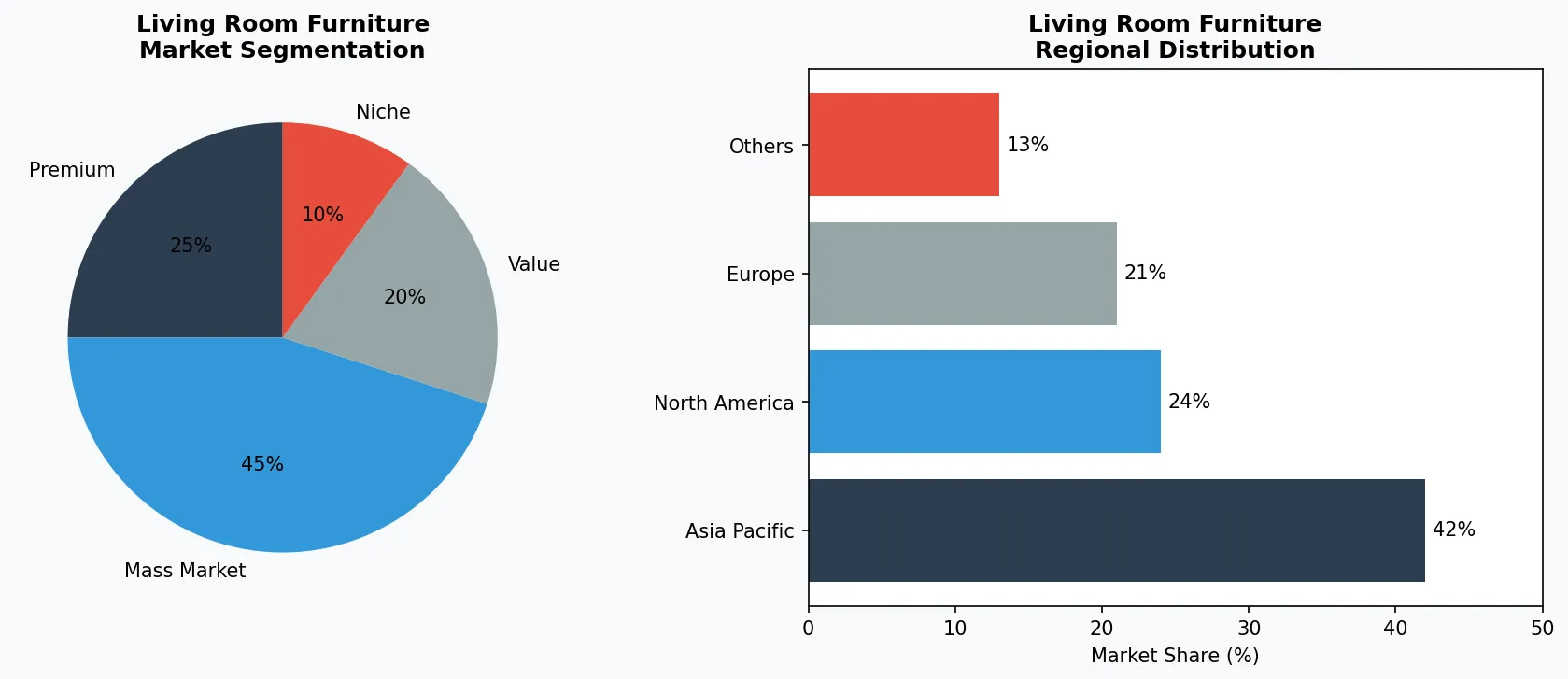
Market segmentation and regional distribution analysis for Living Room Furniture.
3. Product Categories
The market is segmented into core functional categories that define the living space. Seating, led by sofas and sectionals, is the anchor, with brands like IKEA democratizing design and Man Wah dominating through massive manufacturing scale for recliners and functional seating. Surface and storage solutions—including coffee tables, TV cabinets, and bookshelves—are evolving from mere utilities to key design statements, increasingly incorporating smart features and modularity. The adjacent dining area, encompassing dining tables and chairs, often falls within the living room's purview in open-plan homes, with companies like Ashley Furniture offering coordinated suites that blend living and dining into a cohesive aesthetic.
Premium & Artisanal Tier
High-margin specialty products targeting affluent consumers who prioritize quality, craftsmanship, and unique attributes.
Mass Market Mainstream
Volume-driven products serving price-conscious mainstream consumers with reliable quality at accessible price points.
Functional & Niche Segment
Targeted products addressing specific health concerns, dietary requirements, or lifestyle preferences beyond basic needs.
4. Leading Players
IKEA's strategy remains a masterclass in vertical integration and democratic design, using its vast global store footprint and flat-pack logistics to drive affordability and accessibility, constantly refreshing its catalog with space-saving solutions. Ashley Furniture leverages its extensive North American retail network and domestic manufacturing emphasis to cater to the middle-American market with a wide array of traditional to transitional styles, capitalizing on the U.S. home improvement boom. From China, Man Wah Holdings operates as a behind-the-scenes titan, not primarily as a consumer brand but as the world's largest manufacturer of recliner chairs and a critical OEM supplier, showcasing the supply-side power within the industry.
Global Market Leader
Multinational player commanding significant market share. Revenue exceeding $50B with operations across 100+ countries, diversified portfolio spanning all major price tiers.
Regional Champion
Dominant force in Asia Pacific with deeply localized product lines, extensive distribution networks, and strong regional retailer relationships.
Innovation Disruptor
Fast-growing challenger disrupting incumbents through breakthrough product innovation, direct-to-consumer models, and data-driven marketing in the living room furniture space.
5. Market Trends
1. Sustainable & Natural Materials
Sustainable & Natural Materials — Driven by eco-conscious consumers, this trend prioritizes organic fabrics, recycled content, and responsibly sourced wood. It matters as a key brand differentiator and response to regulatory pressure. Lorena Canals exemplifies this with its washable, handcrafted rugs made from 100% natural cotton.
2. Modular & Space-Saving Design
Modular & Space-Saving Design — This addresses urbanization and smaller living spaces, offering customizable, multifunctional furniture that adapts to various needs. IKEA is a pioneer, with its modular sofa systems and transformable storage units dominating this segment.
3. Emotion-Driven Color & Finish
Emotion-Driven Color & Finish — Moving beyond neutral grays, 2026 palettes are leaning toward warm, dark woods, grainy finishes, and colors chosen for psychological impact. This trend reflects a desire for comfort, personality, and tactile connection within the home.
6. Regional Markets
The United States market is characterized by high consumer spending power, a strong DIY and home renovation culture, and a preference for large-scale furniture, driving volume for domestic players like Ashley Furniture and major imports. China serves a dual role: as the world's manufacturing hub, home to giants like Man Wah, and as a massive domestic market where retailers like Red Star Macalline operate vast physical showrooms, though growth is tempered by a slowing property sector. In Europe, the market is fragmented but trend-led, with a high value placed on design, sustainability, and space-efficient solutions, making it a key region for testing innovative and premium concepts from brands like IKEA.
Asia Pacific — The Growth Engine
The world's largest and fastest-growing region, led by China, India, and Southeast Asia. Urbanization, rising middle class, and digital retail adoption are primary catalysts.
North America — Premium & Wellness Driven
A mature market with strong health-and-wellness orientation, sustainability commitments, and robust demand for premium and functional products.
Europe — Quality & Regulatory Leadership
A developed market with stringent quality, safety, and environmental regulations. Strong demand for organic, locally sourced, and ethically certified products.
7. Investment Outlook
Two significant opportunities are poised to shape the next phase. First, the integration of smart home technology into furniture—from sofas with built-in wireless charging and speakers to tables with integrated touchscreen controls—creates a new value-added product category. Second, the direct-to-consumer (DTC) model, refined during the pandemic, allows agile brands to capture margin and customer data by bypassing traditional retail markups. The most concrete risk is persistent supply chain fragility. Geopolitical tensions, trade policy shifts, and logistics bottlenecks can swiftly disrupt the global flow of materials and finished goods, compressing margins and delaying delivery for an industry reliant on complex international manufacturing networks.
Strategic Considerations:
- ('Technology & AI Integration:', 'Artificial intelligence and IoT are revolutionizing production efficiency, quality assurance, and demand forecasting across the supply chain.')
- ('Sustainability as Business Strategy:', 'Regulatory pressure and consumer expectations are making environmental commitments essential, not optional.')
- ('Transparency & Traceability:', 'Consumers demand increasingly granular information about product origins, ingredients, and production methods.')
- ('Emerging Market Penetration:', 'Africa, Latin America, and second-tier Asian cities represent the next wave of volume growth.')
Make Informed Decisions in the Living Room Furniture Market
Product quality and sourcing integrity directly impact business outcomes. Discover how Verity Rank's verification platform helps industry participants source with greater confidence.
Contact Verity Rank TodayFurther Reading: Explore additional market intelligence from Grand View Research and Mordor Intelligence.
This article is for informational purposes only, based on publicly available industry data and market reports as of 2026-04-15. All market figures are estimates and may vary from actual results.