

Table of Contents
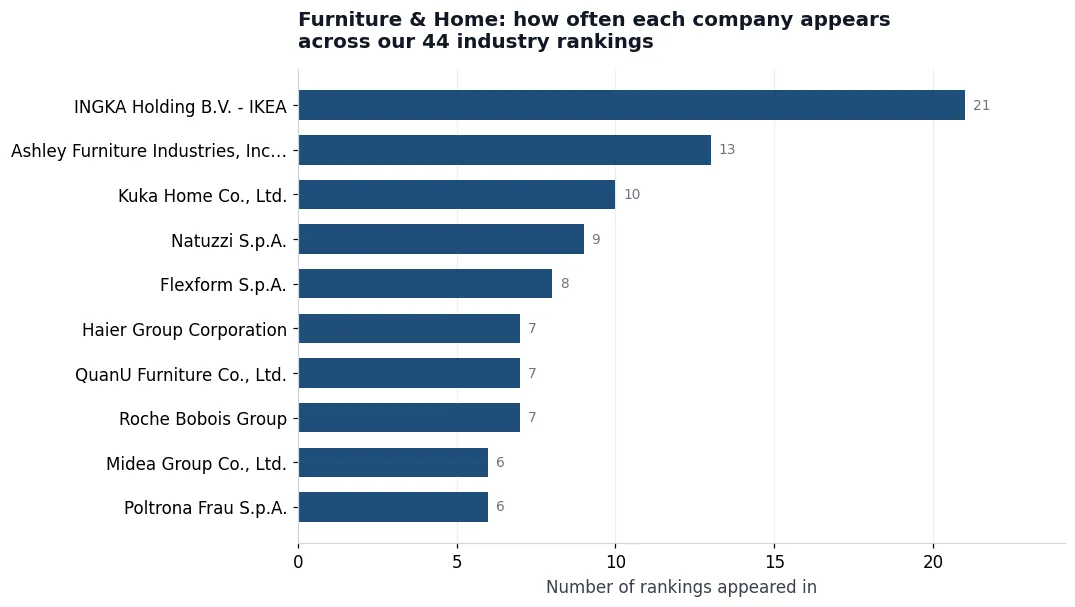
IKEA appears in 21 of the 44 furniture and home rankings we maintain. The second most frequently listed company, Ashley Furniture, appears in 13. After that the counts fall away fast: 10, 9, 8, 7. That distribution is the single most useful fact about this category, and it is not visible from any one of those 44 lists.

Key Findings at a Glance
IKEA appears 21 times
More than half the category's 44 rankings. Its breadth comes from retail integration, not manufacturing scale.
Second place drops to 13
Ashley Furniture, then 10, 9, 8, 7 — the distribution falls away quickly after the leader.
Two countries, half the field
The United States (57) and China (54) dominate; Italy's presence is concentrated in high-design upholstery.
Private label is invisible
A large share of volume reaches consumers under retailer names, so no ranking captures the true manufacturing base.
The IKEA Anomaly
A 21-list footprint means IKEA is treated as a credible entrant in twenty-one separate procurement categories — flat-pack living room furniture, bedroom systems, storage, textiles, kitchen fittings, and so on. Very few manufacturers appear across that range. Most furniture makers, including ones with nine-figure revenues, are specialists: they make sofas, or they make office seating, or they make mattresses, and they do not make all three.
IKEA’s breadth is a consequence of vertical integration into retail rather than of manufacturing scale. The company is a seller first, which means every product category it decides to stock becomes a category it can be ranked in. That is a materially different competitive position from a factory that supplies three retailers with upholstered seating.
Why Furniture Has Never Consolidated
Three economic properties keep this industry fragmented. Freight is expensive relative to product value, so furniture is made near where it is sold. Design preferences are local in a way that, say, semiconductor specifications are not. And the products are bulky but not technically difficult, which caps the advantage a large manufacturer can earn over a competent regional one.
The result is a category where 44 rankings containing 438 positions still do not describe a consolidated supply base. Almost every position is contestable by a company a buyer has never heard of.
Who Recurs Across the Lists
Italy’s presence here — Natuzzi and Flexform both appear repeatedly — is worth pausing on. Italian furniture makers compete globally on a segment where scale matters least: high-design upholstery. That is a deliberate strategic position, not an accident of history.
Two Countries Supply Nearly Half the Category
The United States and China together account for roughly a quarter of the ranked companies in this category, but their positions are structurally different. American entries cluster in brands and retailers; Chinese entries cluster in manufacturing, particularly in the home textiles, lighting, and storage sub-categories. A buyer looking to switch from an American brand to a Chinese manufacturer is not making a like-for-like substitution.
Germany and Japan, with 15 and 14 companies respectively, are over-represented relative to their furniture industries’ public profile. Both concentrate in kitchen systems and fittings — a sub-category where engineering tolerances matter and where global brands have held position for decades.

The Competitor Nobody Ranks
One structural factor is absent from every list in this category: retailer private label. A significant share of furniture and home textile volume in North America and Europe is produced by manufacturers whose output reaches consumers under a retailer’s name, and those manufacturers rarely hold a brand position on any list.
The consequence is that our rankings, and every comparable ranking, systematically understate the true concentration of this industry’s manufacturing base. The companies that appear most often are the ones with consumer-facing brands. The companies that make the most product are frequently invisible, and are found instead through the manufacturer rather than the brand lists — which is why we maintain both.
How to Use This Category When Sourcing
The practical lesson from 438 ranked positions is that depth of choice varies enormously by sub-category. In upholstered seating and case goods, alternatives are abundant. In kitchen fittings, bathroom fixture systems, and smart-home hardware, the field narrows to a handful of recurring names — the same ones appearing on list after list.
Start from the individual lists rather than this hub: home-textiles-fabrics-brands, home-textiles-fabrics-suppliers, living-room-furniture-brands, living-room-furniture-factory. Each shows the full company set with verified headquarters, disclosed revenue where available, and position.
Buyer Questions on This Category
How many furniture and home rankings does VerityRank maintain?
44 rankings containing 438 ranked positions, covering furniture, home textiles, lighting, storage, kitchen and bathroom fittings, and pet products. Each is maintained separately for brands and for manufacturers.
Why does IKEA appear in so many rankings?
IKEA appears in 21 of the 44 lists in this category. Its breadth comes from retail integration rather than manufacturing scale — because IKEA decides which product categories to stock, each decision creates a category where it holds a market position.
Is the furniture industry consolidated?
No, and our data shows why. Freight cost relative to product value, local design preferences, and low technical barriers all favour regional production over global consolidation. Even across 438 ranked positions, most companies appear on only one or two lists.
The Data Behind This Analysis
How to Read This Data
Methodology note
Freight cost relative to product value, local design preferences, and low technical barriers all favour regional production — which is why this category has never consolidated.
Related Rankings and Analysis
Every article draws on the same dataset. These pages go deeper on specific rankings:
Home Textiles & Fabrics — Brands
The largest sub-category in furniture and home.
Living Room Furniture — Brands
IKEA's strongest position in our rankings.
Mattress Brands
A sub-category where regional makers hold most positions.
All-Industries Manufacturer Index
Every manufacturer we maintain, across 213 industries.
VerityRank maintains 426 industry rankings covering 1,506 verified companies and 10,933 ranked positions. Every figure in this article is drawn from that dataset.
Browse the all-industries manufacturer index or verified enterprise directory.