

Table of Contents

The global Organic Cotton Fashion sector serves consumers worldwide with diverse solutions.
1. Industry Overview
Conventional cotton—grown on 2.5% of the world's farmland—consumes nearly 16% of all insecticides used globally. That startling statistic underpins the explosive rise of organic cotton fashion, a sub-segment of the sustainable apparel industry that swaps synthetic inputs for natural, certified farming practices. Unlike generic 'eco-friendly' labeling, organic cotton fashion demands traceability from seed to garment, governed by standards like GOTS (Global Organic Textile Standard) and OCS (Organic Content Standard). This rigor has translated into tangible market momentum: the global organic clothing market was valued at $9.2 billion in 2024 and is projected to nearly triple to $23.61 billion by 2033, registering a compound annual growth rate (CAGR) of 12.5%. What makes this sub-topic distinct within sustainable fashion is its focus on the raw material itself—rather than end-of-life recycling or upcycling, organic cotton addresses the front end of the supply chain. Brands and manufacturers are now investing heavily in regenerative organic practices that go beyond mere substitution, restoring soil health and sequestering carbon while delivering premium, non-toxic fabrics to the market. For B2B buyers, this shift represents both an ethical imperative and a commercial opportunity: consumers are voting with their wallets, and the data shows that organic cotton apparel commands price premiums of 20–40% over conventional alternatives.
Industry Scope & Characteristics
Certification-Driven Raw Material
Unlike generic sustainable fashion, organic cotton fashion relies on farm-level certifications like GOTS and OCS, which audit for non-GMO seeds, banned pesticides, and soil health. This makes the fiber traceable and verifiable.
Supply Chain Fragmentation
The organic cotton supply chain is highly fragmented, with smallholder farmers in India and Turkey producing the majority of the fiber. This necessitates long-term contracts and direct farmer partnerships to ensure volume and quality.
Third-Party Assurance Standards
Certifications such as GOTS (Global Organic Textile Standard) cover entire processing chain, while OCS (Organic Content Standard) verifies content percentage. Both require annual audits and strict chemical input restrictions.
Innovation in Recycling and Blending
R&D focuses on mechanical recycling of post-consumer organic cotton and blending with recycled synthetics or bast fibers (hemp, linen) to improve durability without compromising certification integrity.

Key market segments and growth drivers in the Organic Cotton Fashion sector.
2. Market Analysis
The organic cotton fashion market is riding a wave of structural demand that shows no signs of slowing. According to the latest market intelligence, the organic clothing segment—of which organic cotton is the dominant sub-category—was sized at $9.2 billion in 2024 and is forecast to reach $23.61 billion by 2033, growing at a robust CAGR of 12.5%. To put that in perspective, the broader sustainable fashion market (including recycled, vintage, and upcycled apparel) is projected to expand from $12.44 billion in 2026 to $27.96 billion by 2034, at a CAGR of roughly 10.1%. Organic cotton fashion is clearly outpacing the broader sustainable segment, driven by three primary growth accelerators. First, tightening regulatory frameworks: the European Union’s Strategy for Sustainable and Circular Textiles, which mandates due diligence for environmental claims by 2025, is forcing brands to adopt certified organic sourcing. Second, increased corporate procurement: major retailers like H&M, Patagonia, and Levi’s have committed to sourcing 100% organic cotton by specific milestones (H&M targets 100% by 2025). Third, shifting consumer values: a 2024 McKinsey survey found that 67% of consumers consider the use of sustainable materials as a key purchasing factor, and organic cotton ranks highest in perceived environmental benefit among natural fibers. However, the market still faces friction from supply constraints—organic cotton accounts for less than 1% of global cotton production, meaning brands must invest in long-term contracts and farmer partnerships to secure volume. Despite these challenges, the bullish CAGR validates that organic cotton fashion is transitioning from niche premium to mainstream necessity.
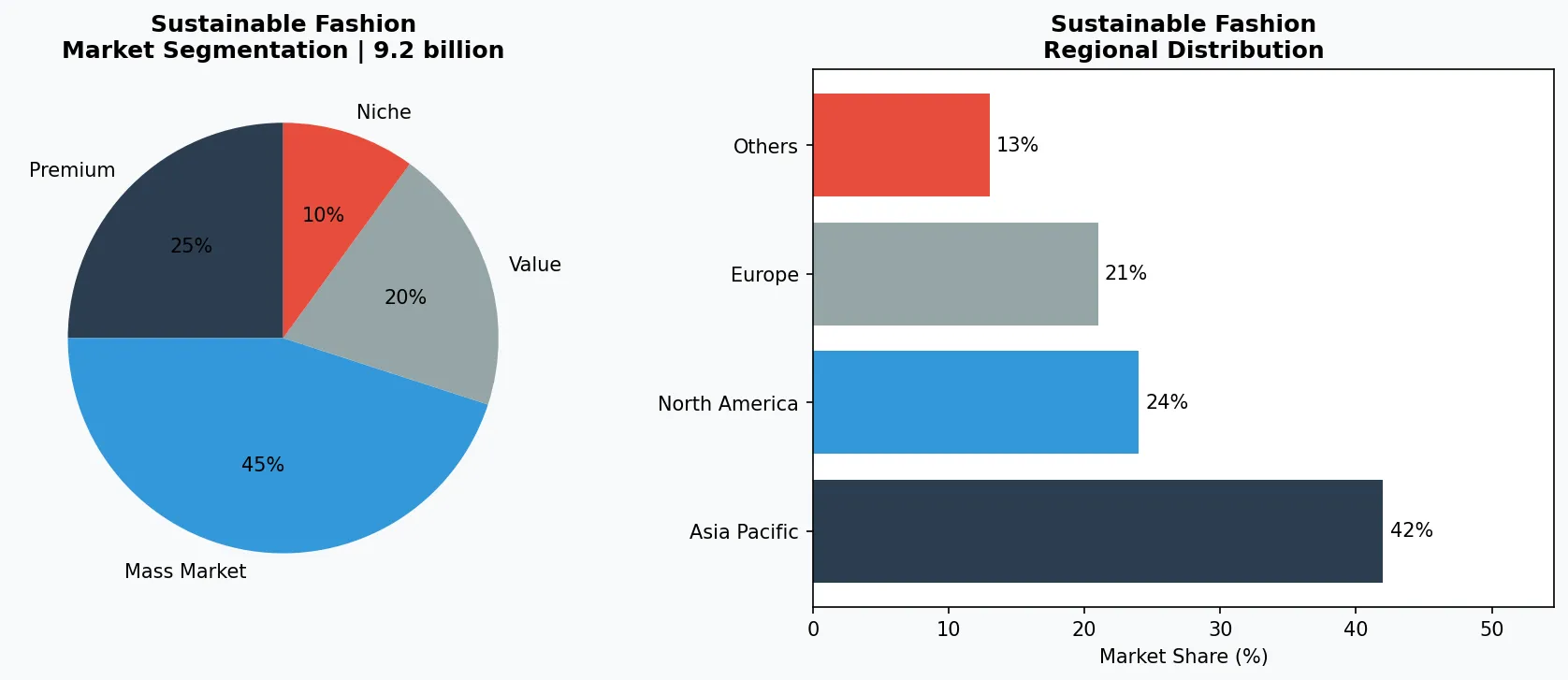
Market segmentation and regional distribution analysis for Organic Cotton Fashion.
3. Product Categories
Organic cotton fashion spans three distinct product categories that cater to different sourcing strategies.
Certified Organic Basics
These are staple items—t-shirts, underwear, denim, and tote bags—made from 100% GOTS-certified organic cotton. Examples include Pact’s organic cotton leggings, which retail at $40 and are marketed as 'home compostable' when blended with Tencel, and Patagonia’s organic cotton t-shirts that use a low-impact dye process.
Blended Organic Fabrics
To improve durability and functionality, many manufacturers blend organic cotton with recycled polyester, hemp, or lyocell. A prime example is tentree, which uses organic cotton-hemp blends for its hoodies, combining low water footprint with strength.
Recycled Organic Cotton
Post-industrial and post-consumer cotton waste is shredded and spun into new yarns. Companies like Recover™ supply mechanically recycled organic cotton fibers that are blended with virgin organic cotton to maintain quality. This sub-category is gaining traction as brands seek circularity without sacrificing certification. B2B buyers should note that price points vary considerably: basic certified organic cotton t-shirts cost about $6–8 per unit in low-volume orders, while recycled blends command a 15–20% premium due to processing complexity.
Everyday Certified Basics
T-shirts, underwear, socks, and denim made from 100% GOTS-certified organic cotton. Examples include Pact’s leggings and Patagonia’s organic cotton tees.
Performance Blends
Organic cotton blended with recycled polyester, Tencel, or hemp for functional benefits like moisture wicking or stretch. Used in activewear and outerwear.
Circular/Recycled Organic Cotton
Post-industrial or post-consumer organic cotton sent through mechanical recycling processes such as Recover™ and spun into new yarns. Often blended with virgin organic to maintain fiber length.
4. Leading Players
The competitive landscape in organic cotton fashion is driven by both heritage players and disruptors.
Patagonia
Remains the gold standard, having pledged to use 100% organic cotton in its core categories since 2016. The company’s 'Worn Wear' program extends product life, while its investment in Regenerative Organic Certified™ (ROC) cotton pilot farms demonstrates a vertical integration strategy that secures supply while improving soil health.
Pact
Targets the conscious middle market by offering affordable organic cotton basics through a direct-to-consumer model. Pact’s competitive edge lies in its 'Climate Neutral Certified' supply chain and a partnership with the Better Cotton Initiative to transition farmers.
Eileen Fisher
Takes a circular approach: its 'Renew' program collects used organic cotton garments and either resells them or re-fibers them into new products. The company’s 2025 goal is to use 100% organic or recycled cotton, with a strong emphasis on transparency—each product includes a QR code showing the farm origin.
SourceAgro
Is a newer B2B player specializing in traceable organic cotton made from regeneratively farmed Indian cotton, aimed at brands needing verified carbon-negative raw materials. These players illustrate that competitive advantage in organic cotton fashion rests on three pillars: certification depth, supply chain transparency, and circular business models.
Vertical Integrators
Brands that invest directly in farming cooperatives and processing facilities to secure traceable organic cotton. They gain control over quality and certification but require high upfront capital.
Certified Sourcing Specialists
Companies that bridge smallholder farmer co-ops and global brands, offering verified organic cotton with full chain-of-custody documentation. Their competitive advantage lies in traceability platforms and farmer training.
Circular Supply Chain Innovators
Players that combine organic cotton with closed-loop recycling and low-impact dyeing technologies, enabling brands to meet upcoming regulatory recycled content requirements.
5. Market Trends
1. TRACEABILITY AND BLOCKCHAIN
Brands are adopting blockchain-based platforms (e.g., Sourcemap, TextileGenesis) to trace organic cotton from field to finished garment, ensuring that claims of organic content are verifiable and reducing fraud. EILEEN FISHER has implemented a pilot using Eon’s digital product passports for organic cotton dresses, allowing consumers to scan a tag and view the entire supply chain.
2. REGENERATIVE ORGANIC AGRICULTURE
Beyond conventional organic, regenerative practices rebuild soil organic matter and sequester carbon. Patagonia’s Regenerative Organic Certified™ (ROC) cotton program, launched in 2020, now includes over 2,000 farmers in India. The trend is critical because it addresses climate change and water scarcity simultaneously, and it commands higher premiums for B2B suppliers.
3. CIRCULAR SOLUTIONS FOR COTTON
Mechanical and chemical recycling of post-consumer organic cotton is increasing, driven by EU policy requiring 50% recycled content in textiles by 2030. Renewcell’s Circulose pulp, made from shredded organic cotton waste, is now used by Levi’s and H&M. This trend matters because it closes the loop on organic cotton, reducing dependence on virgin fiber.
4. LOW-IMPACT DYEING AND FINISHING
Organic cotton’s environmental benefits are amplified when paired with waterless dyeing technologies (e.g., DyeCoo’s CO2 process) or natural dyes. Companies like Kering (Gucci) have invested in natural indigo projects that use organic cotton as the base, reducing water usage by 90% compared to conventional denim finishing.
6. Regional Markets
India – The Organic Cotton Backbone
India produces over 50% of the world's organic cotton, mostly from smallholder farms in Madhya Pradesh and Maharashtra. The region faces challenges with water scarcity and certification costs but offers the lowest price for raw organic cotton.
Turkey – Premium Quality and Proximity
Turkey is a leading supplier of GOTS-certified organic cotton for the European market. Quality is generally higher with finer fiber lengths, and proximity to EU reduces logistics carbon footprint.
United States – Regenerative Pioneer
US organic cotton cultivation is small but growing, particularly in Texas and the Southeast. The US leads in regenerative organic certification (ROC) and offers premium pricing for certified carbon-negative cotton.
7. Investment Outlook
B2B buyers in organic cotton fashion face a clear near-term opportunity: securing long-term supply agreements with certified producers in Turkey, India, and the US, where organic cotton cultivation is expanding. Given the 12.5% CAGR, early commitments will lock in favorable pricing before demand further outstrips supply. A second opportunity lies in partnering with technology providers to offer end-to-end traceability, which will become a contractual requirement as regulations like the EU Digital Product Passport take effect. The primary risk is greenwashing enforcement: the US Federal Trade Commission (FTC) Green Guides and the EU’s upcoming Green Claims Directive mean that any brand making unverified organic claims faces fines of up to 4% of annual revenue. Buyers must demand third-party certification (GOTS, OCS, ROC) and verify chain-of-custody from seed to garment. Those that invest in transparent, certified supply chains will capture the premium value of organic cotton; those that rely on self-declarations will be squeezed out.
Strategic Considerations:
- Secure Long-Term Supply Contracts: With a 12.5% CAGR and less than 1% of global cotton being organic, early-binding contracts with certified producers in India or Turkey will protect buyers from price volatility.
- Invest in Digital Traceability: Implementing blockchain or digital passport systems (e.g., TextileGenesis) for organic cotton will become a regulatory necessity and a competitive differentiator.
- Mitigate Greenwashing Risk: Only source organic cotton with third-party certifications (GOTS, OCS, ROC) and verify chain-of-custody. Non-compliance with upcoming EU and FTC rules can lead to significant fines and reputational damage.
- Diversify into Regenerative Organic Cotton: Regenerative organic cotton (ROC) commands higher consumer trust and carbon credit potential. Early adoption will position B2B suppliers for the next wave of demand.
Frequently Asked Questions
Make Informed Decisions in the Organic Cotton Fashion Market
Product quality and sourcing integrity directly impact business outcomes. Discover how Verity Rank's verification platform helps industry participants source with greater confidence.
Contact Verity Rank TodayFurther Reading: Explore additional market intelligence from Grand View Research and Mordor Intelligence.
This article is for informational purposes only, based on publicly available industry data and market reports as of 2026-07-27. All market figures are estimates and may vary from actual results.