

Table of Contents

The global Pet Feeding Station Furniture sector serves consumers worldwide with diverse solutions.
1. Industry Overview
Pet owners in 2025 are rethinking the humble food bowl. The global pet feeding station furniture market—valued at $1.2 billion in 2024—is no longer an afterthought in the pet furniture aisle. Feeding stations have evolved from simple plastic trays into engineered furniture pieces designed for ergonomics, digestion health, and home aesthetics. What makes this sub-topic distinctive within the broader $4.47 billion pet furniture industry is its functional specificity: these products solve a biological need (reducing neck strain and bloat risk in dogs) while addressing a consumer desire for kitchen-grade design. Unlike cat trees or pet beds, feeding stations sit at the intersection of pet wellness and home decor, often matching cabinetry finishes or counter heights. The category spans elevated wooden stands, stainless steel double-bowl units, and smart feeders with portion control. As pet humanization deepens, feeding station furniture is becoming a staple in households that treat pets as family members—and the numbers back it up: the U.S. pet furniture market alone is projected to reach $3.95 billion by 2033, with feeding stations capturing an increasing share of that spend.
Industry Scope & Characteristics
Ergonomic Design Focus
Pet feeding station furniture is uniquely designed to elevate bowls to a pet’s natural eating height, reducing neck strain and digestive risks—a feature absent in standard pet bowls. Elevated stands for large breeds are the most common product type.
Material Safety Compliance
Products must meet FDA or EU food-contact material standards for bowls and surfaces. Stainless steel and ceramic are preferred over plastic to prevent bacterial growth and chemical leaching.
Multi-Function Integration
Many feeding stations now incorporate storage drawers for food bags, silicone mats for spill control, and even built-in scales—turning a simple stand into a pet care hub.
Smart Technology Embedment
R&D is focused on IoT-enabled feeders with app control, portion accuracy, and health tracking. The next frontier is AI-based feeding schedules that adjust based on pet activity levels.

Key market segments and growth drivers in the Pet Feeding Station Furniture sector.
2. Market Analysis
The global pet feeding station furniture market was valued at $1.2 billion in 2024, according to Verity Rank’s latest market intelligence. This figure sits within the larger pet furniture ecosystem, which is expected to grow from $4.74 billion in 2026 to $8.24 billion by 2034. The feeding station segment is outpacing the broader category, driven by three powerful forces. First, the rise of large-breed dog ownership: breeds like Golden Retrievers and German Shepherds are prone to bloat (gastric dilatation-volvulus), and elevated feeding stations are clinically recommended to reduce risk. Second, the premiumization of pet supplies: consumers are spending more per unit, with high-end feeding stations made from bamboo or solid wood retailing for $150–$300, compared to $20 for a basic bowl. Third, e-commerce penetration: online retail now accounts for over 40% of pet furniture sales in the U.S., enabling direct-to-consumer brands to educate buyers on ergonomic benefits. The U.S. pet furniture market is estimated at $2.59 billion in 2026, growing at a 6.2% CAGR to $3.95 billion by 2033. Dog-specific furniture, a key subsegment, is projected to expand at a remarkable 12.1% CAGR from 2026 to 2033, signaling that canine-centric feeding solutions will be a major growth vector.
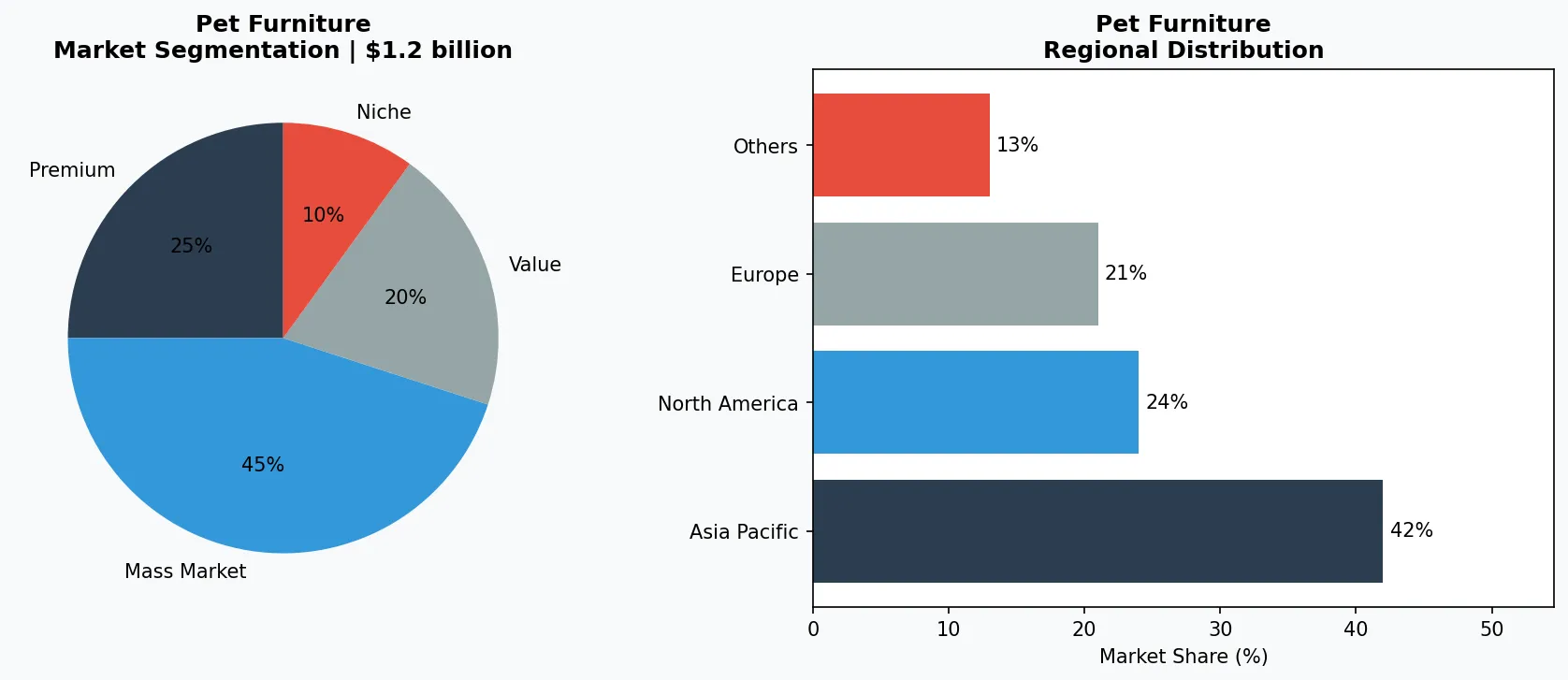
Market segmentation and regional distribution analysis for Pet Feeding Station Furniture.
3. Product Categories
The pet feeding station furniture market can be segmented into three distinct product categories.
Elevated Wooden Stands
are the premium workhorses of the category. Typically crafted from acacia, bamboo, or MDF with a water-resistant finish, these stands hold stainless steel or ceramic bowls at a 6–12 inch height. Brands like Neater Feeder offer models with spill-proof bases and adjustable heights for growing puppies.
Smart Feeding Stations
integrate technology: portion-controlled dispensers, app-based scheduling, and slow-feed inserts. The PetSafe Smart Feed, for example, allows owners to schedule meals remotely, while built-in sensors prevent overfeeding—a key concern given that 56% of U.S. dogs are overweight.
Compact & Space-Saving Units
target apartment dwellers. These combine a feeding station with a mat or storage drawer for food bags. Examples include the IRIS USA 2-in-1 Elevated Feeder with a silicone mat, which fits neatly into small kitchens. Material innovation is accelerating: manufacturers are shifting from plastic to food-grade stainless steel and ceramic, as these materials are easier to sanitize and resist bacterial growth, aligning with veterinary hygiene recommendations.
Elevated Wooden Stands
Premium stands made from bamboo or acacia, with adjustable height and spill-proof bowls. Example: Neater Feeder Express is a top seller for its patented spill containment.
Smart & Connected Feeders
App-controlled units with portion scheduling and weight sensors. Example: PetSafe Smart Feed allows remote feeding and tracks consumption patterns.
Compact & Space-Saving Units
All-in-one designs with built-in mat or storage drawer for small homes. Example: IRIS USA 2-in-1 Elevated Feeder fits under cabinets and includes a silicone mat.
4. Leading Players
Three archetypes dominate the pet feeding station furniture landscape.
E-commerce-Native Premium Brands
like Neater Feeder have carved out a loyal following by focusing on spill-proof engineering and aesthetic design. Their Neater Feeder Express model, which features a patented spill-proof system and elevated bowls, has become a bestseller on Amazon, demonstrating that functional innovation can command premium pricing.
Legacy Pet Product Manufacturers
such as IRIS USA leverage global supply chains and mass-market distribution. IRIS USA’s feeding stations are widely available through big-box retailers like Petco and Walmart, offering value-priced options that still incorporate elevated designs and non-skid bases. Their strategy is volume-driven, targeting the mid-market consumer who wants ergonomic benefits without the designer price tag.
Specialty Woodworkers & Boutique Brands
represent the artisan segment. Companies like PawHut (a DTC brand) produce feeding stations with built-in storage drawers and matching pet bed frames, targeting the ‘pet interior’ trend. These players differentiate through customization—offering multiple stain colors and bowl sizes—and often sell directly via Shopify stores, bypassing traditional retail margins. The competitive tension between these archetypes is driving rapid product iteration, particularly in materials and modularity.
E-commerce-First Functional Innovator
Neater Feeder dominates the premium segment with spill-proof engineering and direct-to-consumer sales, commanding $100+ price points through patent-protected design.
Mass-Market Value Leader
IRIS USA leverages global manufacturing and big-box retail distribution to offer affordable elevated feeding stations, targeting budget-conscious pet owners.
Boutique Customization Specialist
PawHut differentiates with modular feeding stations that include storage and matching furniture, sold via DTC channels with multiple finish options.
5. Market Trends
1. BAMBOO & SUSTAINABLE MATERIALS
Manufacturers are rapidly adopting bamboo, reclaimed wood, and recycled plastics for feeding stations. Bamboo is naturally antimicrobial and moisture-resistant, making it ideal for food-contact surfaces. Neater Feeder recently launched a bamboo variant of its classic stand, responding to consumer demand for eco-friendly pet products. This trend matters because 68% of pet owners under 35 say sustainability influences their purchase decisions. SMART FEEDERS WITH HEALTH ANALYTICS
2. The integration of weight sensors and app connectivity is transforming feeding stations into health monitoring hubs. The PetSafe Smart Feed can track how much a pet eats and alert owners to appetite changes that may signal illness. This trend is critical as pet insurance adoption rises (over 4 million pets insured in the U.S. in 2024), and insurers increasingly offer discounts for preventive care data. MODULAR & MULTI-PET SYSTEMS
As multi-pet households grow (now 45% of U.S. households), feeding stations are being designed with separate compartments, RFID-locked bowls, and adjustable height tiers. IRIS USA’s 3-Bowl Feeder with raised stand allows multiple cats or small dogs to eat simultaneously without competition, reducing stress and food aggression. This modular approach also appeals to breeders and pet sitters.
6. Regional Markets
North America – Premiumization Hub
The U.S. market, valued at $2.59 billion for all pet furniture in 2026, leads in adoption of elevated and smart feeding stations, driven by pet humanization and high disposable income.
Europe – Sustainability-Driven
EU regulations on single-use plastics and strong consumer demand for eco-friendly materials push manufacturers toward bamboo and recycled composites in feeding station production.
Asia-Pacific – Manufacturing & Growth
China and Vietnam are the primary production bases for wood and metal feeding stations, while domestic demand in Japan and South Korea grows for compact, space-saving designs.
7. Investment Outlook
Two opportunities stand out. First, the integration of feeding stations with pet weight management programs: companies that partner with veterinary clinics or pet insurance providers to offer data-driven feeding solutions could capture the $1.2 billion pet obesity treatment market. Second, expansion into commercial channels: dog daycare centers, boarding facilities, and veterinary clinics are underserved segments that need durable, easy-to-clean feeding stations. A concrete risk is supply chain volatility for specialty woods and electronics components. Bamboo shortages in 2025 have already pushed lead times for premium feeding stations to 8–10 weeks, and any disruption in semiconductor supply for smart feeders could stall growth in the high-margin tech segment. Brands that diversify sourcing and maintain buffer inventory will have a competitive edge.
Strategic Considerations:
- Opportunity: Pet Health Integration: Feeding stations that sync with veterinary weight management programs could tap into the $1.2 billion pet obesity treatment market.
- Opportunity: Commercial Channel Expansion: Dog daycares and vet clinics need durable, easy-to-clean feeding stations—a largely untapped B2B segment.
- Risk: Bamboo & Electronics Supply Chain: Bamboo shortages and semiconductor lead times threaten production of premium and smart feeding stations, requiring diversified sourcing.
- Risk: Regulatory Scrutiny on Smart Devices: Emerging data privacy laws for IoT pet products could increase compliance costs for connected feeder manufacturers.
Make Informed Decisions in the Pet Feeding Station Furniture Market
Product quality and sourcing integrity directly impact business outcomes. Discover how Verity Rank's verification platform helps industry participants source with greater confidence.
Contact Verity Rank TodayFurther Reading: Explore additional market intelligence from Grand View Research and Mordor Intelligence.
This article is for informational purposes only, based on publicly available industry data and market reports as of 2026-05-21. All market figures are estimates and may vary from actual results.