

Nobody outside the industry talks about power transmission. Inside it, 160 companies compete for a market that every factory, wind turbine, conveyor line, and electric vehicle depends on. Our power transmission ranking is the largest single list we maintain — 160 verified companies, more than any of our other 425 rankings — and its shape says something uncomfortable about industrial concentration.
What Power Transmission Actually Covers
The category spans gearboxes, couplings, belts and chains, bearings, linear motion systems, and the geared motors that sit between an electric drive and a mechanical load. It is a components industry: almost nothing it makes is sold to a consumer, and almost everything it makes is mission-critical to something else. A failed gearbox stops a mine; a failed bearing stops a paper mill.
The Top of the Ranking
| Rank | Company | Headquarters |
|---|---|---|
| 1 | ZF Friedrichshafen | Germany |
| 2 | Schaeffler AG | Germany |
| 3 | AB SKF | Sweden |
| 4 | Regal Rexnord Corporation | United States |
| 5 | NSK Ltd. | Japan |
| 6 | The Timken Company | United States |
| 7 | SEW-EURODRIVE GmbH & Co KG | Germany |
| 8 | Gates Industrial Corporation | United States |
| 9 | Flender GmbH | Germany |
| 10 | Wanxiang Qianchao Co., Ltd. | China |
| 11 | Xylem | United States |
| 12 | Ingersoll Rand | United States |
| 13 | Grundfos | Denmark |
| 14 | Flowserve | United States |
| 15 | Parker Hannifin | United States |
See the complete list on our power transmission systems ranking, and the separate B2B buyer list on our power transmission suppliers ranking, which covers 112 of the same companies from a sourcing rather than brand perspective.
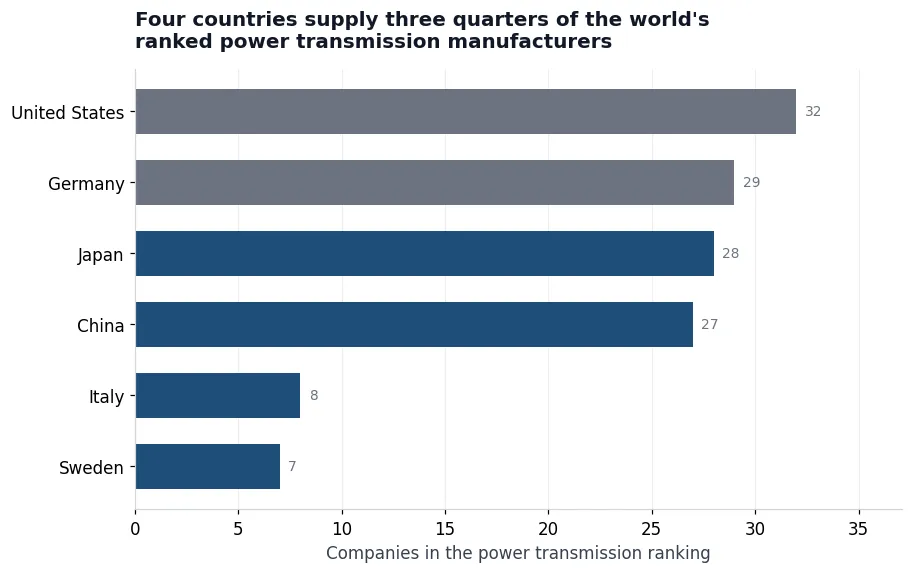
Four Countries, Three Quarters of the Industry
| Headquarters | Companies | Share |
|---|---|---|
| United States | 32 | 20% |
| Germany | 29 | 18% |
| Japan | 28 | 17% |
| China | 27 | 16% |
| Italy | 8 | 5% |
| Sweden | 7 | 4% |
The United States, Germany, Japan, and China together supply 116 of the 160 ranked companies — about 72%. Italy is the only other country with more than a handful of entries, and its eight companies cluster in the high-precision end.
That four-country concentration is why lead times in this industry behave the way they do. When a single German gearbox plant goes down, there is no second-tier supplier country that can absorb the volume, because no such country exists at scale.
The Adjacent Industries Tell the Same Story
We see the identical pattern in the categories that buy from power transmission. Our fluid handling equipment ranking covers 149 companies; material handling covers 138; HVAC systems covers 126 and refrigeration systems 124. Every one of them is a components or systems industry with the same four-country core.
For procurement teams, the practical conclusion is that diversifying away from these four countries is not a sourcing decision — it is a capacity-building programme measured in years. Explore the full set through our all-industries manufacturer index.
Three Layers of Supplier Concentration
The 160-company ranking resolves into three tiers. At the top sit the diversified industrial groups — Bosch, Siemens, ABB, Rexnord — that sell complete drive trains rather than individual components, and whose competitive advantage is systems integration rather than any single product. In the middle are the specialists: Japanese and German bearing makers, Italian gear manufacturers, American coupling suppliers, each holding a defensible position in one narrow sub-category.
The bottom tier is the most interesting analytically. It consists of regional suppliers that do not compete globally at all but hold near-total share within their domestic market, usually because the products are heavy, low-value, or require close engineering support. They rarely appear in international supplier shortlists, and they are frequently the fastest route to a local replacement when a global supplier stumbles.
What Changes in the Next Five Years
The specialist tier is where most procurement decisions actually land. A buyer specifying a gearbox rarely starts with Bosch or Siemens; they start with names like Sandvik, Danaher Corporation, or Rexnord, evaluate technical fit, and only then consider the diversified groups as fallback options. That pattern repeats across every adjacent category we rank — in fluid handling, material handling, and HVAC alike.
Two forces are reshaping this ranking. The first is electrification, which is moving power transmission from mechanical to electromechanical designs and pulling battery and motor specialists into categories they previously did not occupy. The second is reshoring pressure in North America and Europe, which is creating demand for regional capacity that the existing four-country structure cannot quickly supply.
Neither force changes the fundamental constraint. A precision gearbox plant is not built in eighteen months, and the engineering workforce that staffs it takes longer still to assemble. That is why lead times in this industry have remained stubbornly long through every recent supply-chain crisis, and why the ranking above will look broadly similar in 2030 to how it looks today.
For the full picture across adjacent categories, see our power transmission suppliers list, material handling equipment ranking, and HVAC systems ranking.
Questions Buyers Actually Ask
How many companies are ranked in the power transmission industry?
160 verified companies — the largest single ranking VerityRank maintains. It covers gearboxes, couplings, belts and chains, bearings, linear motion systems, and geared motors across the United States, Germany, Japan, China, Italy, and other markets.
Why is power transmission considered a concentrated industry?
Because four countries — the United States, Germany, Japan, and China — account for roughly three quarters of all globally significant suppliers. There is no second-tier supplier nation at scale, which means a single plant outage cannot be absorbed by shifting volume elsewhere.
What is the difference between the power transmission brands and suppliers rankings?
The brands ranking covers companies known by their own product branding to end users and specifiers. The suppliers ranking covers the same industry from a B2B sourcing perspective, listing companies that procurement teams evaluate for direct purchase. 112 companies appear on both lists.