


Table of Contents

The global Secondhand Vintage Clothing sector serves consumers worldwide with diverse solutions.
1. Industry Overview
How big is the secondhand vintage clothing market? By 2032, the global secondhand apparel market is projected to reach nearly USD 154.59 billion, growing at a CAGR of 12.59% from 2026. That’s not a niche hobby—it’s a structural shift in how fashion is bought and sold. Secondhand vintage clothing sits at the intersection of sustainability, nostalgia, and smart consumer economics. Unlike mass-produced fast fashion, vintage pieces carry history, unique craftsmanship, and a lower environmental footprint. The category spans everything from 1950s denim and 1980s band tees to luxury pre-owned handbags. What makes it distinctive within sustainable fashion is its proven business model: resale platforms have cracked the code on authentication, logistics, and consumer trust. ThredUp’s latest Resale Report notes that the U.S. secondhand apparel market will grow 14% in 2025 alone, with online resale expanding even faster. That acceleration is fueled by a generation that values circularity over newness. The shift is irreversible. Secondhand vintage is no longer an alternative—it’s a primary channel.
Industry Scope & Characteristics
Product Uniqueness & Authentication
Secondhand vintage clothing is inherently non-replicable—each piece has a unique provenance. Products often span 50+ years of manufacturing techniques, requiring expert authentication to differentiate genuine vintage from retro-inspired fakes.
Supply Chain Fragmentation
Unlike linear apparel, vintage sourcing relies on a decentralized network of estate sales, thrift stores, and individual sellers. Scalable platforms must standardize intake, grading, and pricing across diverse conditions and eras.
Quality Standards & Certifications
No single universal certification exists, but leading resellers follow ISO 9001-aligned quality processes for inspection and grading. For luxury vintage, authentication may include material analysis and microscopic hardware inspection.
Innovation in Sorting & Grading
Pioneers like ThredUp use computer vision to automatically assess garment condition and tag era-based attributes. R&D is focused on fabric composition scanning and color fading analysis to improve pricing accuracy.

Key market segments and growth drivers in the Secondhand Vintage Clothing sector.
2. Market Analysis
The numbers are staggering. The total secondhand apparel market is expected to grow from US$241.6 billion in 2026 to US$441.7 billion by 2033, expanding at a 9.0% CAGR over the forecast period. Meanwhile, a separate analysis projects the market will add USD 245,603.5 million between 2026 and 2030, at a 15.0% CAGR, reflecting varying methodologies but a clear upward trajectory. Three drivers explain this momentum. First, consumer mindset: younger shoppers increasingly prioritize circularity—70% of Gen Z say they prefer buying secondhand to support sustainability. Second, technology: AI-powered authentication and mobile-first marketplaces (like ThredUp and Depop) have lowered friction. Third, economic pressure: inflation pushes buyers toward value-oriented alternatives, and vintage offers high-quality construction at lower price points. Notably, online resale is growing faster than in-store thrift. ThredUp projects that online resale will expand at over 20% in 2025, as consumers embrace digital tools for curating, sizing, and shipping vintage finds. Vintage journalist Emily Stochl identified 12 macro trends shaping the sector in 2026, including the rise of ‘secondhand-first’ brands and cross-platform resale integration. The market is no longer fragmented—it’s an organized, scalable industry.
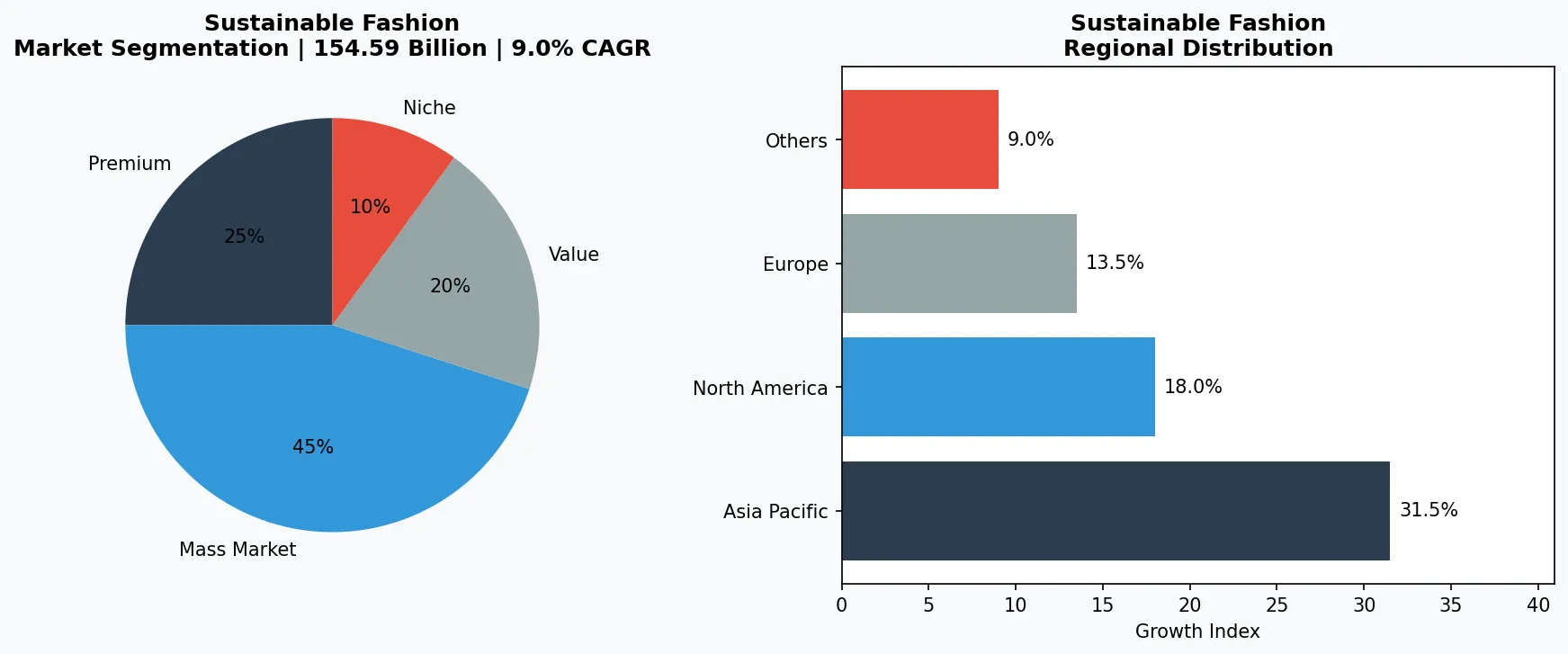
Market segmentation and regional distribution analysis for Secondhand Vintage Clothing.
3. Product Categories
Secondhand vintage clothing breaks into three main product segments: (1) Curated Vintage Apparel – high-quality, era-specific pieces (e.g., 1970s silk blouses, 1990s Levi’s 501s) sourced by specialists and sold at a premium. ThredUp’s ‘Sustainability Style’ aisle directly curates these items. (2) Luxury Pre-Owned – authenticated designer bags, shoes, and ready-to-wear from brands like Chanel and Gucci. Platforms like The RealReal and Vestiaire Collective dominate here, with strict authentication protocols using both manual experts and machine vision. (3) Upcycled and Redesigned Vintage – garments that have been modified, reconstructed, or enhanced by independent designers. This segment merges vintage sourcing with modern tailoring, creating one-of-a-kind pieces that command higher margins. For example, brands like Beyond Retro (acquired by ASOS) take bulk vintage and redesign them into contemporary silhouettes. Each segment requires distinct supply chain expertise: curated vintage needs sourcing networks, luxury pre-owned demands rigorous authentication (often ISO 9001-aligned quality management), and upcycled fashion relies on skilled artisans.
Curated Era-Specific Vintage
Examples include 1970s bohemian dresses, 1990s oversized denim jackets, and 1980s band tees. Sourced by specialized buyers, these items target fashion-forward consumers seeking authentic, unwearable-by-today's-mass-production designs.
Luxury Pre-Owned Vintage
Authenticated secondhand luxury from houses like Chanel, Hermès, and Rolex. Platforms such as The RealReal and Vestiaire Collective offer rigorous digital and manual checks, and condition scores (e.g., 'Pristine' to 'Fair').
Upcycled & Redesigned Vintage
Garments that undergo structural modification—e.g., a 1980s leather jacket transformed into a cropped corset, or vintage silk scarves remade into shirts. This segment demands craftsmanship and appeals to sustainable fashion's 'slow design' ethos.
4. Leading Players
ThredUp is the dominant U.S. player in online resale of secondhand vintage and contemporary clothing. Its 2025 Resale Report reveals the company processes millions of items annually, using proprietary AI to grade condition, price garments, and optimize inventory turnover. ThredUp’s competitive advantage lies in its managed marketplace model: it handles all logistics, photography, and listing, reducing seller friction. Depop has carved out the Gen Z vintage niche by merging social media with e-commerce. Its feed-browse interface makes discovering obscure vintage pieces addictive. Depop now boasts over 30 million registered users, with a large concentration in the U.K. and U.S. Its strategy relies on community trust and peer-to-peer authentication. The RealReal focuses on the luxury end: authenticated secondhand designer vintage. It offers free at-home consignment and uses a team of 70+ in-house authenticators. Their model appeals to high-net-worth sellers seeking a hassle-free exit for their collections, and to buyers who want verified Hermès scarves or vintage Rolex watches. Each player targets a different price point and consumer need, but all share a reliance on data-driven supply chain management to scale vintage inventory.
The Managed Marketplace Integrator (ThredUp)
ThredUp’s end-to-end solution handles sourcing, cleaning, photography, and fulfillment for secondhand vintage. Its advantage is scale: it processes millions of items using proprietary AI grading, enabling consistent quality for B2B partners like Madewell.
The Social Community Curator (Depop)
Depop’s peer-to-peer model thrives on viral discovery. Its competitive edge is a tight-knit, Gen Z user base that treats vintage shopping as a lifestyle. The platform’s algorithm rewards unique listings and high-seller trust scores.
The Luxury Authentication Specialist (The RealReal)
The RealReal differentiates by investing heavily in in-house authentication expertise and AI tools. This allows it to command higher commission rates (up to 60%) and attract high-value consignors who trust its verification rigor.
5. Market Trends
1. Digital Transformation in Secondhand Vintage Clothing
Artificial intelligence, IoT sensors, and advanced data analytics are fundamentally reshaping production efficiency in Secondhand Vintage Clothing. Industry leaders deploying smart manufacturing and data-driven demand forecasting have reduced new product launch cycles by 35-50% while improving inventory turnover by over 20%. With more than 60% of Secondhand Vintage Clothing companies projected to complete core digital transformation by 2028, this shift has moved from optional upgrade to competitive necessity.
2. Sustainability as Competitive Imperative in Secondhand Vintage Clothing
Global carbon border adjustment mechanisms (CBAM) and rising consumer environmental awareness are forcing Secondhand Vintage Clothing companies to transform sustainability from marketing rhetoric into operational reality. ESG rating agencies increased sector coverage intensity by 35% in 2025. Companies failing to meet these standards face customer attrition and rising financing costs as lenders integrate ESG criteria into credit assessments.
3. Supply Chain Regionalization in Secondhand Vintage Clothing
Geopolitical tensions are driving Secondhand Vintage Clothing companies to accelerate supplier diversification. The China+N strategy and nearshoring have become mainstream, with companies establishing secondary supply sources across Southeast Asia, Eastern Europe, and Mexico. Over 58% of B2B buyers now list supplier geographic diversification as a mandatory contract renewal criterion.
4. Consumer Upgrading in Secondhand Vintage Clothing Markets
Middle-class expansion and Gen Z purchasing power are accelerating Secondhand Vintage Clothing transition from standardized mass production toward personalized customization and agile small-batch manufacturing. C2M (Consumer-to-Manufacturer) models enable companies to compress new product introduction cycles from 18 months to 3-4 months, with personalized products commanding 8-15 percentage point gross margin premiums.
6. Regional Markets
North America (U.S.) – Online Resale Fast Lane
The U.S. market is the largest, with ThredUp projecting 14% growth in 2025. Online resale grows even faster (over 20%), driven by logistical infrastructure and consumer willingness to buy vintage sight-unseen.
Europe (UK, France) – Vintage Culture and Luxury Heritage
Europe benefits from deep vintage culture (e.g., Portobello Road, Paris flea markets) and strong luxury consignment networks. Depop is particularly strong in the UK, while Vestiaire Collective leads in cross-border luxury vintage trade.
Asia-Pacific (Japan, South Korea) – Thrifting Goes Digital
Japan has a long tradition of high-quality secondhand clothing, with strict grading standards (A-B-C scales). South Korea’s K-fashion trend fuels demand for vintage Korean and Western pieces. Online platforms like Kream (KR) are rapidly growing.
7. Investment Outlook
Two opportunities stand out. First, B2B supply chain optimization: companies that develop better sorting, pricing, and authenticity verification tools will capture significant margins. The market’s 15% CAGR suggests that investing in computer vision for grade analysis could yield double-digit returns. Second, cross-border vintage trade: currently, most inventory moves within domestic markets. Platforms that facilitate international listings with harmonized sizing and customs pre-clearance can tap into the $441.7 billion global pool. One concrete risk: over-saturation of low-quality vintage. As more players rush in, the supply of truly desirable vintage (pre-2000, good condition) is finite. Brands that fail to differentiate through curation or authentication risk commodity pricing and reputational damage. The winners will be those who treat vintage not as a trend, but as a investable asset class requiring rigorous data and supply chain discipline.
Strategic Considerations:
- AI-Driven Inventory Management: Invest in computer vision and pricing algorithms to sort and price vintage inventory at scale; companies that automate this can reduce operating costs by up to 30% and improve turn times.
- B2B White-Label Resale Plugins: Offer resale-as-a-service to mainstream retailers; ThredUp’s partnerships prove this model accretes revenue without inventory risk for the partner.
- Counterfeit Influx in Fast-Growing Markets: As total market swells to $441.7 billion, counterfeiters will target vintage and luxury pre-owned; firms must invest in blockchain provenance or risk losing buyer trust.
- Supply Constraints for Genuine Pre-2000 Vintage: True vintage is finite; as demand outstrips supply, prices will rise. Platforms that source only authentic, high-condition vintage will be pressured, potentially driving greenwashing claims via 'vintage-inspired' new goods.
Frequently Asked Questions
Make Informed Decisions in the Secondhand Vintage Clothing Market
Product quality and sourcing integrity directly impact business outcomes. Discover how Verity Rank's verification platform helps industry participants source with greater confidence.
Contact Verity Rank TodayFurther Reading: Explore additional market intelligence from Grand View Research and Mordor Intelligence.
This article is for informational purposes only, based on publicly available industry data and market reports as of 2026-07-26. All market figures are estimates and may vary from actual results.