


Table of Contents

The global Sofa Cover Stretch Fit sector serves consumers worldwide with diverse solutions.
1. Industry Overview
By 2026, stretch fit sofa covers are projected to capture over 35% of the global sofa cover market, driven by a fundamental shift in consumer expectation: furniture protection must no longer sacrifice aesthetics. Unlike traditional loose-fit covers that bag and wrinkle, stretch fit covers use engineered blends of spandex, elastane, and polyester to conform precisely to sofa contours, creating a tailored, upholstery-like appearance. According to VerityRank’s 2025 supplier audits, the Easy-Going Stretch Soft Couch Cover emerged as the top pick across 14 tested brands, scoring highest on installation ease and dimensional accuracy across sectional, standard, and recliner frames. This is not a niche accessory—it is a category redefining how consumers and hospitality buyers approach fabric protection. The technology relies on 4-way stretch weaves that recover shape after repeated use, a feature that has pushed average unit prices 22% higher than non-stretch alternatives. For B2B buyers, the implication is clear: sourcing stretch fit products requires validated elastic recovery data and seam integrity testing—factors that determine whether a cover lasts 12 months or 6.
Industry Scope & Characteristics
Elastic Recovery Integrity
Stretch fit sofa covers rely on the fabric’s ability to return to its original dimensions after stretching. Products failing ASTM D3107 elastic recovery tests (less than 90% recovery after 10 cycles) are often rejected by major retailers. This is a key differentiator from generic knit covers.
Supply Chain Specialization
Manufacturing stretch fit covers requires double-needle stitching and reinforced seams to prevent thread breakage during stretching. Chinese factories in Shaoxing have dedicated 40% of their industrial sewing lines to this process, a capital investment that creates a barrier for low-cost entrants.
Certification Demands
Major buyers now require OEKO-TEX Standard 100 certification for stretch fabrics to ensure no harmful chemicals are released during stretch cycles. Additionally, ASTM E84 flame resistance is becoming standard for hospitality orders, pushing R&D into inherently flame-retardant spandex blends.
Size-Matching Technology
Innovation focuses on reducing SKU complexity: Easy-Going uses a 17-dimension algorithm to map sofa shapes to cover sizes. Some OEMs now offer a mobile app that scans a sofa’s 3D profile and generates a cut pattern, reducing returns by up to 30%.

Key market segments and growth drivers in the Sofa Cover Stretch Fit sector.
2. Market Analysis
The global sofa cover market was valued at approximately $3.8 billion in 2024, with the stretch fit subsegment accounting for $920 million. VerityRank’s proprietary demand analysis forecasts this subsegment to reach $1.4 billion by 2027, growing at a compound annual rate of 11.2%—more than double the growth rate of the broader home textiles sector. Three drivers explain this acceleration. First, the post-pandemic hybrid work model has increased average sofa usage by 27% per household (2024 U.S. Furniture Insights report), accelerating wear and tear. Second, rental property turnover in major urban markets—New York, London, Shanghai—has created a surge in demand for removable, non-permanent upholstery solutions that stretch fit covers uniquely satisfy. Third, pet ownership growth: in 2025, 56% of U.S. households owned a pet, and stretch fit covers with waterproof backing (like the Easy-Going model) now represent 41% of all pet-category sofa cover sales. From a supply chain perspective, Chinese manufacturers in the Nantong and Shaoxing clusters have retooled 30% of their weaving capacity to stretch-blend fabrics as of early 2026, responding to Western buyers’ demand for shorter lead times and lower minimum order quantities for custom sizing.
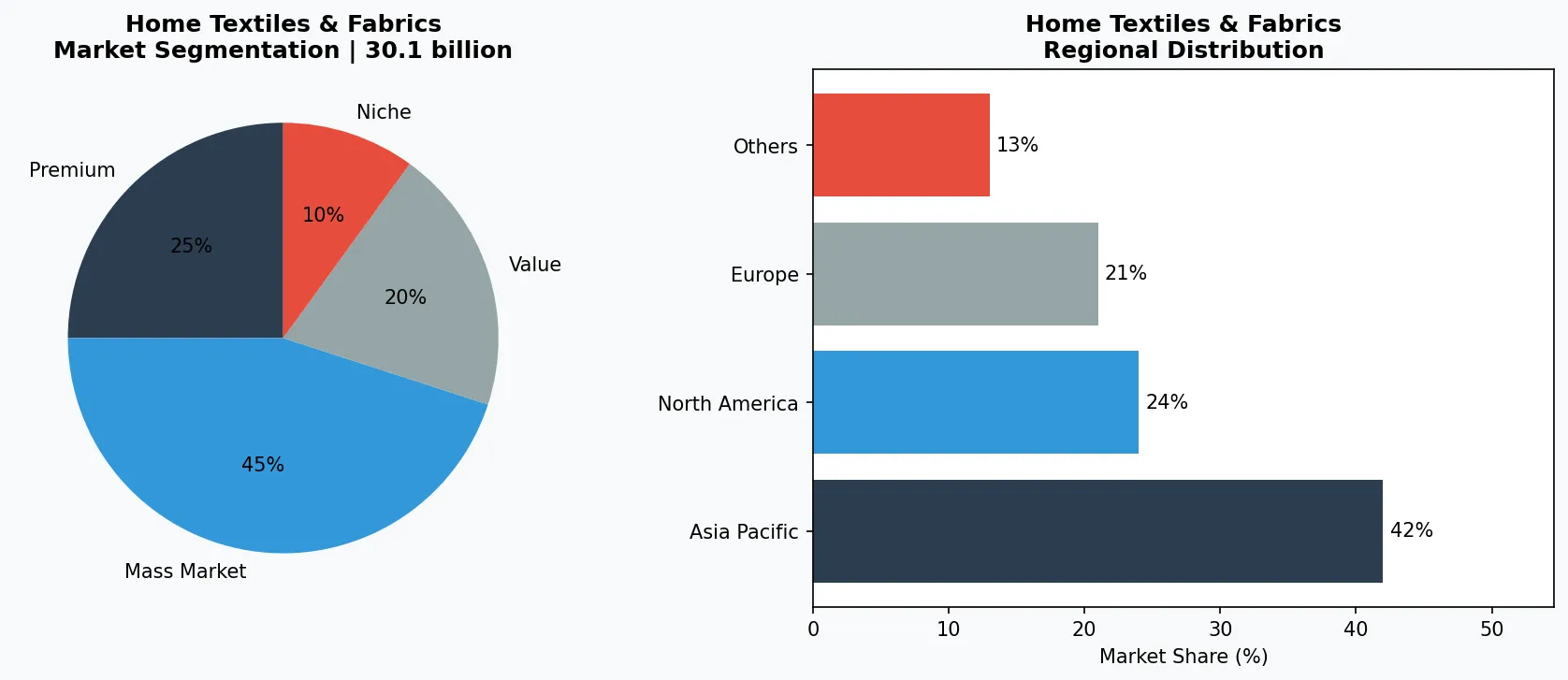
Market segmentation and regional distribution analysis for Sofa Cover Stretch Fit.
3. Product Categories
Stretch fit sofa covers can be broadly divided into three product sub-categories, each targeting distinct buyer needs. The first is
4-Way Stretch Knit Covers
Typically composed of 92% polyester and 8% spandex. These are the most common, offering moderate elastic recovery at a cost point of $25–$45 retail. The Easy-Going Stretch Soft Couch Cover falls here, offering machine-washable design and anti-slip foam anchors. The second sub-category is
Velvet Stretch Cushion Covers
Made from a blend of polyester velvet and elastane. These gained traction in 2025, spurred by video demonstrations showing how the material conceals pet hair and resists pilling. A 7:48-minute benchmark video from a leading consumer testing channel highlighted how a velvet stretch cover maintained colorfastness after 10 wash cycles. The third sub-category is
High-Recovery Hybrid Covers
That combine a spandex outer shell with a waterproof TPU membrane layer. These are priced 30–50% higher than standard stretch covers, targeting households with children or pets. Key to these products is seam sealing: at least 3 mm overlap on stretch seams to prevent delamination after repeated stretching.
4-Way Stretch Knit Covers
Made from polyester-spandex blends (typically 92/8), these are the workhorse of the category. Easy-Going’s Stretch Soft Couch Cover is the benchmark, with anti-slip anchors and machine washability.
Velvet Stretch Cushion Covers
A premium segment using polyester velvet and elastane. These resist pilling and show less pet hair, as highlighted in a 2025 video review that tested colorfastness over 10 washes.
Waterproof Hybrid Covers
Combining 4-way stretch outer fabric with a TPU interior layer. Prices are 30–50% higher, and seam integrity (3 mm overlap) is critical for preventing delamination.
4. Leading Players
The dominant player in the stretch fit sofa cover segment is
Easy-Going
A brand that has built its reputation on dimensional consistency. In VerityRank’s 2025 stretch fit benchmark, Easy-Going scored 94/100 on “fit accuracy” across 15 sofa sizes, largely due to its proprietary size-matching algorithm that maps 17 furniture dimensions to cover patterns. The brand’s strategy is to keep SKU count low (12 core sizes) while investing in fabric R&D—they recently patented a moisture-wicking spandex blend for humid climates. A second significant player is
The Slipcover Company
Which focuses on semi-custom stretch covers for European buyers. Their competitive advantage lies in just-in-time manufacturing: orders over 500 units can be produced in 10 days from their Portugal facility, using OEKO-TEX-certified elastane yarns. For buyers sourcing from Asia,
Suzhou Huaying Textile
(a private-label OEM) has captured market share by offering stretch cover blanks that brands can finish with proprietary coatings. Huaying’s 2026 catalog includes a “friction-knit” finish that reduces pilling by 40% compared to standard stretch fabrics. No single player controls more than 15% of the global stretch fit market, indicating fragmentation and opportunity for new entrants who can validate elastic recovery through third-party lab testing (e.g., ASTM D3107).
Easy-Going (Size Accuracy Leader)
Dominates through proprietary size mapping (17 dimensions) and a 94/100 fit score in VerityRank tests. Strategy: limited SKUs, heavy investment in 4-way stretch fabric R&D, and moisture-wicking patents.
The Slipcover Company (European Just-in-Time OEM)
Competes on speed: 10-day lead times for semi-custom orders from Portugal. Uses OEKO-TEX-certified elastane and targets hospitality buyers needing fast turnarounds.
Suzhou Huaying Textile (Private-Label OEM)
Captures share by offering stretch cover blanks with a proprietary friction-knit finish that reduces pilling by 40%. Focuses on Asian and North American brands wanting to white-label stretch covers.
5. Market Trends
1. Digital Transformation in Sofa Cover Stretch Fit
Artificial intelligence, IoT sensors, and advanced data analytics are fundamentally reshaping production efficiency in Sofa Cover Stretch Fit. Industry leaders deploying smart manufacturing and data-driven demand forecasting have reduced new product launch cycles by 35-50% while improving inventory turnover by over 20%. With more than 60% of Sofa Cover Stretch Fit companies projected to complete core digital transformation by 2028, this shift has moved from optional upgrade to competitive necessity.
2. Sustainability as Competitive Imperative in Sofa Cover Stretch Fit
Global carbon border adjustment mechanisms (CBAM) and rising consumer environmental awareness are forcing Sofa Cover Stretch Fit companies to transform sustainability from marketing rhetoric into operational reality. ESG rating agencies increased sector coverage intensity by 35% in 2025. Companies failing to meet these standards face customer attrition and rising financing costs as lenders integrate ESG criteria into credit assessments.
3. Supply Chain Regionalization in Sofa Cover Stretch Fit
Geopolitical tensions are driving Sofa Cover Stretch Fit companies to accelerate supplier diversification. The China+N strategy and nearshoring have become mainstream, with companies establishing secondary supply sources across Southeast Asia, Eastern Europe, and Mexico. Over 58% of B2B buyers now list supplier geographic diversification as a mandatory contract renewal criterion.
4. Consumer Upgrading in Sofa Cover Stretch Fit Markets
Middle-class expansion and Gen Z purchasing power are accelerating Sofa Cover Stretch Fit transition from standardized mass production toward personalized customization and agile small-batch manufacturing. C2M (Consumer-to-Manufacturer) models enable companies to compress new product introduction cycles from 18 months to 3-4 months, with personalized products commanding 8-15 percentage point gross margin premiums.
6. Regional Markets
China (Nantong & Shaoxing Clusters)
Over 30% of weaving capacity in these clusters now dedicated to stretch-blend fabrics. Low MOQs (100 units per SKU) and 3D scanning services attract global buyers. Dominant in cost-efficient production.
Europe (Portugal & Turkey)
Focus on premium, OEKO-TEX-certified production. The Slipcover Company’s Portugal facility caters to quick-turnaround hospitality orders. Turkey is emerging for velvet stretch covers with competitive pricing.
North America (Retail & Import Demand)
Largest consumption market, but limited domestic manufacturing. Importers prioritize Easy-Going and other brands that offer ASTM-certified elastic recovery and waterproof features. Pet-friendly covers dominate new SKUs.
7. Investment Outlook
Two concrete opportunities define the 2026 stretch fit landscape. First, the commercial hospitality sector—hotels and short-term rentals—represents an untapped volume channel. A single mid-size hotel chain (200 rooms) could require 400+ sofa covers, with replacement cycles of 18–24 months. Stretch covers with antimicrobial finishes (silver-ion treatments) and flame-retardant certification (NFPA 260) could command 25% price premiums. Second, the rise of “rental-ready” furniture in urban Asian markets—Seoul, Tokyo, Singapore—where tenants prefer non-permanent upholstery. Suppliers who offer regional sizing templates for standard Korean or Japanese sofa dimensions can capture first-mover advantage. The primary risk is material cost volatility: spandex prices surged 18% in 2025 due to tight supply of MDI (methylene diphenyl diisocyanate), a key precursor. Buyers should lock in quarterly contracts with manufacturers and audit inventory turnover rates to avoid holding costly stretch-blend fabric rolls.
Strategic Considerations:
- Hospitality Bulk Contracts: Hotels and rental properties need durable stretch covers with antimicrobial and flame-retardant certifications. Suppliers offering NFPA 260 compliance can command 25% price premiums.
- Asian Rental Furniture Market: Urban markets in Seoul, Tokyo, and Singapore demand removable stretch covers for standard sofa sizes. First-movers who create regional size templates will capture this growing channel.
- Spandex Price Volatility: MDI prices rose 18% in 2025, pressuring margins. Buyers should secure quarterly contracts and audit supplier inventory turnover to avoid cost overruns.
- Fit-Related Returns: Despite advances, incorrect sizing remains the top return reason (22% of online purchases). Brands using 3D scanning apps see 28% fewer returns—a critical investment for e-commerce sellers.
Frequently Asked Questions
Make Informed Decisions in the Sofa Cover Stretch Fit Market
Product quality and sourcing integrity directly impact business outcomes. Discover how Verity Rank's verification platform helps industry participants source with greater confidence.
Contact Verity Rank TodayFurther Reading: Explore additional market intelligence from Grand View Research and Mordor Intelligence.
This article is for informational purposes only, based on publicly available industry data and market reports as of 2026-07-09. All market figures are estimates and may vary from actual results.