

Table of Contents

The global Sports & Outdoor Gear industry serves consumers worldwide with diverse solutions.
1. Industry Overview
Over 52% of what? That's the untold story behind the outdoor gear market's explosive growth, a figure representing the surge in global participation in hiking, camping, and adventure sports. This isn't just a niche hobby sector; it's a powerful economic engine within the broader textile and apparel industry, distinguished by its fusion of performance technology, lifestyle branding, and a fundamental shift towards health-conscious living. The industry has moved decisively beyond basic sportswear into a realm of smart, sustainable, and experience-driven consumer products.
Industry Scope & Characteristics
Broad Product Portfolio
Products span sportswear, sports shoes, fitness equipment, yoga mats, hiking backpacks, tents, sleeping bags, serving diverse consumer needs from everyday essentials to premium specialized offerings.
Complex Global Supply Chains
Integrated international networks spanning multiple continents ensure year-round product availability across diverse markets.
Quality & Compliance Standards
Rigorous regulatory frameworks and quality certifications ensure product safety, consistency, and consumer trust worldwide.
Continuous Innovation
Heavy R&D investment drives formulation breakthroughs, processing technologies, and novel product development cycles.
Historically, the sector bifurcated into athletic performance and rugged outdoor survival. The defining recent shift is the convergence of these segments. Yoga mats are used for home fitness and park picnics; hiking jackets are worn as urban fashion; and smartwatches track both marathon training and daily step counts. This blurring of lines has created a larger, more dynamic market where functionality meets everyday life.
This convergence is backed by formidable numbers. The core sports and fitness wear segment alone is on a strong trajectory, growing from $75.21 billion in 2025 to $79.32 billion in 2026 at a compound annual rate. Meanwhile, the specialized outdoor equipment segment in the United States is projected for even faster expansion at 8.9% annually from 2026 to 2033. This dual-engine growth underscores the industry's resilience and its central role in the modern consumer economy.

Key market segments and growth drivers in the Sports & Outdoor Gear sector.
2. Market Analysis
The sports and fitness wear market's climb to $79.32 billion in 2026 is the headline figure, but it's just one part of a broader, multi-faceted growth story. This expansion is driven by several powerful, quantifiable forces. First, the post-pandemic prioritization of health and wellness continues to fuel spending on home fitness equipment and performance apparel, creating a sustained baseline of demand.
Second, the 'experience economy' is a critical driver, with over half of the outdoor gear market's growth linked directly to increasing participation in activities like hiking and camping. Consumers are investing in gear that enables adventures, from premium tents to technical backpacks. Third, technological integration is creating new revenue streams, as wearable tech and smart fitness devices become essential accessories, adding a high-margin layer to traditional product categories.
Geographically, the market is not monolithic. The United States remains the dominant force, with its outdoor gear and equipment segment showcasing robust 8.9% projected growth. However, the Asia-Pacific region, led by China and powered by domestic giants like Li-Ning and Anta, represents the most dynamic growth frontier. These markets are seeing rapid urbanization coupled with a rising middle class that is enthusiastically embracing both athletic lifestyles and outdoor recreation, creating a dual demand surge.
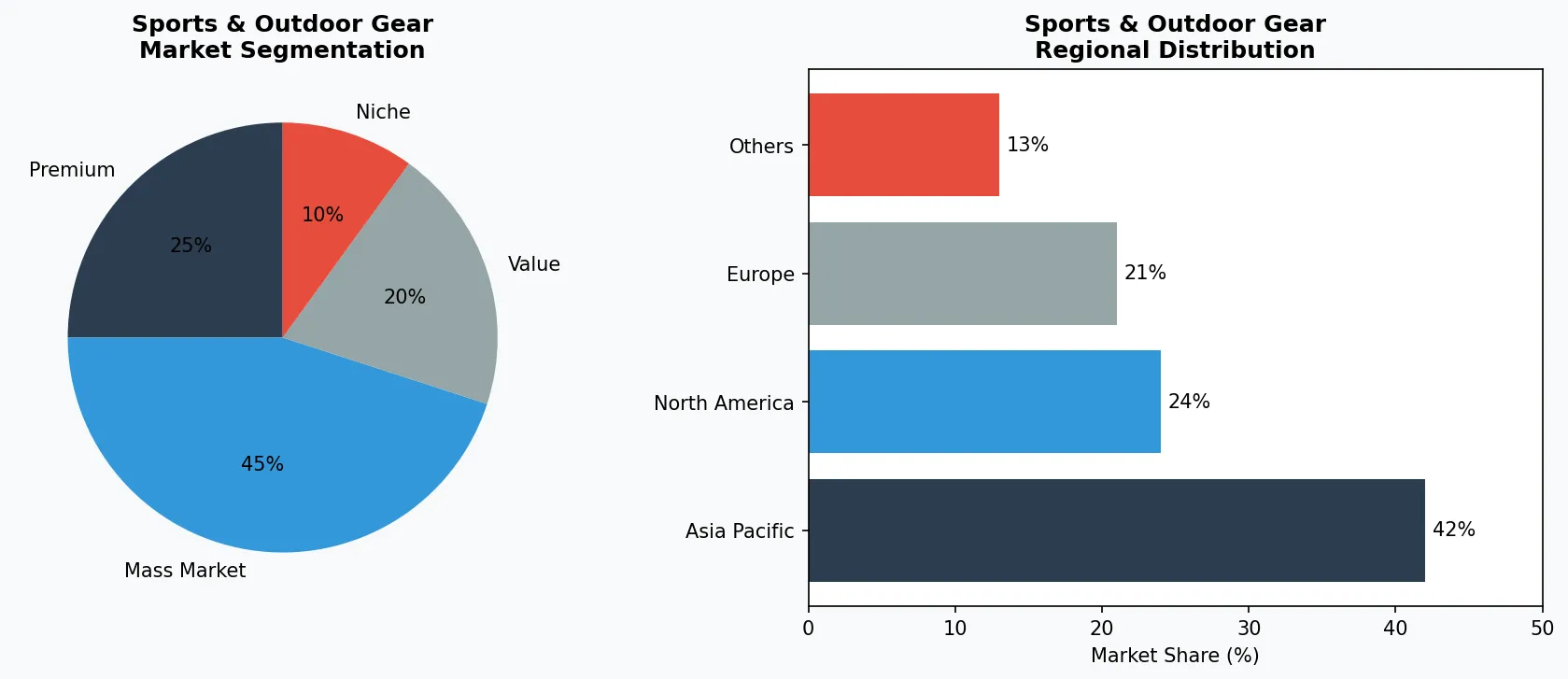
Market segmentation and regional distribution analysis for Sports & Outdoor Gear.
3. Product Categories
The industry's product landscape is strategically segmented into performance apparel, footwear, hardgoods equipment, and experiential gear. Performance apparel, led by giants like Nike and Adidas, encompasses everything from moisture-wicking sportswear to insulated jackets from The North Face. This category is the revenue workhorse, constantly innovating with fabrics and fits.
Premium & Artisanal Tier
High-margin specialty products targeting affluent consumers who prioritize quality, craftsmanship, and unique attributes.
Mass Market Mainstream
Volume-driven products serving price-conscious mainstream consumers with reliable quality at accessible price points.
Functional & Niche Segment
Targeted products addressing specific health concerns, dietary requirements, or lifestyle preferences beyond basic needs.
Footwear represents a high-stakes, technology-intensive battleground. It spans specialized running shoes from Adidas with carbon-fiber plates to durable hiking boots from Columbia. Innovation here focuses on biomechanics, material science, and sustainability, with each launch capable of shifting market share.
Hardgoods and experiential gear form the ecosystem that enables activity. This includes fitness equipment like adjustable dumbbells and smart stationary bikes, as well as outdoor essentials such as hiking backpacks, lightweight tents, and temperature-rated sleeping bags. Brands like Decathlon have mastered this category by offering reliable, multi-functional equipment at accessible price points, democratizing access to sports and the outdoors.
4. Leading Players
Nike continues to leverage its unmatched brand marketing and direct-to-consumer digital strategy to maintain premium positioning. Its focus on innovation cycles, like its Move to Zero sustainability initiative and investment in digital fitness platforms, aims to create an integrated ecosystem beyond physical product sales.
Global Market Leader
Multinational player commanding significant market share. Revenue exceeding $50B with operations across 100+ countries, diversified portfolio spanning all major price tiers.
Regional Champion
Dominant force in Asia Pacific with deeply localized product lines, extensive distribution networks, and strong regional retailer relationships.
Innovation Disruptor
Fast-growing challenger disrupting incumbents through breakthrough product innovation, direct-to-consumer models, and data-driven marketing in the sports & outdoor gear space.
Adidas counters with strong partnerships in football (soccer) and a deep commitment to material innovation, such as its Futurecraft.Loop recyclable sneaker project. The brand is aggressively pursuing a circular economy model to appeal to environmentally conscious consumers while maintaining its performance credibility.
Decathlon operates on a fundamentally different axis. As the world's largest sporting goods retailer, its strategy is vertical integration and volume. By designing, manufacturing, and selling its own extensive range of affordable brands under one roof, it captures the entire value chain and serves as the entry point for millions of new participants globally.
5. Market Trends
1. Smart fitness and wearable tech integration is no longer a n...
Smart fitness and wearable tech integration is no longer a novelty but a baseline expectation. Devices that track biometrics, sync with apps, and provide personalized coaching are becoming standard. This matters because it transforms passive gear into an interactive service, increasing brand loyalty and customer lifetime value. Nike's investment in its Training Club app and Adidas' partnership with Zwift are clear plays in this space.
2. The demand for eco-friendly and sustainable outdoor gear is ...
The demand for eco-friendly and sustainable outdoor gear is reshaping material sourcing and brand narratives. Consumers are scrutinizing supply chains, demanding recycled materials, and durable, repairable products. This trend matters for risk management and brand equity. Patagonia's Worn Wear repair program and commitment to environmental activism, though not in the leading players list, set an industry benchmark that pressures all major brands to follow.
3. Multi-functional equipment design addresses the urban consum...
Multi-functional equipment design addresses the urban consumer's desire for versatility and space efficiency. Products that transition seamlessly from gym to trail to city street are winning. This matters as it maximizes usage occasions and perceived value. Columbia's interchangeable jacket systems and the proliferation of hybrid training shoes that work for both road running and gym sessions exemplify this trend.
6. Regional Markets
North America, particularly the United States, is the established powerhouse with mature but growing markets. The U.S. outdoor gear segment's projected 8.9% annual growth from 2026 signals sustained, high-value demand from consumers who view outdoor recreation as a core part of their identity and are willing to invest in premium, technical products.
Asia Pacific — The Growth Engine
The world's largest and fastest-growing region, led by China, India, and Southeast Asia. Urbanization, rising middle class, and digital retail adoption are primary catalysts.
North America — Premium & Wellness Driven
A mature market with strong health-and-wellness orientation, sustainability commitments, and robust demand for premium and functional products.
Europe — Quality & Regulatory Leadership
A developed market with stringent quality, safety, and environmental regulations. Strong demand for organic, locally sourced, and ethically certified products.
Europe presents a mixed landscape of premium innovation and value retail. Markets like Germany and the UK have strong traditions in outdoor sports, supporting brands like Adidas. Meanwhile, Decathlon's French-origin model has achieved massive penetration across the continent by focusing on accessibility, effectively growing the total addressable market for sports participation.
The Asia-Pacific region, led by China, is the critical growth engine. Here, rising disposable incomes, government promotion of sports, and a burgeoning outdoor culture are converging. Domestic champions Li-Ning and Anta are not only capturing this homegrown demand but are also expanding globally, challenging the historical dominance of Western brands and reshaping competitive dynamics.
7. Investment Outlook
Two specific opportunities stand out. First, the integration of Artificial Intelligence into wearable tech and fitness apps presents a massive upside for personalized coaching, injury prevention, and dynamic product recommendations, creating sticky, subscription-based revenue models. Second, the untapped potential in emerging Southeast Asian markets like Vietnam and Indonesia offers a long-term growth runway, as their middle classes expand and recreational infrastructure develops.
The most concrete risk is supply chain volatility and material cost inflation, exacerbated by the industry's dual reliance on technical synthetic fabrics (often petroleum-based) and natural materials like cotton and down. Geopolitical tensions, trade policy shifts, and climate-related disruptions to raw material production could severely compress margins and delay the innovation cycles that drive consumer upgrades. Navigating this while meeting sustainability pledges will be the paramount operational challenge for the decade ahead.
Strategic Considerations:
- ('Technology & AI Integration:', 'Artificial intelligence and IoT are revolutionizing production efficiency, quality assurance, and demand forecasting across the supply chain.')
- ('Sustainability as Business Strategy:', 'Regulatory pressure and consumer expectations are making environmental commitments essential, not optional.')
- ('Transparency & Traceability:', 'Consumers demand increasingly granular information about product origins, ingredients, and production methods.')
- ('Emerging Market Penetration:', 'Africa, Latin America, and second-tier Asian cities represent the next wave of volume growth.')
Make Informed Decisions in the Sports & Outdoor Gear Market
Product quality and sourcing integrity directly impact business outcomes. Discover how Verity Rank's verification platform helps industry participants source with greater confidence.
Contact Verity Rank TodayFurther Reading: Explore additional market intelligence from Grand View Research and Mordor Intelligence.
This article is for informational purposes only, based on publicly available industry data and market reports as of 2026-04-13. All market figures are estimates and may vary from actual results.