

Table of Contents

The global Sustainable Fashion Eco Materials sector serves consumers worldwide with diverse solutions.
1. Industry Overview
By 2040, the global sustainable fashion market is expected to hit $46 billion, but the real revolution isn't in silhouettes or branding—it's in the threads. Eco materials—recycled cotton, organic cotton, recycled polyester, and regenerated fibers—are the literal fabric of change. In 2026, the segment for recycled cotton and polyester alone will command a 53.46% market share, underscoring that material innovation, not just marketing, is where value is being created. The sustainable fashion ecosystem is pivoting from 'green claims' to measurable material inputs. Eco materials are distinct because they address the industry's twin crises: resource depletion and textile waste. Unlike conventional fashion, which relies on virgin petrochemicals and water-intensive cotton, eco materials either divert waste from landfills or regenerate natural resources. The market for these materials is projected to grow from $10.12 billion in 2026 to $19.85 billion by 2033, a compound annual growth rate (CAGR) of 10.1%. This growth is fueled by tightening EU regulations, corporate net-zero commitments, and a generation of consumers who can now read a fiber content label as fluently as a nutrition fact.
Industry Scope & Characteristics
Material Traceability is Non-Negotiable
Eco materials products must be verifiable at every stage. Recycled polyester requires chain-of-custody certification (e.g., SCS Recycled Content) to claim post-consumer content. Smart tags and digital IDs are becoming standard.
Close-Loop Manufacturing Cycles
Unlike conventional textile mills, eco-material production often integrates mechanical recycling on-site. Lenzing's lyocell process, for example, recycles 99% of water and solvents within a closed loop, drastically reducing effluent.
Multi-Certification Compliance
A single fabric can require GOTS for organic fibers, Oeko-Tex Standard 100 for harmful substances, and ISO 14001 for environmental management. B2B buyers must audit suppliers against at least two of these standards to avoid greenwashing.
Digital Fabric Passports
Innovations like FibreTrace embed microscopic pigments into fibers that can be scanned along the supply chain. This allows buyers to verify recycled content and origin in real time, a leap forward from paper certificates.

Key market segments and growth drivers in the Sustainable Fashion Eco Materials sector.
2. Market Analysis
The sustainable fashion market's expansion is being led by its material segment. In 2026, recycled cotton and recycled polyester will hold a dominant 53.46% share, driven by their compatibility with existing supply chains and lower carbon footprints compared to virgin equivalents. The broader market is set to climb from $11 billion in 2026 to $46 billion by 2040, representing a robust CAGR of 10.81%. Meanwhile, supplementary forecasts peg the annual growth rate between 6.8% and 10% through 2033, with the market reaching $2.5 billion to $3.2 billion by the end of 2026 alone. Three forces are accelerating this: first, the EU Strategy for Sustainable and Circular Textiles, which mandates recycled content in apparel by 2030; second, the cost parity achieved by mechanical recycling of cotton and polyester through scale; and third, the rise of 'material-first' brands that source only certified eco inputs. Notably, the alternative fibers segment—hemp, lyocell, and mushroom leather—is growing at over 15% annually, though from a smaller base. B2B buyers should note that price premiums for eco materials have narrowed from 30-40% in 2020 to 10-20% in 2025, making them commercially viable for mass-market retailers.
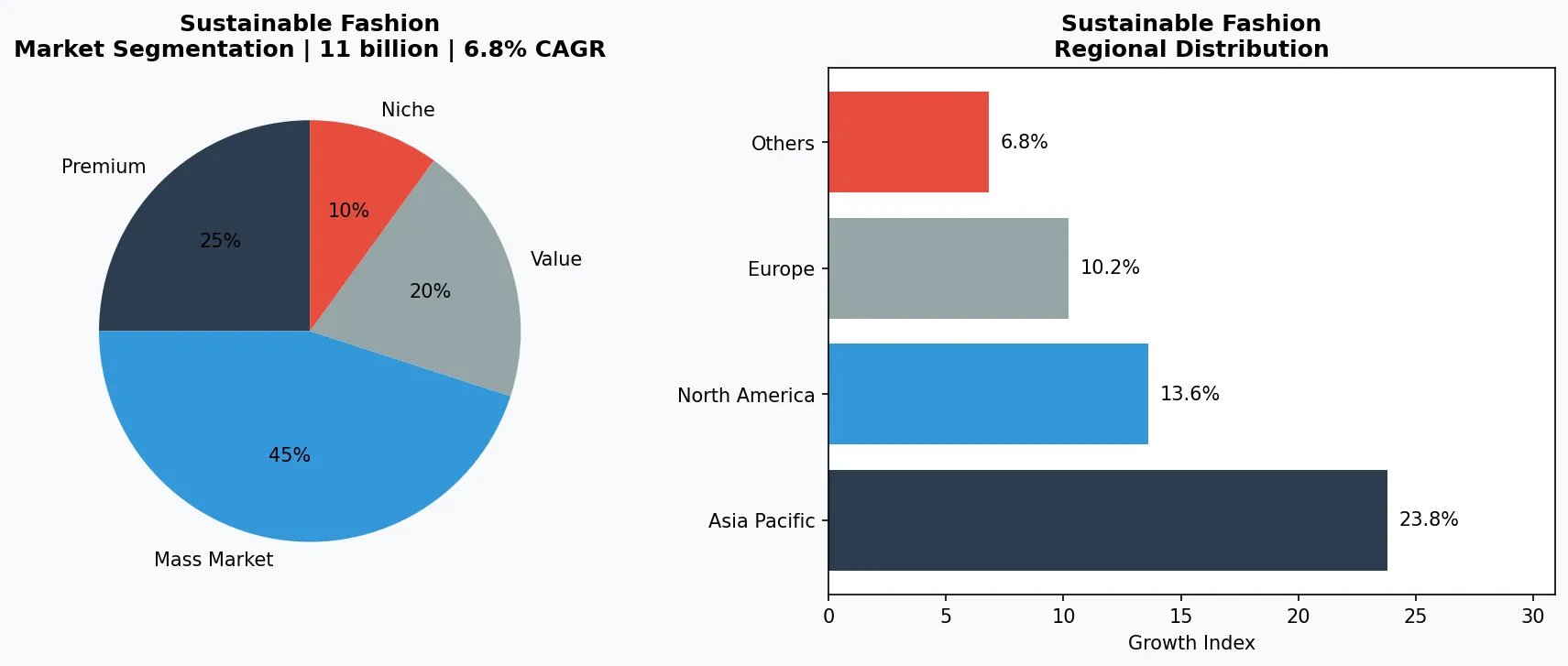
Market segmentation and regional distribution analysis for Sustainable Fashion Eco Materials.
3. Product Categories
Recycled Fabrics
The backbone of the eco materials market. Recycled polyester (rPET) is produced from post-consumer plastic bottles or post-industrial textile waste. Brands like Patagonia and Nike have embedded rPET into their core lines, reducing energy use by nearly 60% compared to virgin polyester. Recycled cotton is mechanically shredded from pre- and post-consumer garments, then re-spun. It's 50% less water-intensive than conventional cotton.
Organic Fabrics
Grown without synthetic pesticides or fertilizers, organic cotton accounts for roughly 1% of global cotton production but commands premium channels. Certification by GOTS (Global Organic Textile Standard) ensures traceability from field to finished fabric. Eileen Fisher has built its entire supply chain around organic cotton and linen.
Regenerated and Alternative Fibers
Man-made cellulosics like Tencel (lyocell) from Lenzing use closed-loop solvent recovery, achieving 99% water reuse. Hemp and linen are returning as high-durability, low-impact alternatives. Stellamccartney uses Econyl, a regenerated nylon from ocean waste.
Upcycled Fashion
Unlike recycling, upcycling transforms waste materials into higher-value products without degrading the fiber. Brands like Reformation and MUD Jeans design collections around deadstock fabrics and post-consumer denim.
Recycled Synthetic Fibers (rPET, Econyl)
Post-consumer plastic bottles and discarded fishing nets are mechanically or chemically recycled into polyester and nylon. Examples include rPET fleece from Patagonia and Econyl swimwear from Stella McCartney.
Organic Natural Fibers (GOTS Cotton, Hemp, Linen)
Grown without synthetic pesticides or fertilizers, these fibers meet Global Organic Textile Standard (GOTS) certification. Eileen Fisher sources 100% organic cotton for its core collection.
Regenerated Cellulosics (Tencel Lyocell, Modal, Refibra)
Derived from sustainably harvested wood pulp using closed-loop solvent recovery. Lenzing's Refibra incorporates recycled cotton scraps. Used by Reformation and H&M Conscious.
4. Leading Players
Patagonia
The outdoor apparel pioneer has embedded recycled materials into its supply chain for over 30 years. Its strategy revolves around 'Worn Wear' repair programs and using 100% recycled polyester in most fleece products. Patagonia's advocacy for the 1% for the Planet and its B Corp certification reinforce its material-first credibility.
Eileen Fisher
This womenswear brand operates a closed-loop circular economy: its 'Renew' program takes back worn garments, recycles them into new pieces, and sources 100% organic cotton and linen. The company's commitment to Global Organic Textile Standard (GOTS) and bluesign® certified dyes sets a benchmark for chemical management in eco materials.
Lenzing AG
As the world's largest producer of lyocell (Tencel) and modal, Lenzing supplies eco fibers to major retailers including H&M and Levi's. Its closed-loop production process recovers 99% of solvents, and its 'Eco Balance' certification provides verified lifecycle data. Lenzing's innovation pipeline includes 'Refibra', a fiber incorporating recycled cotton scraps from garment cutting.
Reformation
A fast-growing direct-to-consumer brand that uses upcycled deadstock fabrics and Tencel. Reformation publishes a 'RefScale' report for every product, detailing water and carbon savings compared to industry averages. Its data-driven approach to material sourcing appeals to B2B buyers seeking transparency in eco claims.
The Vertical Integrator (Patagonia)
Controls material sourcing from resin to finished garment, enabling full traceability and cost efficiency. Its in-house recycled fleece program reduces virgin petroleum use by 60% per jacket.
The Circular Design Lab (Eileen Fisher)
Operates a closed-loop take-back program that mechanically recycles worn garments into new fibers. Its 'Renew' initiative keeps textiles out of landfills and earns B Corp status.
The Material Innovator (Lenzing AG)
Invests heavily in R&D for low-impact cellulose fibers. Their Tencel brand is the gold standard for eco-friendly man-made fibers, with refibra technology that diverts textile waste.
5. Market Trends
1. CIRCULAR MATERIAL SYSTEMS
What it is: Brands moving from linear take-make-waste to closed-loop models where materials are endlessly cycled through mechanical or chemical recycling. Why it matters: It reduces virgin resource extraction and keeps textiles out of landfills. Patagonia's Worn Wear program and Renewcell's Circulose pulp are leading examples.
2. BIO-BASED AND FERMENTED FIBERS
What it is: Fibers derived from agricultural waste, fungi, or microbial fermentation, such as mushroom leather (MycoWorks) and pineapple leaf fiber (Piñatex). Why it matters: They offer animal-free, low-carbon alternatives to leather and synthetics. Adidas partnered with Bolt Threads to create a mushroom-based shoe upper.
3. DIGITAL MATERIAL TRACEABILITY
What it is: Blockchain and AI platforms that track eco materials from source to final product, providing verifiable proof of recycled or organic content. Why it matters: Prevents greenwashing and satisfies EU Digital Product Passport requirements. TextileGenesis and FibreTrace are used by brands like Puma and Kering.
4. CHEMICAL RECYCLING OF POLYESTER
What it is: Depolymerizing post-consumer polyester into virgin-quality monomers, then re-spinning into new fiber. Why it matters: Unlike mechanical recycling, chemical recycling can handle blended fabrics and maintain fiber integrity. Eastman's Naia Renew and Loop Industries are scaling this technology.
6. Regional Markets
Europe – Regulatory Leader and High Adoption
The EU's Textiles Strategy and Digital Product Passport mandate recycled content by 2030. European brands like H&M and Inditex are already sourcing 50%+ recycled materials for their mainstream lines.
North America – Brand-Driven Innovation
U.S. market growth is propelled by consumer demand and B Corp commitments. Patagonia and Reformation lead in recycled and upcycled materials, with California's extended producer responsibility law set to push recycling infrastructure.
Asia Pacific – Manufacturing Hub with Rising Domestic Demand
China and India produce over 60% of global recycled polyester. Domestic brands like Li-Ning are launching eco lines, while Southeast Asian mills invest in GOTS-certified organic cotton processing.
7. Investment Outlook
Two opportunities stand out. First, scaling chemical recycling for polyester blends could unlock a $6 billion addressable market by 2030, especially for high-fashion brands that require premium fiber quality. Second, AI-driven sorting systems—like those from Tomra and Amut—will reduce contamination in recycling streams, making eco materials more cost-competitive with virgin alternatives. The primary risk is regulatory fragmentation: without a global standard for 'recycled' or 'organic' claims, buyers face confusion and potential liability. Companies that invest in third-party certifications (e.g., GOTS, SCS Recycled Content, OEKO-TEX) and blockchain audit trails will win supplier trust and market share.
Strategic Considerations:
- Chemical Recycling of Polyester Blends: Scaling depolymerization technologies (e.g., Eastman Naia Renew) could unlock $6 billion in new material value by 2030, especially for high-end apparel that requires virgin-like quality.
- AI-Powered Sorting for Textile Waste: Automated sorting using hyperspectral imaging (Tomra) can separate blended fabrics at 90%+ purity, reducing recycling costs by 30% and making eco materials price-competitive with virgin fibers.
- Regulatory Fragmentation in Eco Claims: Without a harmonized global standard for 'recycled' or 'organic', B2B buyers face legal risks from varying definitions (e.g., EU vs. ASEAN). Investment in third-party certifications and blockchain traceability is essential.
- Greenwashing Scandals Eroding Trust: Well-publicized cases (e.g., H&M's 'Conscious' line rebranding) have made buyers skeptical. Only suppliers that provide audited lifecycle data and chain-of-custody certificates will retain premium contracts.
Frequently Asked Questions
Make Informed Decisions in the Sustainable Fashion Eco Materials Market
Product quality and sourcing integrity directly impact business outcomes. Discover how Verity Rank's verification platform helps industry participants source with greater confidence.
Contact Verity Rank TodayFurther Reading: Explore additional market intelligence from Grand View Research and Mordor Intelligence.
This article is for informational purposes only, based on publicly available industry data and market reports as of 2026-07-24. All market figures are estimates and may vary from actual results.