

Table of Contents
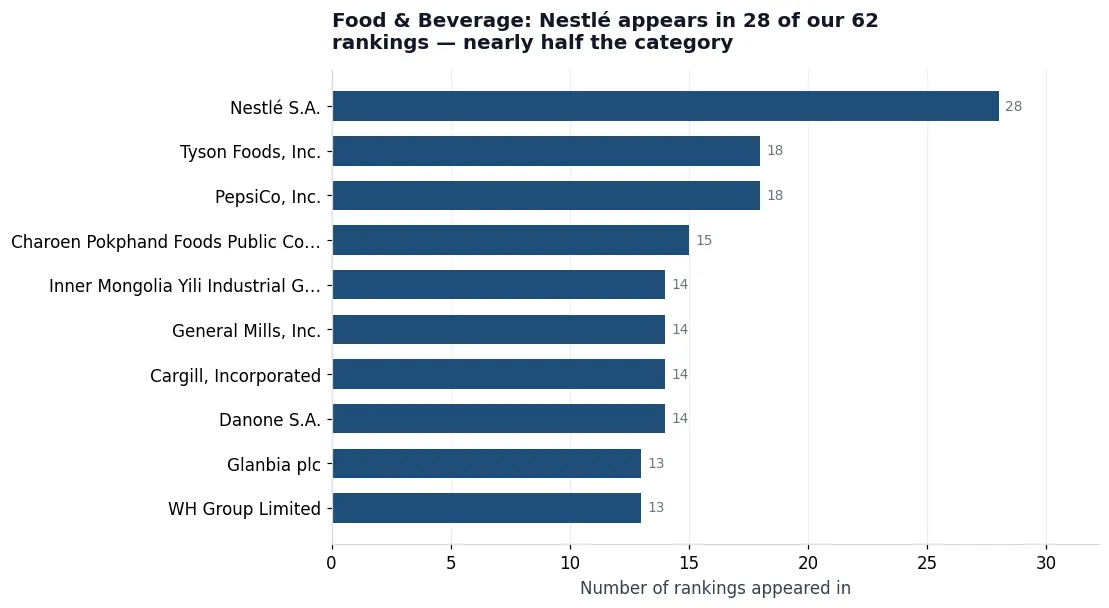
Nestlé appears in 28 of the 62 food and beverage rankings we maintain. No other company in this category comes close: Tyson Foods and PepsiCo each appear in 18, and the counts fall from there. Food and beverage is the largest category in our directory by both rankings and ranked positions — 802 of them — and yet a single company has a presence in nearly half of it.
Key Findings at a Glance
Nestlé appears 28 times
Nearly half the category's 62 rankings — a portfolio strategy rather than dominance in any single sub-category.
Consolidation has stalled
Most ranked companies appear on only one list. Regional producers and family-owned makers hold positions the global groups have not displaced.
One category, many businesses
A Chinese dairy producer and an American snack company share a label and almost nothing else.
Private label is the blind spot
A large share of supermarket own-brand food is made by suppliers absent from every consumer-facing ranking.
What 28 Appearances Actually Means
Food and beverage is the most sub-divided category we cover. Instant food, beverages and mixes, dairy, confectionery, bakery snacks, seasonings, edible oils, meat and poultry, seafood, food additives, and special dietary products are all maintained as separate industries with separate brand and manufacturer lists.
Nestlé’s footprint spans most of those divisions, but the reason is not that Nestlé dominates each one. It is that the company operates a portfolio strategy: a large number of mid-sized positions across many categories rather than a dominant position in one. That is a legitimate and highly defensible strategy, and it is invisible in any single ranking.
The Consolidation That Stopped
Food and beverage is routinely described as a consolidating industry. Our data suggests the consolidation phase largely finished, and what remains is a long tail that has proven resistant to further acquisition.
Of the 62 rankings in this category, most contain dozens of companies with no overlap with any other list. Regional producers, private labels, and family-owned manufacturers hold positions that the global groups have not displaced — usually because the local advantage is distribution or freshness rather than brand, and neither is buyable at a sensible price.
The practical consequence for buyers is that "global supplier" and "best supplier" diverge more sharply here than in any other category we rank. In industrial components, the largest companies usually are the most capable. In food, that correlation is weak.
The Companies That Recur
Note the geographic spread of these recurring names: Switzerland, the United States, Thailand, China, and Japan. Charoen Pokphand Foods appearing 15 times is the clearest example in our data of a company whose regional base — Southeast Asia — has produced genuine multi-category presence without global brand recognition.
Three Regions, Three Different Businesses
American entries in our food rankings concentrate in branded packaged goods and meat processing. Chinese entries concentrate in dairy, staples, and ingredients, with a growing presence in beverages. Japanese entries span a wide range of processed and prepared foods, and are unusually well represented relative to Japan’s population.
These are not variations of the same business. A Chinese dairy producer and an American snack company share a category label and almost nothing else — different cost structures, different retail channels, different regulatory environments, and in most cases different customers.
The Private Label Blind Spot
The same structural gap appears in food as in furniture. A large share of supermarket own-brand food is produced by manufacturers who never appear on a consumer-facing list — they sell to retailers, not to shoppers, and their names are absent from branded rankings by design.
For buyers this cuts both ways. It means the branded leaders in our lists are not the whole supply base, and it means a supplier that looks small on a brand ranking may be operating at considerable scale. Use the manufacturer lists alongside the brand lists when assessing whether capacity actually exists.
Reading a Food Ranking Correctly
Because this category is so sub-divided, a ranking’s scope matters more than its order. Before comparing two companies on a food list, confirm three things: whether the list covers finished products or ingredients, whether it covers brands or manufacturers, and whether its geographic scope is global or regional. A company ranked third on a regional ingredients list and a company ranked third on a global branded list are not comparable.
Each of our lists states its own scope. The most useful entry points are instant-food-brands, instant-food-manufacturers, beverages-mixes-companies, beverages-mixes-manufacturers, and the full set is indexed under the all-industries manufacturer index.
Buyer Questions on This Category
How many food and beverage rankings does VerityRank maintain?
62 rankings containing 802 ranked positions — the largest category in our directory. They cover instant food, beverages, dairy, confectionery, bakery, seasonings, edible oils, meat and poultry, seafood, additives, and special dietary products, each maintained separately for brands and manufacturers.
Why does Nestlé appear in so many food rankings?
Nestlé appears in 28 of the 62 lists in this category. The reason is portfolio breadth rather than dominance in any single sub-category: the company holds mid-sized positions across many divisions, which accumulates into the largest footprint in our data.
Is the food industry still consolidating?
Our data suggests the main consolidation phase is largely complete. Most of the ranked companies in this category appear on only one list, and regional producers, private labels, and family-owned manufacturers continue to hold positions the global groups have not displaced.
The Data Behind This Analysis
How to Read This Data
Methodology note
Because this category is so sub-divided, a ranking's scope matters more than its order. Confirm whether a list covers finished products or ingredients, brands or manufacturers, global or regional.
Related Rankings and Analysis
Every article draws on the same dataset. These pages go deeper on specific rankings:
Instant Food — Brands
Nestlé's widest single-category presence.
Dairy Products
Chinese and European producers lead this sub-category.
Edible Oils — Brands
A category where regional producers resist consolidation.
All-Industries Manufacturer Index
Every ranked manufacturer in the directory.
VerityRank maintains 426 industry rankings covering 1,506 verified companies and 10,933 ranked positions. Every figure in this article is drawn from that dataset.
Browse the all-industries manufacturer index or verified enterprise directory.