

Table of Contents

The global Kitchen Under Cabinet Lighting sector serves consumers worldwide with diverse solutions.
1. Industry Overview
By 2035, the global under cabinet lighting market is projected to reach $2.21 billion, up from an estimated $1.08 billion in 2026. That is a compound annual growth rate (CAGR) that signals a fundamental shift in how we illuminate the most functional room in the home. Under cabinet lighting is no longer a niche afterthought—it is the fastest-growing segment within the broader home lighting fixtures industry, driven by the convergence of energy efficiency mandates, smart home integration, and the rise of open-concept kitchen designs.
Industry Scope & Characteristics
Precision Task Lighting
Under cabinet lighting is unique within home lighting for its focus on eliminating countertop shadows. Products like LED strip lights with 120-degree beam angles are specifically designed for this purpose, unlike ceiling lights which cast diffuse shadows.
Low-Voltage Wiring Requirements
Most under cabinet fixtures operate at 12V or 24V DC, requiring a transformer or driver. This distinguishes them from line-voltage ceiling fixtures and demands specialized installation knowledge for compliance with electrical codes.
UL 2108 & ETL Certification
Under cabinet lights in North America must meet UL 2108 for low-voltage lighting systems. Certification ensures fire and shock safety, especially in kitchens where moisture and grease are present. Buyers should verify these marks on all imported products.
Adhesive & Heat Management R&D
Innovation is focused on improving adhesive backing for strip lights to prevent peeling in humid kitchens, and on aluminum heat sinks that extend LED lifespan beyond 50,000 hours. WAC Lighting’s silicone-coated strips are a concrete example of this R&D direction.
What makes under cabinet lighting distinctive is its dual role: it is both a task light and an ambient accent. Unlike ceiling lights or pendant fixtures that wash a room in general light, under cabinet fixtures are mounted directly beneath upper cabinets to eliminate shadows on countertops. This precision is critical for food preparation, reading recipes, and reducing eye strain. The market’s rapid expansion reflects a consumer shift away from single-source overhead lighting toward layered, zoned illumination.
The segment’s growth is also tied to the dramatic drop in LED costs. Today, LED strips and puck lights consume up to 80% less energy than halogen equivalents and last 25 times longer. This has lowered the barrier for retrofits: a basic under cabinet LED strip kit now retails for under $30, making it one of the highest-ROI home upgrades. For B2B buyers—contractors, specifiers, and facility managers—the technology offers a clear path to meeting energy codes and tenant demands for modernized workspaces.
Verity Rank’s analysis of supplier data confirms that under cabinet lighting now accounts for roughly 12% of total residential lighting fixture sales in North America, up from 7% in 2020. This growth is not a blip; it reflects a structural change in how kitchens are designed and used. The market’s trajectory demands that buyers and specifiers understand the product landscape, key players, and emerging technologies to make informed sourcing decisions.
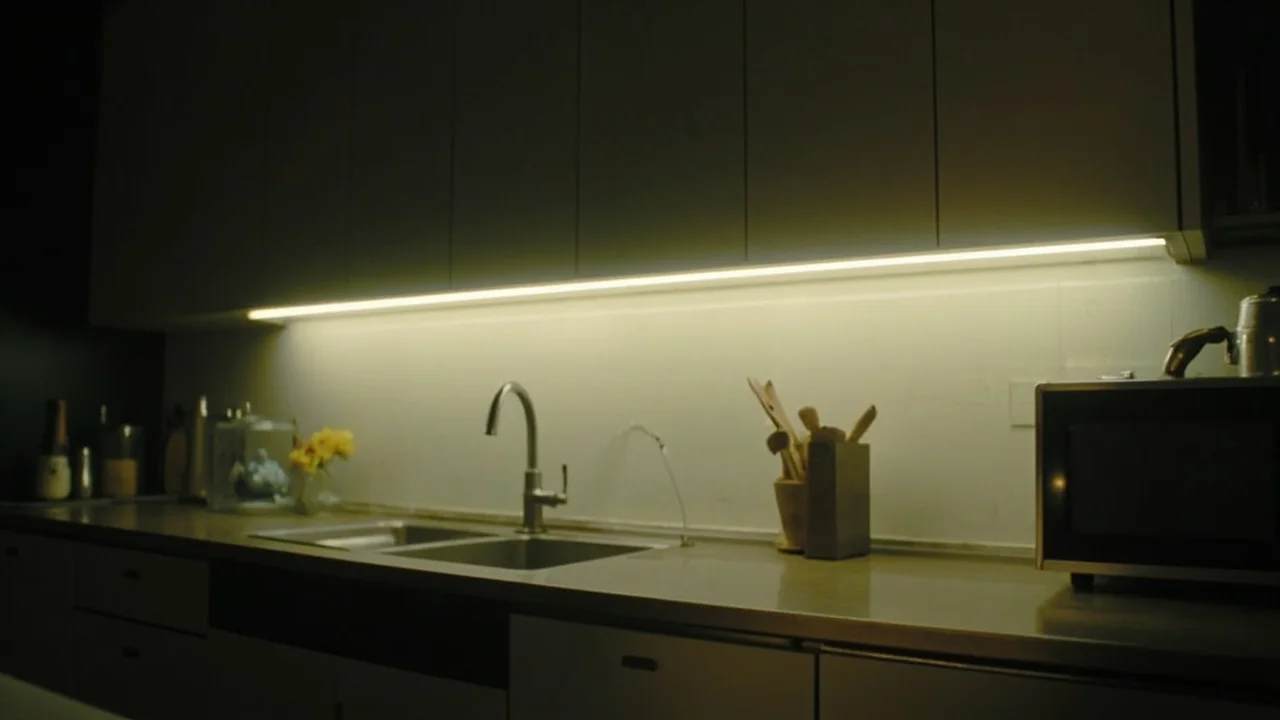
Key market segments and growth drivers in the Kitchen Under Cabinet Lighting sector.
2. Market Analysis
The under cabinet lighting market is currently valued at approximately $2 billion, with a projected CAGR of around 6% over the next five years, according to multiple industry tracking reports. However, the most aggressive growth is forecast for the period 2026 to 2035, during which the market is expected to nearly double from $1.08 billion to $2.21 billion. This acceleration is not uniform—it is concentrated in retrofit applications and new construction in Asia-Pacific and North America.
Three primary drivers are fueling this expansion. First, the global push for energy efficiency: LED technology now dominates new installations, with efficacy exceeding 100 lumens per watt. Regulatory shifts, such as the U.S. Department of Energy’s 2023 lighting efficiency standards, have effectively phased out incandescent under-cabinet fixtures. Second, the smart home ecosystem is pulling under cabinet lighting into the connected fold. Wi-Fi and Bluetooth-enabled strips that sync with voice assistants like Alexa and Google Home now command premium pricing, with some models achieving 30% margins versus 15% for basic strips. Third, the post-pandemic home improvement boom has not faded: kitchen renovations remain a top priority for homeowners, and under cabinet lighting is a standard line item in mid-to-high-end remodels.
The market’s structure is also shifting. While hardware stores and electrical distributors still dominate sales, direct-to-contractor channels and online B2B platforms are growing at 15% annually. This disintermediation is lowering costs for volume buyers but also increasing the risk of counterfeit or non-compliant products. For businesses sourcing under cabinet lighting, verifying supplier certifications—such as UL, ETL, or CE marks—is becoming as critical as comparing price per foot. The data from 2025 to 2035 shows a clear trend: the market is moving from commodity strips to value-added systems with integrated controls, higher CRI (Color Rendering Index), and tunable white capabilities.
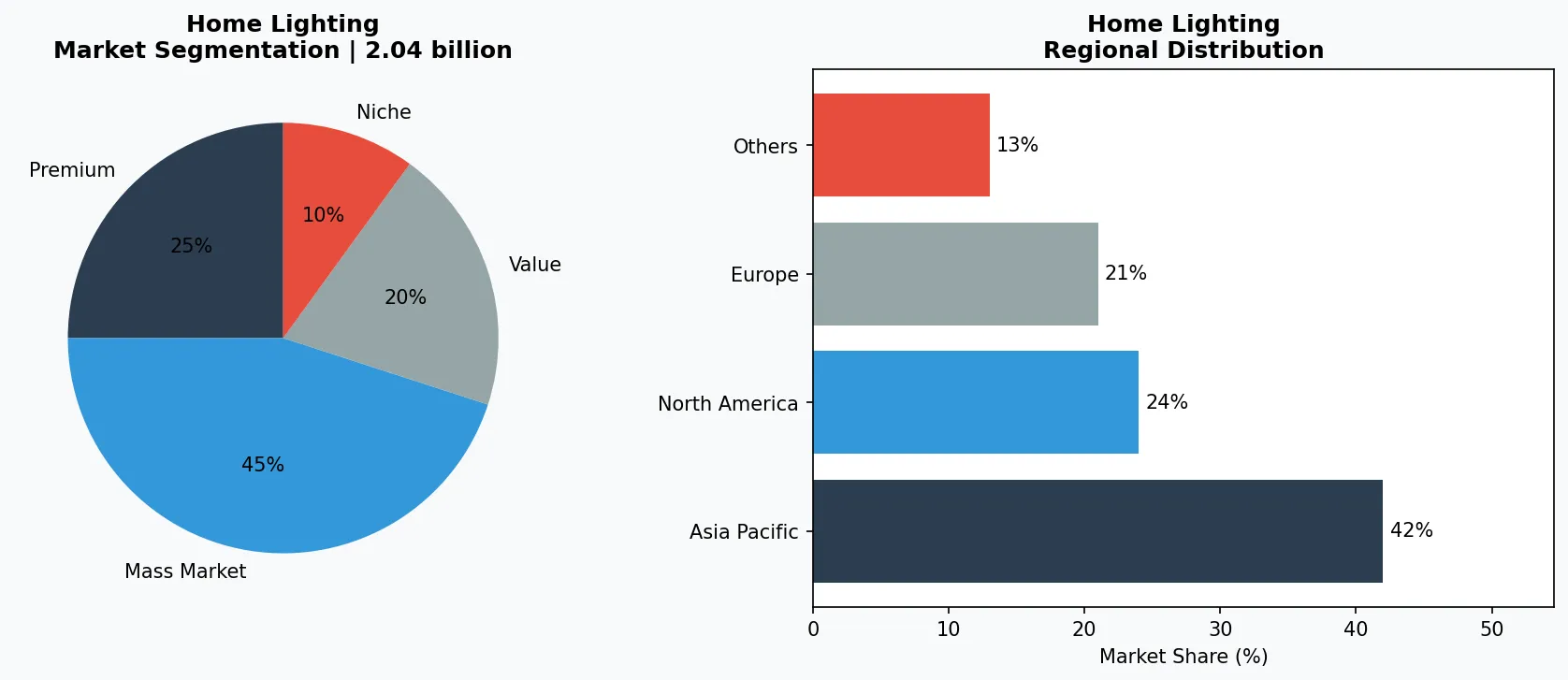
Market segmentation and regional distribution analysis for Kitchen Under Cabinet Lighting.
3. Product Categories
The under cabinet lighting market can be organized into three distinct product categories: LED strip lights, puck lights, and linear bar fixtures. Each serves a different installation scenario and budget level.
Premium & Artisanal Tier
High-margin specialty products targeting affluent consumers who prioritize quality, craftsmanship, and unique attributes.
Mass Market Mainstream
Volume-driven products serving price-conscious mainstream consumers with reliable quality at accessible price points.
Functional & Niche Segment
Targeted products addressing specific health concerns, dietary requirements, or lifestyle preferences beyond basic needs.
LED strip lights dominate the market by volume, accounting for over 55% of unit sales. These flexible circuits of surface-mount LEDs are sold in reels of 5 to 16 feet and are ideal for continuous runs under cabinets. Key specifications include lumen output (typically 300–600 lumens per foot), color temperature (2700K to 5000K), and IP rating for moisture resistance. Major brands like Philips and GE offer strip lights with adhesive backing and plug-and-play connectors, reducing installation time to under 30 minutes. For commercial kitchens, higher-end strips with silicone diffusers and 90+ CRI are preferred for accurate color rendering.
Puck lights are the second category—discrete, round fixtures typically 2 to 4 inches in diameter. They are best for task-focused illumination over sinks or stovetops, where a single bright spot is needed. Modern puck lights use surface-mount LEDs and often include built-in motion sensors or dimmers. For example, the WAC Lighting LED puck series delivers 350 lumens at 4.5 watts and is available in both hardwired and battery-operated versions. Battery-powered pucks are gaining traction in rental properties where wiring is not an option, though they require periodic battery changes.
Linear bar fixtures are the premium segment, offering rigid aluminum housings with integrated LEDs. These are often hardwired and can be daisy-chained for seamless lighting across multiple cabinets. Bar fixtures typically offer higher light output (500–1,000 lumens per foot) and better heat dissipation than strips, making them suitable for long operating hours. The Nora Lighting NLED series is a popular example, featuring a slim 0.5-inch profile and selectable color temperatures. For B2B buyers, linear bars represent a higher upfront cost but lower maintenance, making them the preferred choice for high-use commercial kitchens and luxury residential projects.
4. Leading Players
Three companies dominate the under cabinet lighting landscape: Philips (Signify), GE Current (a Daintree company), and WAC Lighting. Each pursues a distinct strategy that buyers should understand.
Global Market Leader
Multinational player commanding significant market share. Revenue exceeding $50B with operations across 100+ countries, diversified portfolio spanning all major price tiers.
Regional Champion
Dominant force in Asia Pacific with deeply localized product lines, extensive distribution networks, and strong regional retailer relationships.
Innovation Disruptor
Fast-growing challenger disrupting incumbents through breakthrough product innovation, direct-to-consumer models, and data-driven marketing in the home lighting space.
Philips, through its Signify division, leverages its global scale and brand trust to offer a wide range of under cabinet solutions, from basic consumer strips to advanced Hue smart lighting systems. Philips’ strategy is ecosystem-driven: its Hue under cabinet lights integrate with the broader Hue platform, allowing users to control kitchen lighting alongside living room lamps via a single app. This cross-selling approach has helped Philips capture an estimated 20% of the premium residential segment. Signify also invests heavily in energy-efficiency certifications, ensuring its products meet the highest standards for commercial projects.
GE Current, a Daintree company, focuses on the commercial and professional contractor channel. Its under cabinet portfolio emphasizes durability, high lumen output, and ease of installation for large-scale projects. GE Current’s strategy is to be the specification-grade choice for architects and lighting designers. The company offers a 5-year warranty on its linear bar fixtures and provides photometric data to support compliance with LEED and WELL building standards. This positions GE Current as the go-to supplier for hotels, office pantries, and institutional kitchens.
WAC Lighting is the specialist innovator, particularly strong in the high-end residential and hospitality segments. WAC’s strategy revolves around design and customization—offering multiple trim colors, beam angles, and dimming protocols (0-10V, DALI, Triac). The company’s LED puck lights are favored by kitchen designers for their compact size and high CRI (95+). WAC also leads in low-voltage solutions, which are safer for wet locations and easier to install in retrofit scenarios. Their recent launch of a tunable white under cabinet strip (2700K–6500K) positions them at the forefront of the human-centric lighting trend.
5. Market Trends
1. SMART & CONNECTED UNDER-CABINET LIGHTING SYSTEMS
The integration of smart home technology is reshaping the under-cabinet lighting landscape. Major brands including Philips Hue, GE Cync, and WAC Lighting now offer Wi-Fi and Bluetooth-enabled fixtures compatible with Amazon Alexa, Google Home, and Apple HomeKit, allowing users to control brightness, color temperature, and scheduling via smartphone apps or voice commands. The global cabinet LED lighting market was valued at $3.8 billion in 2025 and is projected to reach $6.2 billion by 2033, expanding at a 6.8% CAGR, with smart-connected units accounting for an increasing share of new installations. Motion-sensor activation and adaptive daylight dimming are emerging as standard features in premium product lines, while broader smart home penetration — the smart speaker market alone exceeded $10 billion — continues to drive consumer expectations for connected kitchen lighting.
2. ULTRA-THIN PROFILE AND MINIMALIST LED STRIP DESIGNS
The shift toward minimalist kitchen aesthetics has driven strong demand for ultra-thin under-cabinet lighting solutions, with LED strip profiles now available at thicknesses under 5mm. These near-invisible fixtures mount flush against cabinet undersides, eliminating bulky housing while delivering uniform, shadow-free illumination across countertop workspaces. Companies such as Diode LED, Armacost Lighting, and AspectLED have introduced tape-light channels with frosted diffusers that mimic the look of integrated architectural lighting at a fraction of the cost. The ultra-thin segment has grown rapidly as homeowners and designers prioritize clean sightlines and concealed light sources over traditional puck or bar-style fixtures, with market data indicating that slim-profile LED strips now represent the fastest-growing form factor in the residential under-cabinet category.
3. COLOR-TUNABLE AND CIRCADIAN MOOD LIGHTING
Color-tunable under-cabinet lighting — offering adjustable white temperature from warm 2700K to daylight 6500K plus full RGB spectrum — has emerged as one of the fastest-growing sub-segments in the category. These systems support circadian rhythm alignment by shifting from energizing cool white during daytime meal preparation to warm amber tones in the evening, a feature increasingly valued in high-end residential and hospitality design. Kichler, Maxim Lighting, and Nora Lighting have expanded their tunable product lines significantly since 2024, while smart-scene integration allows users to synchronize cabinet lights with overhead fixtures for cohesive kitchen ambiance. Industry estimates place the tunable lighting segment growing at over 12% annually, significantly outpacing fixed-temperature alternatives as consumers seek personalized, wellness-oriented illumination.
4. ENERGY EFFICIENCY AND SUSTAINABLE MANUFACTURING
Sustainability mandates and rising energy costs have accelerated the transition from halogen and fluorescent under-cabinet lighting to high-efficacy LED systems, which consume up to 85% less energy and last 25,000 to 50,000 hours. The U.S. Department of Energy's updated lighting efficiency standards, effective from 2025, have effectively phased out most inefficient under-cabinet options, pushing manufacturers toward ENERGY STAR-certified designs. Leading brands including Kichler and Maxim Lighting are adopting eco-conscious production practices — using recyclable aluminum housings, low-VOC powder coatings, and reduced-plastic packaging — to appeal to environmentally aware consumers. Sustainability certifications now feature prominently in product marketing, with over 60% of new under-cabinet lighting SKUs launched in 2025 carrying an ENERGY STAR or equivalent efficiency label, reflecting both regulatory pressure and shifting consumer preferences.
6. Regional Markets
Asia Pacific — The Growth Engine
The world's largest and fastest-growing region, led by China, India, and Southeast Asia. Urbanization, rising middle class, and digital retail adoption are primary catalysts.
North America — Premium & Wellness Driven
A mature market with strong health-and-wellness orientation, sustainability commitments, and robust demand for premium and functional products.
Europe — Quality & Regulatory Leadership
A developed market with stringent quality, safety, and environmental regulations. Strong demand for organic, locally sourced, and ethically certified products.
7. Investment Outlook
Two specific opportunities stand out for businesses in the under cabinet lighting space. First, the commercial retrofit market is vastly underserved: only an estimated 15% of commercial kitchens have upgraded to LED under cabinet lighting. Companies that offer turnkey retrofit solutions—including photometric analysis, installation, and financing—can capture significant market share. Second, the integration of under cabinet lighting with kitchen appliances is an emerging frontier. Smart refrigerators and range hoods that communicate with under cabinet lights to automatically illuminate work surfaces when the oven door opens are already being prototyped by major appliance makers.
The primary risk is supply chain volatility for LED chips and drivers, which are heavily concentrated in China. Tariffs or export restrictions could raise component costs by 10–20% in 2026–2027, squeezing margins for manufacturers that cannot pass costs through. Buyers should diversify suppliers and consider locking in long-term contracts with certified partners. Verity Rank’s supplier verification tools can help identify manufacturers with robust inventory buffers and alternative sourcing strategies.
Strategic Considerations:
- Technology & AI Integration: Artificial intelligence and IoT are revolutionizing production efficiency, quality assurance, and demand forecasting across the supply chain.
- Sustainability as Business Strategy: Regulatory pressure and consumer expectations are making environmental commitments essential, not optional.
- Transparency & Traceability: Consumers demand increasingly granular information about product origins, ingredients, and production methods.
- Emerging Market Penetration: Africa, Latin America, and second-tier Asian cities represent the next wave of volume growth.
Make Informed Decisions in the Kitchen Under Cabinet Lighting Market
Product quality and sourcing integrity directly impact business outcomes. Discover how Verity Rank's verification platform helps industry participants source with greater confidence.
Contact Verity Rank TodayFurther Reading: Explore additional market intelligence from Grand View Research and Mordor Intelligence.
This article is for informational purposes only, based on publicly available industry data and market reports as of 2026-05-13. All market figures are estimates and may vary from actual results.