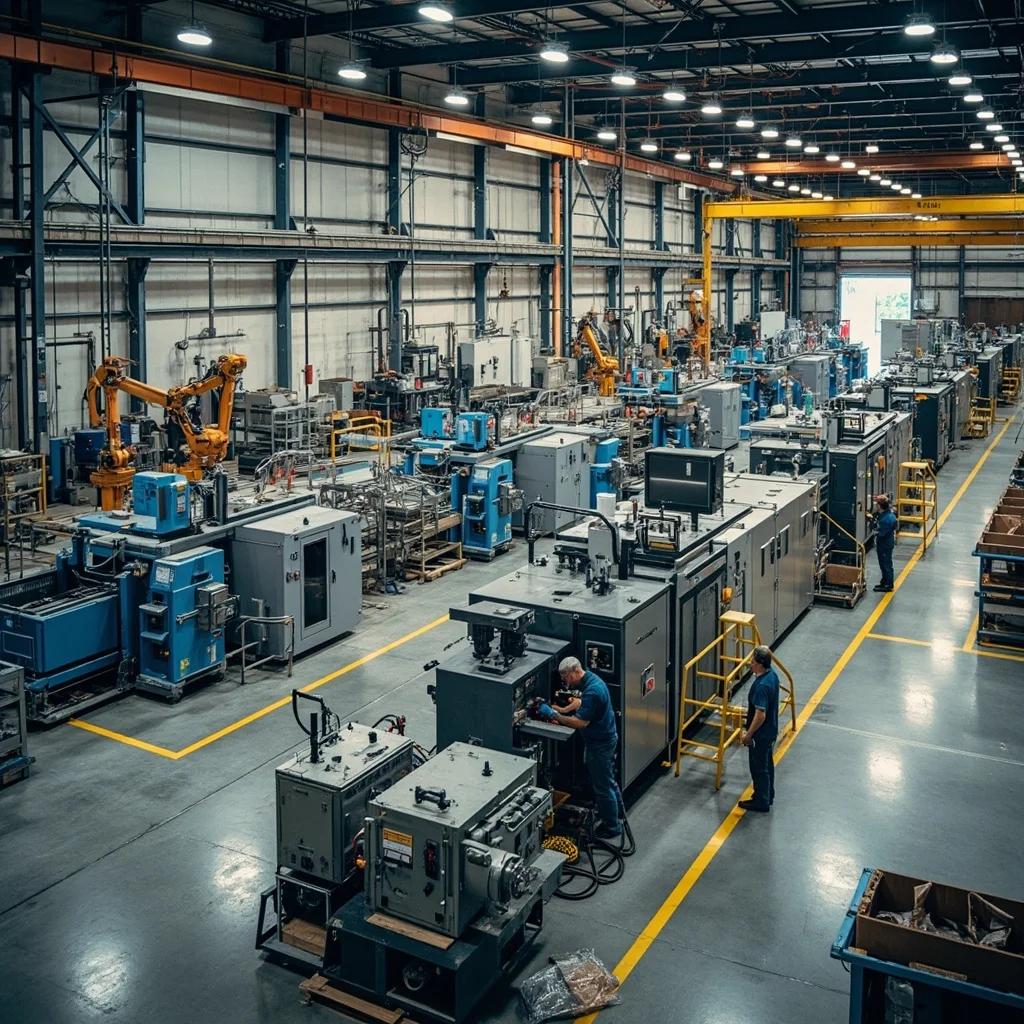
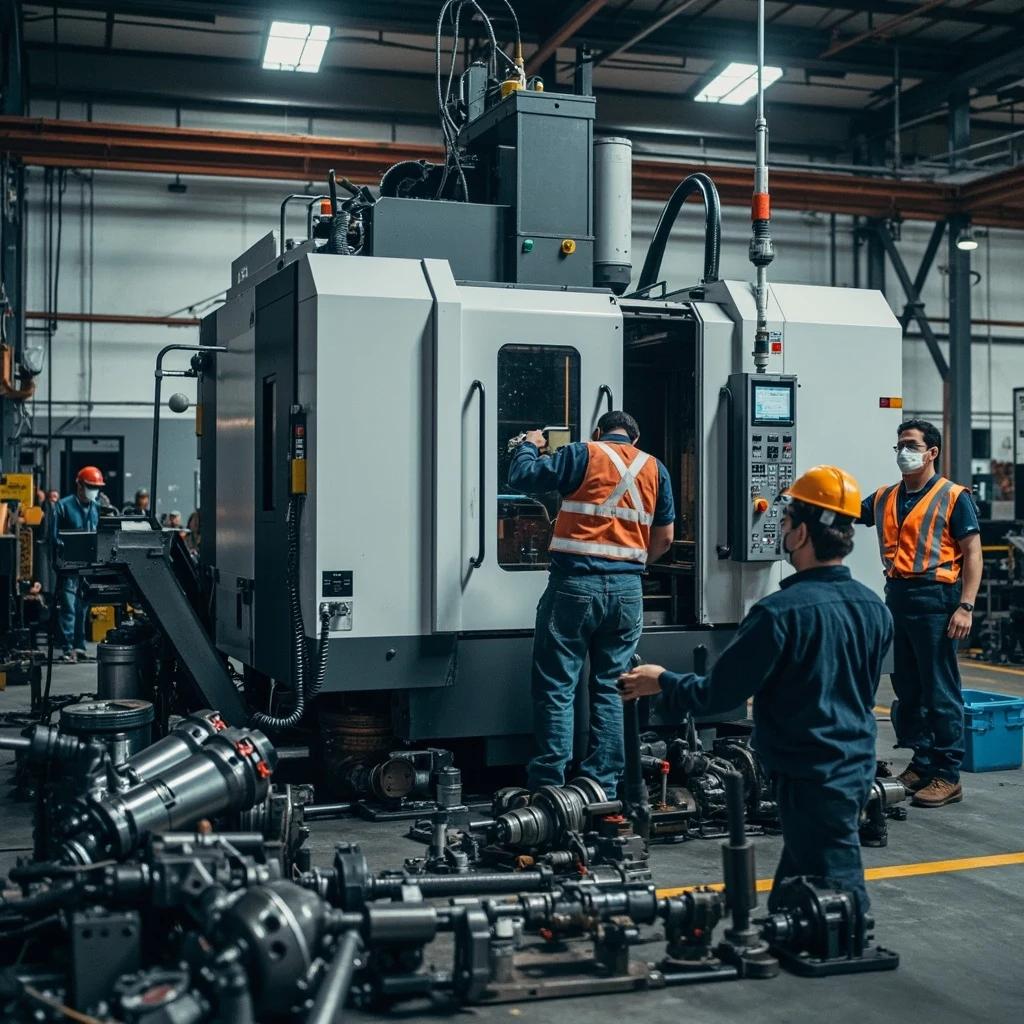
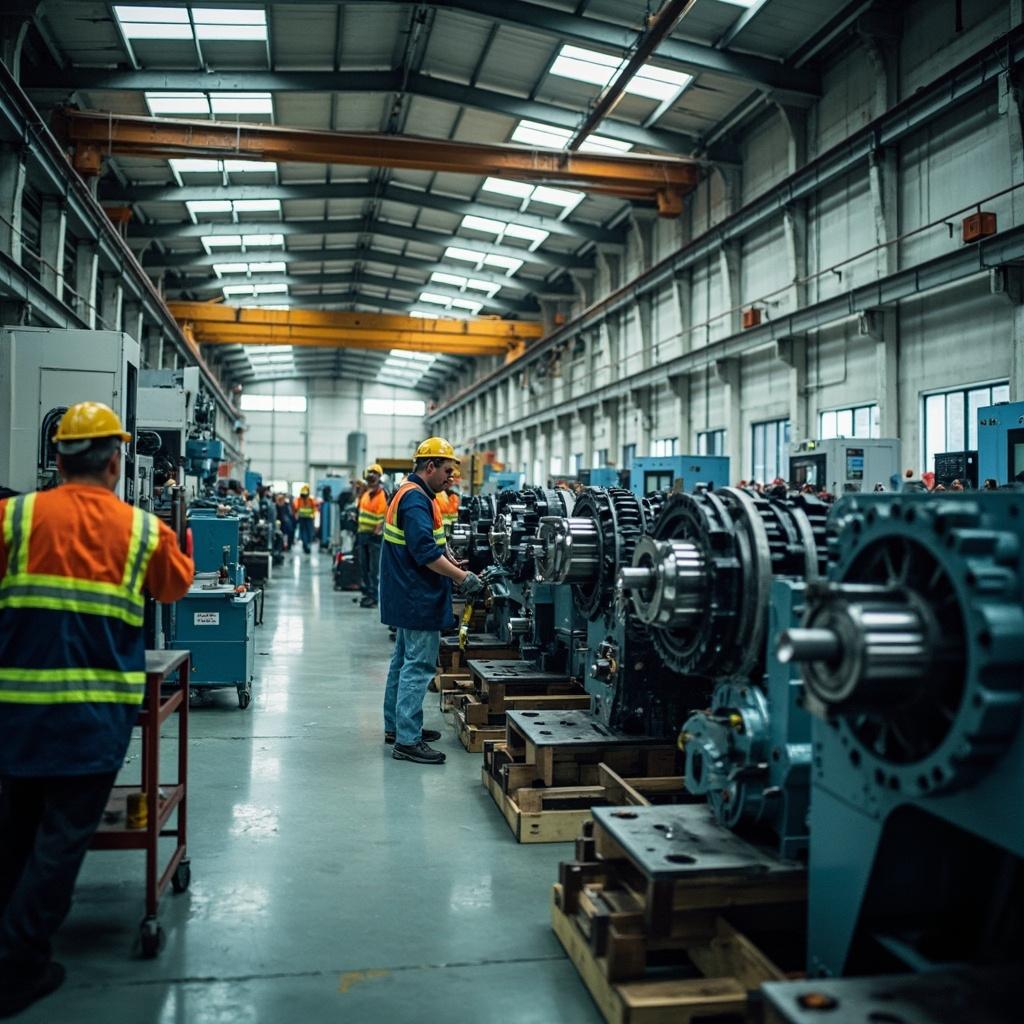
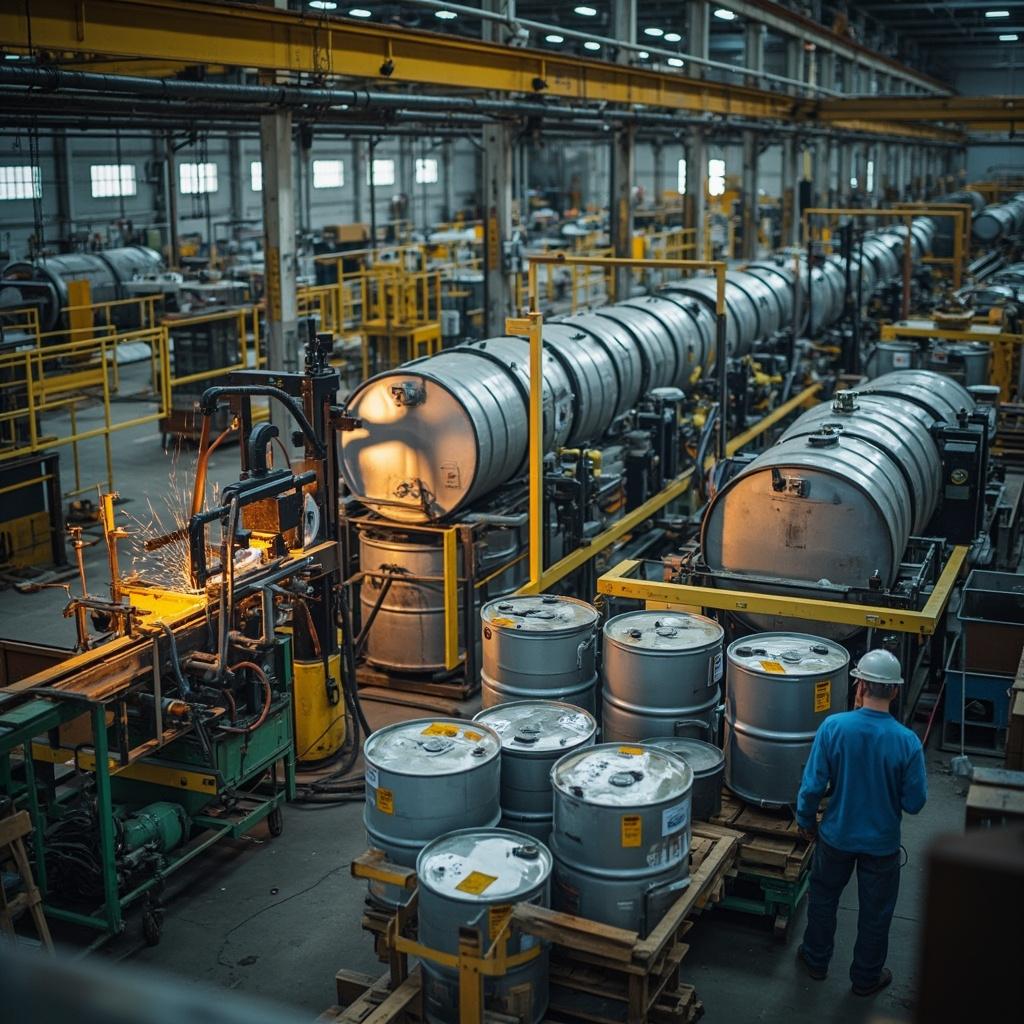
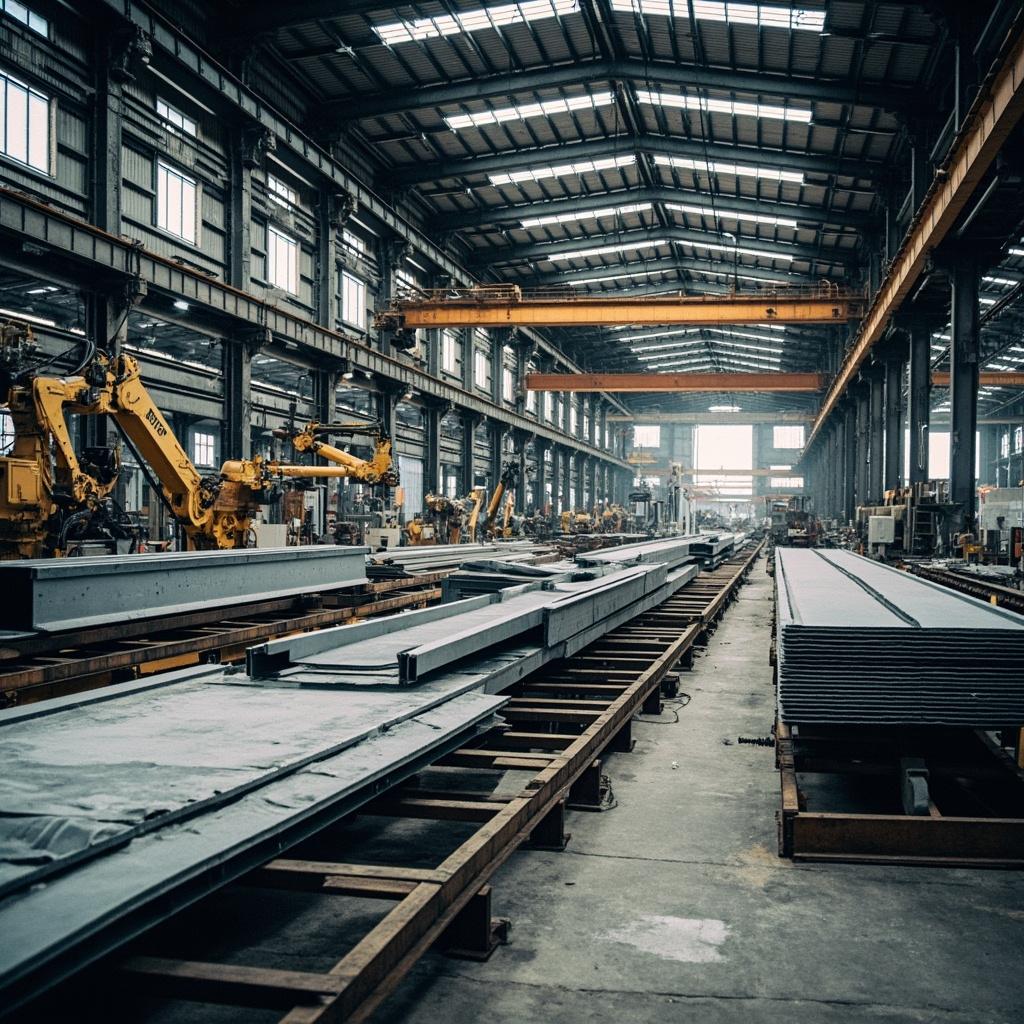
Our manufacturer rankings are built on a proprietary asset test requiring verified factory ownership. Each candidate must demonstrate physical metal forming, rolling, extrusion, welding, or coating facilities with documented equipment inventories and production capacity data. Companies outsourcing 100% of production or operating purely as trading entities are excluded — a critical filter that eliminates approximately 40% of entities that market themselves as "manufacturers" in the architectural metal components sector. This factory-ownership requirement reflects the capital-intensive nature of metal manufacturing, where a single coil-coating line costs EUR 5-15 million, a modern roll-forming line EUR 2-8 million, and an aluminum extrusion press EUR 3-10 million depending on tonnage capacity.
Four weighted dimensions are evaluated, each contributing 25% to the composite ranking score. Production Scale assesses annual output tonnage, number of owned manufacturing facilities, factory floor area, and capital equipment depth — for example, Kingspan Group's 270+ manufacturing sites across 80 countries dwarfs the 2-5 plant networks typical of regional metal panel producers. Technological Integration evaluates proprietary manufacturing technologies, automation levels, and digital design-to-fabrication integration — Kalzip's mobile roll-forming equipment enabling single-piece 100-meter panels represents the highest tier, while basic sheet metal bending shops score at the bottom. Supply Chain Reach measures geographic delivery capability, export market diversity, and raw material sourcing security — BlueScope Steel's 160+ facilities across 18 countries and Nucor's 25-state EAF network exemplify top-tier logistics. Sustainability & Compliance weighs third-party-verified Environmental Product Declarations (EPDs), recycled content percentages, low-carbon technology deployment (HYBRIT fossil-free steel, EAF-based production), ISO 14001/45001 certifications, and alignment with EU Taxonomy and LEED v5 requirements — Nucor's Econiq™ net-zero carbon steel and Ruukki's fossil-free roofing represent the sustainability frontier.
Data sources are multi-layered and cross-verified. Financial data derives from audited annual reports for publicly listed manufacturers (SSAB, Nucor, Kingspan, RPM International, BlueScope, LIXIL, Nippon Steel) and verified financial databases for private companies. Factory and certification data comes from ISO certificate registries, EN 1090 structural component databases, and national industry association directories. Environmental data is sourced from the International EPD System, UL Environment, and IBU (Institut Bauen und Umwelt) databases. Third-party industry data from Freedonia Group, Grand View Research, and Mordor Intelligence supplements proprietary research. Rankings are refreshed quarterly following major corporate disclosures (earnings releases, capacity announcements, M&A transactions) and annually through a comprehensive full-database review. Manufacturers with deeper vertical integration and proprietary technologies consistently score higher, reflecting the capital intensity and technical barriers that characterize architectural metal manufacturing at scale.
Five interdependent capabilities define world-class architectural metal components manufacturers. These capabilities, developed over decades of capital investment and engineering refinement, create competitive moats that are extraordinarily difficult for new entrants to replicate in an industry where a single coil-coating line represents EUR 5-15 million in capital expenditure and years of process optimization.
First, vertical integration depth. The most competitive manufacturers control multiple stages of the value chain from raw material through finished building products. Nucor Corporation exemplifies this model — controlling the entire process from ferrous scrap recycling through electric arc furnace (EAF) steelmaking, continuous casting, hot rolling, cold forming, and finished pre-engineered metal building (PEMB) systems. This integration eliminates three to four layers of intermediate supplier margins, provides guaranteed material availability during steel market tightness, and enables end-to-end quality traceability that sustainability certifications increasingly demand. SSAB's integration from primary steelmaking through Ruukki Construction's 14 forming plants represents an equivalent vertical control model. At the opposite extreme, a fabricator purchasing commodity coil from third-party mills and performing only final forming and cutting operates with inherently compressed margins and limited quality control over upstream processes.
Second, proprietary manufacturing technology. World-class manufacturers possess differentiated production technology protected by patents, trade secrets, or decades of accumulated process knowledge. Kingspan Group's QuadCore® insulated panel chemistry — a proprietary micro-cell thermoset insulation technology achieving thermal conductivity of 0.018 W/mK, approximately 20% better than standard PIR — represents billions in cumulative R&D investment and provides a specification advantage that competing panel manufacturers cannot easily match. Kalzip's mobile roll-forming equipment fleet represents a different form of proprietary advantage — truck-mounted production units enabling on-site forming of 100-meter seamless aluminum panels, eliminating transportation length constraints that limit stationary-factory competitors to 12-18 meter panel sections. Jinggong Steel's BIM-to-CNC-to-robotic-welding digital manufacturing thread represents Industry 4.0 leadership, with autonomous welding robots and AI-driven quality inspection systems driving per-ton fabrication costs that manual fabrication shops cannot approach. These proprietary technologies create durable specification advantages — architects and engineers design around manufacturer-specific performance capabilities, embedding the manufacturer into project specifications in ways that price competition alone cannot dislodge.
Third, distributed manufacturing networks. The physics of metal building products — high weight-to-value ratios, bulky dimensions, and freight sensitivity — make proximity to construction sites a decisive competitive factor. Kingspan Group's 270+ manufacturing sites across 80 countries and BlueScope Steel's 160+ facilities across 18 countries create natural freight-cost moats: a container of insulated panels shipped 2,000 kilometers costs 15-25% more in logistics than the same panels produced within 500 kilometers of the construction site. This distributed network model becomes self-reinforcing — a densely networked manufacturer can quote lower delivered prices in more regions, winning more projects, generating volumes that justify additional regional facilities. Zamil Steel's Dammam mega-factory complex in Saudi Arabia provides similar regional advantages for Middle Eastern and North African markets, with 500,000+ tonnes annual structural steel capacity and deep-water port access for export logistics.
Fourth, digital manufacturing integration. The frontier of construction industrialization is the seamless digital thread from Building Information Modeling (BIM) through computer-aided manufacturing (CAM) to automated fabrication. Leading Chinese manufacturers — Jinggong Steel, Hangxiao Steel, and China Construction Steel Structure — have deployed autonomous welding robots achieving 90%+ automation rates on repetitive structural connections, AI-driven computer vision quality inspection systems that detect weld defects with greater accuracy than human inspectors, and BIM-to-CNC direct interfaces that eliminate manual drawing interpretation errors. This digital integration reduces per-ton fabrication costs by 15-25% compared to conventional manual fabrication while simultaneously improving dimensional accuracy (sub-millimeter tolerances versus typical 3-5mm manual fabrication tolerances), reducing material waste by 5-10%, and compressing project lead times by 20-30%. Western manufacturers who have not invested in comparable digital integration face a structural cost disadvantage that tariffs and trade barriers can only partially offset.
Fifth, green manufacturing capability. As embodied carbon becomes a mandatory specification criterion under LEED v5, EU Taxonomy, and emerging national building codes, manufacturers with verified low-carbon production processes gain a structural market access advantage. Nucor Corporation's EAF-based production — recycling 20+ million tonnes of ferrous scrap annually — delivers structural steel at approximately 0.45 tonnes CO2 per tonne of steel, roughly one-third the global steel industry average of 1.85 tonnes CO2 per tonne. Ruukki/SSAB's HYBRIT hydrogen direct reduction technology represents an even more radical decarbonization pathway, eliminating over 95% of process emissions by replacing coking coal with green hydrogen. These low-carbon production capabilities are not optional differentiators — they are becoming prerequisites for specification in European public procurement (where Green Public Procurement criteria increasingly mandate EPDs) and for projects pursuing LEED Platinum or BREEAM Outstanding certification.
Three structural forces are fundamentally reshaping architectural metal manufacturing through 2030, creating clear winners and losers in an industry historically characterized by gradual, incremental change. These forces — decarbonization of primary steelmaking, supply chain regionalization, and automation of construction fabrication — are compressing into a single decade changes that would normally unfold over multiple generations of industrial infrastructure investment.
First, decarbonization of primary steelmaking represents the most disruptive force in the history of the metal building products industry. The European Union's Carbon Border Adjustment Mechanism (CBAM), entering its full implementation phase from 2026, will progressively impose carbon costs on imported steel, aluminum, and fabricated metal products based on their embedded emissions. By 2034, free EU Emissions Trading System (ETS) allowances for domestic steel producers will be fully phased out, creating a level carbon-cost playing field where every tonne of CO2 carries an explicit price — projected by analysts at EUR 80-120 per tonne by 2030. For architectural metal products, this mathematics is transformative: a tonne of steel produced via the conventional blast furnace-basic oxygen furnace (BF-BOF) route at 1.85 tonnes CO2 per tonne of steel will carry an embedded carbon cost of EUR 148-222 at projected carbon prices, while EAF-produced steel at 0.45 tonnes CO2 carries only EUR 36-54. This EUR 112-168 per tonne cost differential fundamentally restructures competitiveness. Nucor Corporation's EAF network — the largest and most technologically advanced in North America, producing at roughly one-third industry-average carbon intensity — and Ruukki/SSAB's HYBRIT fossil-free steel technology represent the two commercially viable decarbonization pathways at scale. The implications for global trade patterns are profound: Turkish, Indian, and Chinese BF-BOF-dominated steel exporters will face progressively steeper carbon penalties in European markets, while EAF-based and hydrogen-based producers gain structural market-share tailwinds. Forward-thinking architectural specifiers are already writing EPD requirements and embodied carbon limits into project specifications, accelerating the competitive reordering. By 2030, the market will bifurcate into a premium "green steel" specification tier — commanded by Nucor, SSAB/Ruukki, and potentially ArcelorMittal's decarbonization investments — and a lower-tier commodity segment where carbon costs progressively erode margins.
Second, supply chain regionalization is reversing the three-decade trend toward globalized manufacturing and long-distance trade in metal building products. Multiple reinforcing drivers are compressing supply chains geographically. Trade policy instability — US Section 232 tariffs (25% on steel imports, 10% on aluminum, implemented 2018 and maintained through successive administrations), EU safeguard measures, and anti-dumping duties on Chinese, Turkish, and Vietnamese metal products — has introduced persistent, unpredictable cost layers that make long-distance sourcing of bulky, low-value-density building products economically irrational for an increasing share of projects. Ocean freight volatility — the 400%+ spot rate spikes during the 2021-2022 supply chain crisis demonstrated that the "cheap freight" assumption underpinning globalized metal product supply chains is unreliable — adds a risk premium that regional manufacturing avoids entirely. Geopolitical instability — Russia-Ukraine conflict disruption of Black Sea steel trade routes, Red Sea/Houthi shipping disruptions adding 10-14 days to Asia-Europe transit times, and escalating US-China trade restrictions — has made supply chain resilience a board-level priority for major contractors and developers. Kingspan Group's 270+ manufacturing sites across 80 countries and BlueScope Steel's 160+ facilities across 18 countries represent the adaptive template: produce locally for local markets, maintain regional raw material stockpiles, and minimize exposure to intercontinental logistics disruption. Chinese metal building product exporters face the inverse of these dynamics — structural overcapacity in domestic steel production (1+ billion tonnes annual capacity against ~900 million tonnes demand) creates relentless pressure to export, but trade barriers, carbon tariffs, and logistics costs increasingly close those export channels. The net effect: by 2030, the global metal building products market will be more regionally fragmented, with fewer manufacturers shipping products across oceans and more investment in distributed, multi-country manufacturing capacity.
Third, automation of construction fabrication is driving an unprecedented productivity divergence between technologically advanced and conventional manufacturers. The core dynamic is simple but profound: autonomous welding robots, AI-driven quality inspection, and BIM-to-CNC direct digital manufacturing interfaces are driving per-unit fabrication costs down 15-25% while simultaneously improving quality (sub-millimeter versus 3-5mm manual tolerances) and compressing lead times 20-30%. These technologies exhibit strong economies of scale — a robotic welding cell costing EUR 500,000-1.5 million requires sufficient production volume to amortize, creating a structural advantage for large-scale manufacturers that smaller fabricators cannot economically match. Chinese manufacturers — Jinggong Steel, Hangxiao Steel, China Construction Steel Structure, and Zhejiang Southeast Space Frame — are deploying these technologies at the largest scale globally, driven by China's construction market scale (annual steel structure output exceeding 80 million tonnes) and relatively lower automation integration costs. The automation divergence creates a self-reinforcing cycle: automated manufacturers win more projects through lower pricing and faster delivery, generating volumes that justify additional automation investment, further widening the cost gap versus manual fabricators. By 2030, the structural steel and metal panel fabrication industry will likely exhibit a hourglass structure — a small number of highly automated, large-scale manufacturers at the top serving major commercial, industrial, and infrastructure projects, a large number of small craft fabricators at the bottom serving local residential and light commercial work, and a "missing middle" of mid-scale manual fabricators squeezed out by automation-driven cost competition. For specifiers and contractors, the strategic implication is clear: for any project exceeding approximately 500-1,000 tonnes of structural steel or 10,000 square meters of metal panel area, the cost and schedule advantages of automated manufacturers will increasingly dominate procurement decisions.
Selecting the right architectural metal component manufacturer requires evaluation across six dimensions beyond unit pricing. Metal building products represent 15-35% of total construction cost for typical industrial and commercial buildings, but specification errors, supply chain failures, or quality defects in metal components can generate remediation costs that are orders of magnitude larger than any upfront price savings. A systematic, auditable supplier evaluation process is not optional — it is the single most effective risk management investment a project team can make.
First, conduct a factory capability audit. Request and verify: (a) annual production capacity in tonnes and square meters, cross-referenced against claimed project references to confirm that a manufacturer has actually produced at the scale claimed; (b) owned facilities list with addresses, floor areas, and equipment inventories — manufacturers operating trading-company models (purchasing from third-party factories and rebranding) should be identified and excluded from consideration for any project requiring quality traceability; (c) quality management certifications — ISO 9001 at minimum, with EN 1090 (Execution Class 1-4 depending on structural criticality), AISC certification for North American structural steel, and relevant national welding certifications (AWS D1.1, ISO 3834); (d) recent project references within the same building typology (logistics, cold storage, data center, industrial) and similar scale within the past 36 months — demand client contact details and conduct reference calls focused on delivery reliability, dimensional accuracy, coating durability, and post-installation support quality. A manufacturer that cannot or will not provide this information within two weeks should be eliminated from consideration — the inability to produce basic capability documentation is a reliable leading indicator of operational weakness.
Second, evaluate supply chain geography and freight economics. For bulky metal building products — insulated sandwich panels at 8-15 kg/m², structural steel sections at 30-100+ kg per linear meter, standing seam roofing coils at 2-4 tonnes per coil — freight costs typically represent 10-20% of delivered product cost for distances exceeding 500 kilometers and can exceed 25% for intercontinental shipments. Proximity to manufacturing facilities therefore often outweighs unit price differentials of 5-15%. Kingspan Group's 270+ manufacturing sites across 80 countries provide natural freight advantages — a European project supplied from Kingspan's nearest regional plant (typically within 300-500 kilometers) will have substantially lower delivered costs than the same specification panels imported from Turkish or Chinese manufacturers, even if the ex-works unit price appears 10-15% lower on the latter. BlueScope Steel's regional manufacturing model achieves similar economics. Zamil Steel's Dammam complex provides freight advantages for GCC and broader Middle Eastern markets. For projects in regions without established local manufacturing, the delivered-cost calculation must include estimated freight, port handling, customs clearance, inland transportation, and — increasingly important — carbon border adjustment costs.
Third, require third-party-verified Environmental Product Declarations (EPDs). With LEED v5 (effective 2025) requiring embodied carbon assessments for Materials and Resources credits, the EU Taxonomy for Sustainable Activities establishing technical screening criteria for construction products, and a growing number of national building codes incorporating embodied carbon limits, product-specific EPDs are transitioning from optional differentiators to mandatory compliance documents. Demand EPDs that are: (a) product-specific (not industry-average or association-level), (b) third-party verified by an approved program operator (International EPD System, UL Environment, IBU), (c) less than five years old, and (d) covering cradle-to-gate (A1-A3) lifecycle stages at minimum, with cradle-to-grave (A-D) preferred. Manufacturers who have invested in EPD development — Nucor (Econiq™ with certified net-zero carbon), Kingspan (35+ Low Embodied Carbon products with published EPDs), SSAB/Ruukki (fossil-free steel EPDs), and LIXIL (Premial® low-carbon aluminum EPDs) — have already borne this compliance cost, while manufacturers without EPDs will require project teams to fund EPD development or accept compliance gaps.
Fourth, assess digital integration and BIM compatibility. Modern construction projects depend on accurate 3D digital models for coordination, clash detection, quantity takeoffs, and fabrication. Demand: (a) BIM-compatible product libraries in native Revit, ArchiCAD, and IFC formats — Kingspan, Kalzip, and BlueScope provide comprehensive BIM object libraries, while smaller manufacturers often provide only 2D CAD blocks requiring manual modeling; (b) automated design-to-fabrication workflows — manufacturers like Jinggong Steel offer direct BIM-to-CNC interfaces where structural models feed directly into fabrication equipment, eliminating manual drawing interpretation that introduces errors in approximately 3-8% of connections in conventional workflows; (c) digital project management portals providing real-time production status, shipping tracking, and installation documentation. The cost of BIM incompatibility — manual remodeling, coordination errors, field modifications — typically ranges from 2-5% of the metal package budget, far exceeding any upfront price savings from a lower-specification manufacturer.
Fifth, evaluate financial stability through public disclosures or audited financials. Architectural metal component projects involve substantial advance payments (typically 20-30% of contract value) and extended production lead times (8-20 weeks for custom insulated panels, 12-26 weeks for complex structural steel). A manufacturer's financial failure mid-project is catastrophic — replacement manufacturers charge premium pricing for accelerated production and project delays of 3-6 months are typical. For publicly listed manufacturers — Nucor (NYSE: NUE, $30B+ market cap), Kingspan (LSE: KRX, EUR 15B+), BlueScope (ASX: BSL, AUD 10B+), SSAB (Nasdaq Stockholm, SEK 50B+), RPM International (NYSE: RPM, $14B+) — audited financial statements, credit ratings, and analyst coverage provide transparency. For private manufacturers — Zamil Steel, most Chinese fabricators, and regional metal panel producers — demand audited financial statements (income statement, balance sheet, cash flow statement) from the most recent fiscal year, parent company guarantees for subsidiary entities, and trade credit references from raw material suppliers (coil mills and chemical suppliers). A manufacturer unwilling to provide audited financials should trigger risk escalation — the absence of financial transparency in a business requiring substantial customer prepayments is a fundamental red flag.
Sixth, evaluate after-sales support and warranty infrastructure. Metal building envelope failures — roof leaks, coating delamination, insulation thermal degradation, structural connection corrosion — typically manifest 3-15 years after installation, long after project completion and final payment. Evaluate: (a) warranty terms — Kingspan offers up to 40-year thermal and structural warranties on QuadCore® panels, Kalzip provides 40-year coating warranties on PVDF-finished aluminum panels, while commodity manufacturers may offer only 5-10 year limited warranties; (b) warranty claims infrastructure — determine whether the manufacturer maintains dedicated technical service teams, whether claims are processed through local offices or a distant headquarters, and typical claims resolution timelines; (c) installer certification programs — manufacturers with certified installer networks (Kingspan, Kalzip, Ruukki, Nucor Building Systems) provide installation quality assurance that manufacturer-only warranties cannot offer, since the majority of metal envelope failures result from installation defects rather than manufacturing defects. For critical building typologies — data centers, pharmaceutical facilities, cold storage, food processing — where envelope failure directly threatens core operations, the warranty and support infrastructure should carry equal or greater weight than upfront pricing in the manufacturer selection decision.
Sustainability leadership in architectural metal components manufacturing is measured through three interconnected metrics: embodied carbon intensity per unit of production, recycled content percentage, and deployment of breakthrough low-carbon manufacturing technology. These metrics are increasingly embedded in project specifications through LEED v5 Materials and Resources credits, EU Taxonomy technical screening criteria, BREEAM materials credits, and national Green Building Standards — transitioning sustainability from marketing positioning to mandatory compliance in premium construction markets.
Nucor Corporation (NYSE: NUE) is the undisputed sustainability leader in structural steel and metal building systems. Operating the largest electric arc furnace (EAF) network in North America — 25+ scrap-based steelmaking facilities across the United States — Nucor recycles approximately 20+ million tonnes of ferrous scrap annually, transforming end-of-life vehicles, demolished buildings, and industrial scrap into new structural steel at roughly 0.45 tonnes CO2 per tonne of steel. This represents approximately one-third of the global steel industry average of 1.85 tonnes CO2 per tonne (BF-BOF route) and one-quarter of the Chinese steel industry average (heavily BF-BOF dependent at 2.0+ tonnes CO2 per tonne). Nucor's Econiq™ product line, launched in 2022, offers certified net-zero carbon steel verified through third-party lifecycle assessment, with residual emissions offset through certified carbon credits — making Nucor the only major structural steel producer offering a commercially available net-zero product at industrial scale. Beyond carbon, Nucor's circular production model generates negligible process waste — EAF slag is processed into construction aggregate and agricultural lime, mill scale is recycled internally, and water is recirculated at 95%+ efficiency across most facilities. For specifiers pursuing LEED Platinum, Living Building Challenge, or net-zero carbon building certifications, Nucor/Econiq™ represents the structural steel specification benchmark against which all other suppliers are measured.
Ruukki Construction (SSAB) achieved the construction industry's most significant sustainability milestone of the 2020s: the world's first commercial deployment of fossil-free steel roofing products using hydrogen-based direct reduction technology. The HYBRIT (Hydrogen Breakthrough Ironmaking Technology) process — a joint venture between SSAB, LKAB (iron ore mining), and Vattenfall (energy) — replaces coking coal with green hydrogen produced via water electrolysis using fossil-free electricity. The process reduces carbon emissions by over 95% compared to conventional blast furnace steelmaking, producing high-quality direct reduced iron (DRI) that is then processed through electric arc furnaces into finished steel products. In 2023, Ruukki delivered the first commercial fossil-free steel roofing products to select projects in Finland and Sweden, with production volumes scaling as SSAB's HYBRIT demonstration plant in Luleå, Sweden transitions to full commercial operation (targeting 1.3 million tonnes annual fossil-free steel capacity by 2026, expanding toward SSAB's ambition to largely eliminate CO2 emissions from its Nordic operations by 2030). For European construction projects subject to EU Taxonomy requirements and increasingly stringent national embodied carbon limits, Ruukki's fossil-free roofing products represent the only commercially available option that structurally eliminates — rather than merely offsets — the carbon emissions embedded in steel roofing and cladding products. The green premium for fossil-free steel is currently estimated at EUR 100-200 per tonne, a cost that CBAM carbon tariffs on conventional steel will progressively narrow and potentially eliminate for European markets by 2030.
Kingspan Group (LSE: KRX) has established the most comprehensive corporate sustainability program in the insulated metal panel industry through its Planet Passionate 2030 strategy. The company reduced absolute Scope 1 and 2 greenhouse gas emissions by 70% from its 2019 baseline by 2025, achieved through: (a) transitioning 100% of manufacturing facilities to renewable electricity (completed across most European operations), (b) installing on-site solar PV generation at 50+ manufacturing facilities globally, (c) deploying direct renewable heat technologies including biomass boilers and heat pumps at panel manufacturing plants, and (d) eliminating HFC blowing agents from insulation manufacturing processes in favor of zero-ODP, low-GWP alternatives. Kingspan has launched 35+ Low Embodied Carbon (LEC) products with published, third-party-verified EPDs, covering insulated panels, structural insulated panels, and building envelope components. The QuadCore® insulation technology — a proprietary micro-cell thermoset formulation achieving thermal conductivity of 0.018 W/mK — delivers approximately 20% better thermal performance than standard PIR insulation, reducing operational carbon emissions over building lifecycles. Kingspan targets net-zero manufacturing (Scope 1 and 2) by 2030, with net-zero embodied carbon across the full value chain (Scope 1, 2, and 3) targeted by 2050 — aligned with the Science Based Targets initiative (SBTi) Net-Zero Standard. For cold storage, data center, and industrial building projects where insulated panel thermal performance directly determines operational energy consumption, Kingspan's combined embodied carbon reductions and superior thermal performance create a lifecycle carbon advantage that competing panel manufacturers without comparable sustainability programs cannot replicate.
LIXIL Corporation (TSE: 5938) leads in aluminum building product sustainability through its high-percentage recycled aluminum manufacturing technology. The company's Premial® low-carbon aluminum components utilize post-consumer recycled aluminum content exceeding 70% in many product lines, requiring approximately 95% less energy than primary aluminum smelting (which consumes 13-15 MWh of electricity per tonne of primary aluminum produced via the Hall-Héroult process). LIXIL operates advanced aluminum sorting, melting, and casting facilities that process mixed post-consumer aluminum scrap — including architectural demolition waste — into high-quality extrusion billets suitable for architectural-grade aluminum profiles. This aluminum recycling technology addresses the construction industry's aluminum sustainability paradox: aluminum is infinitely recyclable without quality degradation, yet the construction sector's aluminum recycling rates remain below 40% in most markets due to inadequate demolition-phase sorting and recovery infrastructure. LIXIL's integrated recycling-manufacturing model demonstrates a commercially viable pathway to closing the construction aluminum loop, particularly relevant as EU Construction and Demolition Waste regulations mandate 70%+ recycling rates and as LEED v5 increases emphasis on material ingredient reporting and circular economy criteria. For projects where aluminum curtain walls, window frames, cladding panels, and architectural components represent substantial material volumes, specifying LIXIL's recycled-content aluminum products can contribute 3-8 LEED Materials and Resources points while reducing project embodied carbon by 60-80% versus primary aluminum alternatives.
For specifiers evaluating sustainability across multiple manufacturers, the minimum standard is demanding product-specific, third-party-verified Environmental Product Declarations (EPDs) covering cradle-to-gate (A1-A3) lifecycle stages at minimum. Industry-average or association-level EPDs — which aggregate data across multiple manufacturers and obscure company-specific performance — should be rejected. The International EPD System database (environdec.com), UL SPOT database, and IBU EPD database maintain searchable registries of verified EPDs. Beyond EPDs, specifiers should evaluate: (a) recycled content percentage with documentation (not claims), (b) manufacturing energy source mix (grid electricity carbon intensity varies by 10x between regions), (c) waste diversion rates from manufacturing facilities, and (d) whether the manufacturer participates in take-back programs for end-of-life building products — Kingspan, Nucor, and LIXIL operate formal product take-back and recycling programs that close the material loop, while most metal building product manufacturers still operate linear produce-sell-dispose models. As embodied carbon regulation accelerates — EU Taxonomy, national building codes in France (RE2020), Netherlands (MPG), and Denmark (BR18), and emerging North American Buy Clean legislation — manufacturers who have already invested in EPD development, low-carbon production technology, and circular economy infrastructure will capture disproportionate market share in sustainability-regulated premium construction markets.