The revenue column on this page holds two incompatible measurements, because a grain merchant books the value of everything it buys and moves while a packaged-food supplier books only what it sells to a customer, and that difference is wider than the difference between most of the entrants. Cargill's roughly US$160 billion for its 2025 financial year is a turnover figure in which the physical crop dominates: the company buys corn, wheat, barley and sorghum, ships them, converts some of them and records the whole flow. General Mills reports US$19.8 billion of net sales over the same period and WK Kellogg reports US$2.6 billion, and neither total contains a tonne that was bought and sold on unchanged.
Gross Turnover Counts The Same Crop Several Times. A bushel leaving a farm can be booked by an elevator, again by a barge operator, again by a port terminal and again by the mill that finally grinds it, and a company standing at several of those steps reports the sum. That is what more than 1,000 production sites and terminals across 70 countries does for Cargill, and what 270 or more processing plants in more than 190 countries does for ADM; the revenue line reflects position in the chain rather than the size of the harvest handled.
Net Sales Nets Out The Part That Makes The Two Sides Different. Bunge prints the distinction directly, reporting net sales of about US$70.3 billion for 2025, and Louis Dreyfus reports net revenue of roughly US$50.6 billion, yet both still carry the elevators the trade depends on, more than 300 storage and processing assets in Bunge's case and more than 100 plants and terminals in Louis Dreyfus's. Even a net figure at a merchant covers cargo the company never owned outright but carried the price risk on for part of a voyage, which is a trading position rather than a manufacturing one.
A Subsidiary Or Segment Figure Is A Third Kind Of Number. Quaker appears here at about US$3.2 billion of grain and cereal sales rather than at PepsiCo's US$93.925 billion of 2025 net revenue, because the ranking scores the business on the card and not the group above it. Yihai Kerry reports RMB 245.126 billion, about US$34.2 billion, as a listed company whose turnover already sits inside its parent's consolidation, so counting both would book the same rice, flour and oil twice. COFCO's RMB 589.1 billion group total and October Paddy's RMB 6.81 billion are consolidated figures from two very differently sized groups.
A Reader Can Still Use The Column With Two Corrections. Compare merchants with merchants and brands with brands, then check how much of turnover comes from grain, because that share is what the 35% category-fit weight measures. Where profit as well as revenue is published, use the ratio: October Paddy closed 2025 with gross margin at 19.9% and attributable profit of RMB 428 million on RMB 6.81 billion of revenue, while Yihai Kerry earned RMB 3.153 billion of attributable profit, up 26.01%, on RMB 245.126 billion. Two revenue numbers a factor of thirty-six apart describe two businesses that are not thirty-six times different in any other respect.
What The Column Cannot Tell You At All. It cannot show who owns the berth, the silo or the crushing line, which is the 15% block, and it cannot show whether consumers recognise the name on the pack, which is the last 10%. Reading it as a league table of size alone produces the wrong conclusion about almost every entry on the page.
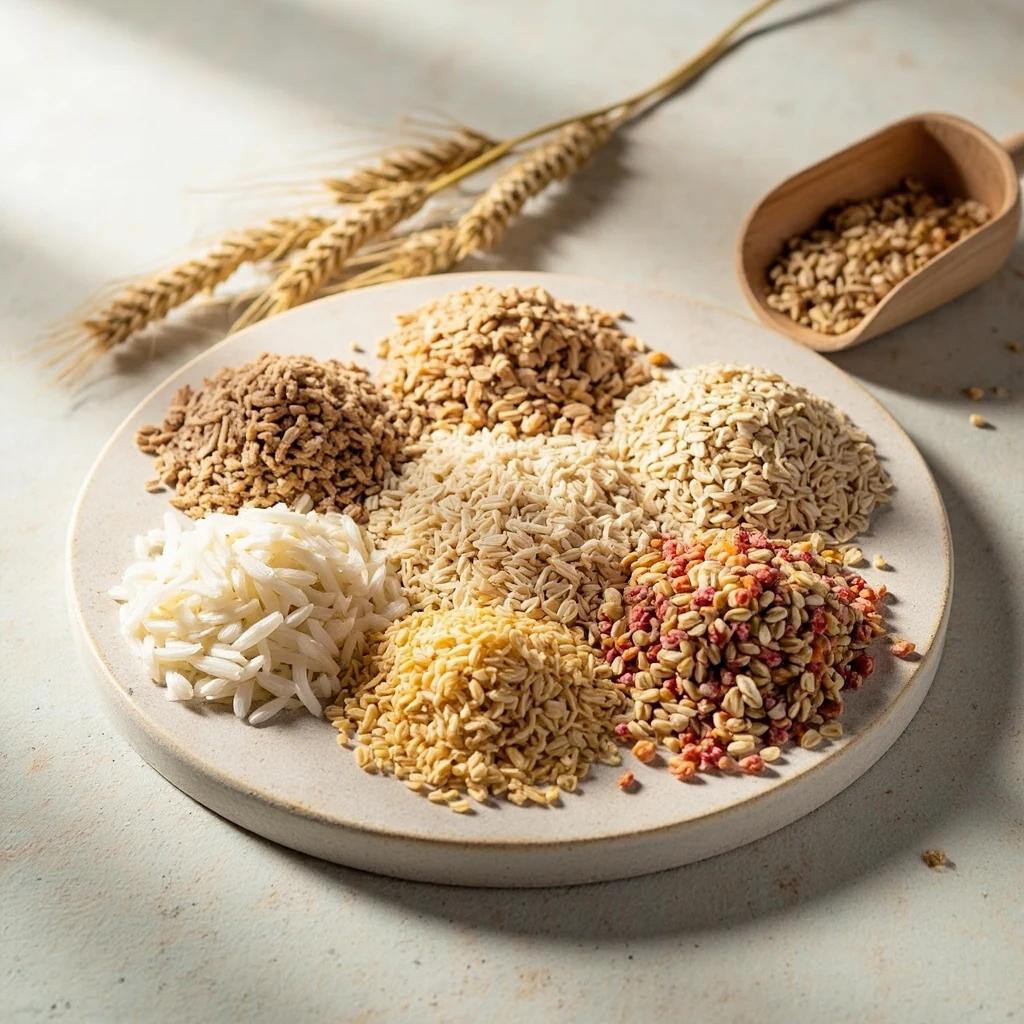
Before any of these ten can be scored, someone has to decide whether the category counts kernels, milled fractions, pressed oil or extruded cereal, because the entries sit at four different points along that line and the answer decides the score. Six of the ten convert grain rather than merely moving it, and the conversion step sets both the margin and the customer: wheat leaving a mill for an industrial bakery is not the same business as wheat leaving a plant as a breakfast flake bound for a shopper. The boundary is therefore a statement about products, not about how large a company is.
Wet Milling Turns A Kernel Into An Ingredient And Nearly Ends The Argument. Corn entering a wet mill leaves as starch, glucose syrup, protein and feed co-products, which is why ADM's carbohydrate business sits inside a grains ranking although a shopper will never meet it on a shelf, and why Bunge's dry corn milling for grits and flour is counted on the same basis. Both are grain businesses whose customers are other processors.
Milling Keeps The Kernel Whole But Changes Who Buys It. General Mills' Gold Medal flour and much of ADM's wheat book leave the plant as flour, still grain by any reasonable test, but the buyer is a bakery, a food processor or a store-brand supplier rather than a household. WK Kellogg's six North American plants take corn, wheat and rice and press them into flakes, puffs and crisps, output of more than 500 million pounds a year, which is grain that has changed shape twice before it is packed.
Pressing Moves The Crop Into Oils, Which Is Where The Line Gets Contested. A large share of Yihai Kerry's tonnage is soybean as well as rice and wheat, and the soybean side leaves as oil and meal; Louis Dreyfus and Bunge run crushing lines beside their elevators and are oilseed processors as much as grain handlers. Oil and meal count here when they come out of the same company's own crush, because the grain is still the input, but a refiner that only buys crude oil would not qualify on this measure at all.
The Line This Page Draws. Rice, wheat, corn, oats, barley, sorghum, millet and pulses count in full; flours, grits, starch, syrups, bran and germ count as grain-derived; edible oils and oilseed meal count when they leave the company's own plant; and ready-to-eat cereal counts because the base is still a grain. October Paddy is the useful test case, since RMB 4.755 billion of its 2025 revenue came from packaged rice and RMB 2.055 billion from coarse grains, beans and other grain products, so the whole company qualifies, while a diversified group with a small grain division is discounted by the 35% weight rather than excluded outright.
Why The Boundary Is Not A Technicality. The further a business moves from the kernel, the more of its margin comes from packaging, brand and shelf position rather than from the crop, and a company that is paid for those things is being rewarded for something other than grain. Fixing the line first is what allows a US$160 billion trader and a US$950 million rice brand to be placed on the same page without one of them being misdescribed.
China supplies three entries on this page and each reaches capacity through a different structure: a central state group that owns the chain, a subsidiary of a foreign group that owns the plants, and a listed brand that owns its bases. The structure decides who funds expansion, who absorbs a bad harvest and who can be asked for the accounts, which is why three companies operating in one market read so differently.
The Central State Group Owns The Chain And Weighs Policy Alongside Profit. COFCO was founded in 1949, runs more than 300 grain and oil processing plants, handles over 180 million tonnes of agricultural product a year across 35 countries with more than 100,000 staff, and expanded its Santos port grain terminal in 2025 to strengthen cross-border collection and storage. The group is unlisted and keeps its exchange filings at listed subsidiaries such as COFCO Sugar under 600737.SH and COFCO Engineering under 301058.SZ, so group figures arrive from domestic publication while audited detail arrives only at the subsidiary level.
The Foreign-Held Listed Arm Owns The Plants And Answers To Minority Shareholders. Yihai Kerry was incorporated in 2005 on a business traced to 1988, trades on the ChiNext board under 300999, holds more than 80 integrated production bases and earned RMB 3.153 billion of attributable profit in 2025, up 26.01%, on revenue of RMB 245.126 billion with more than 98% of it inside China. Its parent is Singapore-listed Wilmar, so capital allocation, disclosure duties and brand strategy arrive from two jurisdictions at once, and the Chinese arm competes with a state group that does not face the same shareholder calendar.
The Brand That Owns Its Bases Sells Through Fewer Hands. October Paddy listed on the Hong Kong main board under 09676, began in 2011, runs seven production bases including Shenyang and Wuchang with over 1.5 million tonnes of designed capacity and about 3,200 staff, and sells mostly online. The results keep channel cost visible: 2025 revenue of RMB 6.81 billion, up 18.5%, attributable profit up 109.5% to RMB 428 million, gross margin at 19.9%, and more than 99% of sales inside China.
Where Each Structure Is Most Exposed. The state group carries a reserve and food-security duty that a listed peer does not, and profit is not its only objective. The foreign-held arm depends on a home market that supplies nearly all its revenue and on decisions taken above it. The direct-to-consumer brand funds capacity before the volume arrives and sells through platforms that can reprice its channel at any time. What the three share is that they built processing close to the grain rather than close to the customer, exactly the logic that produced the merchants' terminals higher up the page.
What The Chinese Entries Say About The Wider List. All three are scored on grain revenue rather than on group size, and between them they hold three of the four most grain-concentrated positions on this page. That concentration is the reason the 35% category-fit block carries weight close to the 40% scale block, and the reason a Chinese rice brand with less than a billion dollars of turnover can sit within reach of companies many times its size.
Fortune Global 500 membership belongs to the legal entity that files the revenue, not to a brand on a pack and not to a group that happens to own one, and two positions on this page turn on that single rule. It protects the ranking from inflating a small operating company with a large shareholder, and it is the reason the lower half of this list is made of businesses that are household names and comparatively modest in scale.
A Spin-Off Starts With Its Own Accounts And No Ranking History. WK Kellogg was created in 2023 when the Kellogg Company separated its North American cereal business, so it inherited a plant network and a brand heritage reaching back to 1906 rather than a position on any revenue list. It reports US$2.6 billion of net sales for 2025 from six large plants and roughly 3,000 employees, well below the threshold, and the separation means the cereal business is now graded on its own resources instead of on the scale of the group it left behind.
A Subsidiary Inside A Larger Group Is Scored On Its Own Sales Line. Quaker has been wholly owned by PepsiCo since 2001, and PepsiCo reported US$93.925 billion of net revenue for 2025, but the oat and cereal business on this page generated about US$3.2 billion from more than 25 dedicated oat mills handling over two million tonnes of raw grain a year, with China alone worth roughly US$450 million. None of the parent's revenue is attributed to the entry, and none of the parent's distribution scale is credited to it either.
The Five Members Clear The Bar Inside Their Own Filings. ADM was placed 143rd in the 2025 list; Bunge 279th on US$53.1 billion; Louis Dreyfus 299th on US$50.6 billion; Cargill qualifies as an unlisted company on roughly US$160 billion of turnover; and COFCO qualifies on RMB 589.1 billion of group revenue. Each of the five appears because its own revenue clears the threshold, which is also why four of them occupy the top four positions here rather than being spread through the table.
Why The Rule Matters To A Reader. Anyone comparing Quaker with its parent, or WK Kellogg with the company it was separated from, will compare a grain business against a snack, beverage or international foods portfolio and will badly misjudge the grain operation's size. The rule also explains the shape of this page: the branded entrants are graded at the size of the cereal, flour or oat business they actually run, which is why a globally familiar name can sit below a private Swiss-registered oilseed processor.
The Rule Cuts Both Ways For A Reader Looking For Safety. A parent's balance sheet can support a subsidiary long after the subsidiary's own accounts would have failed, and the ranking deliberately does not credit that support. What it does credit is what the entry controls, which is also the only basis on which a supplier of grain for a packaged product can be compared with the brand that sells it.
Certified acres have moved out of the sustainability section of an annual report and into the terms of a supply contract, because a premium retail or industrial buyer now asks for a verifiable growing practice rather than a policy commitment. The change is measurable because the programmes are written as acreage targets tied to named crops in named regions, which makes them auditable in a way that a carbon pledge framed as an ambition never was.
Regenerative Sourcing Is Written As Acreage, Not As Intention. Cargill committed through 2025 and 2026 to adding two million acres of certified sustainable grain in China and the wider Asia-Pacific region, and ADM runs certified programmes across its North American and South American origination areas; in both cases a growing method becomes a contract term that a farm must satisfy to keep a delivery slot. An acre figure survives an audit and a statement of intent does not, which is the whole reason the metric changed.
Traders And Brand Owners Want The Same Certificate For Opposite Reasons. A merchant wants certified volume because physical buyers increasingly specify it, because lenders and reporting frameworks ask about emissions in the supply chain, and because verifiable practice is a defence when a customer asks where a cargo came from. A consumer brand wants it for a claim on a pack and for access to retailers that will not list a product without it, which is why General Mills ties its whole-grain range to a regenerative wheat programme and Quaker rebuilt its North American supply chain through 2025. The paperwork is identical; the motive is not.
The Cost Of Transition Lands Where The Bargaining Power Is Weakest. Cover crops, reduced tillage and rotation changes cost money up front, take several seasons to repay and can cut yield in the first years, so a grower carrying the change alone absorbs the risk while the benefit arrives somewhere else in the chain. Where a contract prices the practice, through a per-bushel premium or a fixed delivery agreement, the cost is shared; where it does not, the programme is a service the farm provides to its buyer for nothing.
The Chinese Entrants Reach The Same Place By A Different Route. Yihai Kerry's rice circular economy turns husk, bran and rice oil into products that would otherwise be waste, and its central-kitchen expansion moves the same grain into prepared staples; COFCO controls collection, storage and processing along a state-built chain from the north-eastern growing regions to port; October Paddy owns or contracts its bases directly, which removes intermediaries between the field and the pack. None of the three runs a certified-acre programme of the Western kind, yet each does the same job of closing the distance between the farm and the buyer.
How To Test The Claim. Ask how many acres are certified, under which standard and verified by whom; ask whether the figure is cumulative or annual; and ask whether the practice is tied to a purchase obligation or only to a reporting target. A programme that fails the third test is a marketing line, and one that passes it changes how grain is bought rather than how a company is described.