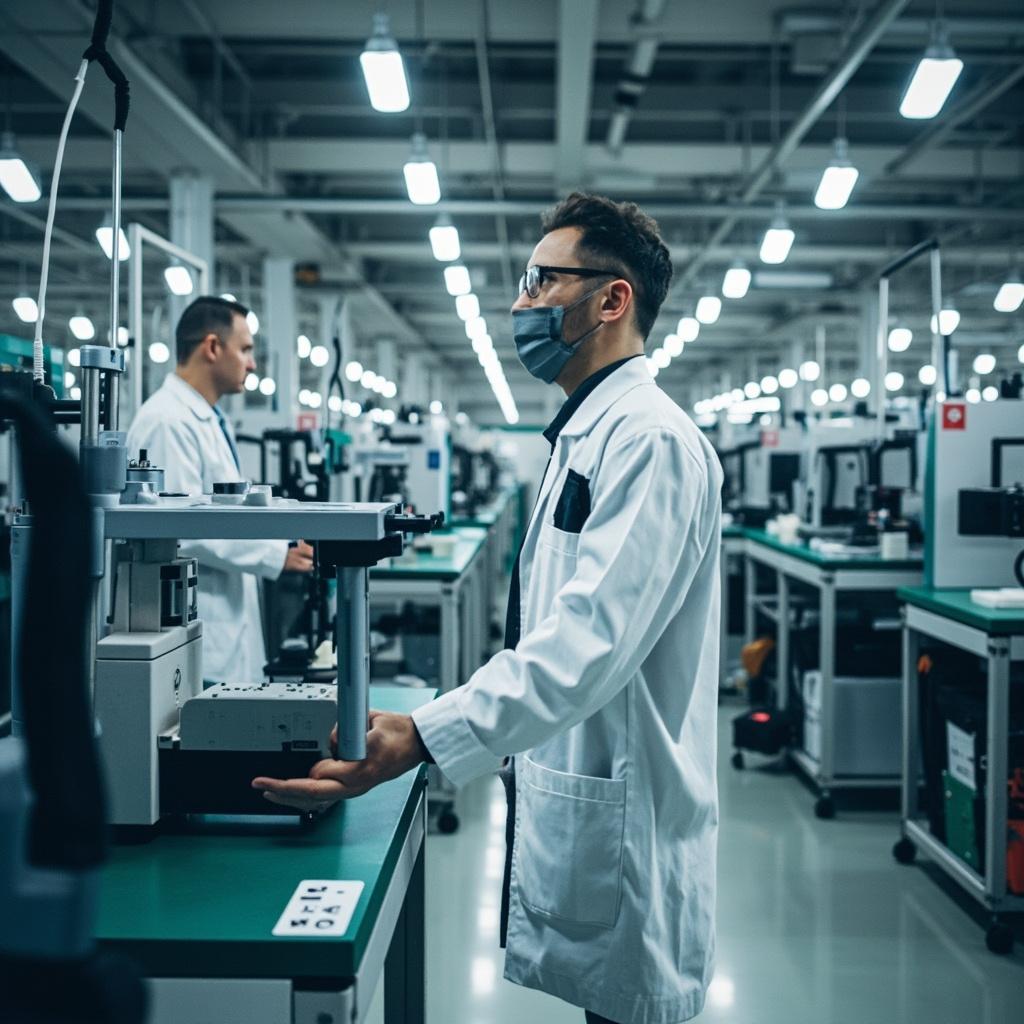
Heavy-asset self-production is the admission ticket to this ranking — a 40% weight and a veto criterion. Every manufacturer listed owns its precision machining lines, sensor fabrication, electronics assembly, and calibration facilities. Brand-licensing shells, pure OEM/ODM assemblers, and companies outsourcing core production are excluded entirely.
Scale of production carries the core weight. Thermo Fisher operates hundreds of facilities in more than 50 countries with 125,000 employees; Emerson runs 117 manufacturing plants; Danaher's factories span diagnostics and life sciences; Mindray operates 14 modern manufacturing facilities with five R&D centers. Facility count, production capacity, and heavy-asset investment define this dimension.
Category fit adds 30%. The most valuable manufacturers span multiple instrument categories: Thermo Fisher covers scientific laboratory equipment, medical diagnostics, and biopharma services; Siemens spans industrial automation, process control, and building technology; Danaher covers diagnostics, life sciences, and biotechnology.
Financial performance and market reach contribute the final 30%. Revenue, free cash flow, R&D intensity, and brand heat determine the composite score. A manufacturer can rank high on output yet lose points on profitability or brand recognition — the composite reveals which manufacturers combine scale with sustainable value creation.
Thermo Fisher, Danaher, and Emerson represent the three deepest vertical integration models in the instrumentation industry, followed closely by Endress+Hauser and Mindray.
Thermo Fisher is the extreme case of closed-loop manufacturing. The company produces everything from core reagents and cell culture media to large precision instruments and gene sequencers in-house, with US$2 billion of new US capacity announced in 2025. Its factories in Waltham, Carlsbad, Suzhou, and Hangzhou span the full scientific supply chain.
Danaher applies the Danaher Business System (DBS) across its operating companies. Cepheid's molecular diagnostics cartridges, Leica's microscopy systems, and Beckman Coulter's clinical analyzers are all manufactured in Danaher-owned facilities with obsessive lean-process discipline, giving the company exceptional quality and margin performance.
Emerson is the process industry integration benchmark. Its 117 manufacturing plants build Rosemount transmitters, Fisher control valves, and ASCO solenoid products, and the 2025 integration of AspenTech software and National Instruments hardware created a full-stack "hardware + software + digital twin" offering.
Endress+Hauser even fabricates its own ASICs and printed circuit boards. This family-owned Swiss group controls the entire process instrumentation stack, from semiconductor-level components to complete measurement systems — a level of vertical integration rare even among large public companies. Mindray similarly maintains 100% self-manufacturing across its 14 plants, with 90% overseas employee localization.
Five trends are reshaping global instrument manufacturing in 2026: regionalized production, Instrument-as-a-Service, software-defined instruments, AI-enabled automation, and the return to vertical integration.
Production is regionalizing at unprecedented speed. US tariffs on sensors, analyzers, and control components ended the "single origin, global distribution" model. Thermo Fisher is investing US$2 billion in US manufacturing; Chinese companies like Mindray are deepening Asian supply loops; and European manufacturers are expanding North American capacity. The result is redundant, "in-region for region" production lines for critical equipment.
Instrument-as-a-Service (IaaS) is transforming revenue models. Traditional one-time hardware purchases are shifting toward predictive maintenance, consumable auto-replenishment, and cloud data analytics subscriptions. Hexagon's 44% software/recurring revenue share and Mettler-Toledo's 8% service growth show the economics of this transition.
Software-defined instruments are blurring hardware boundaries. Emerson's AspenTech and NI integration, Keysight's PathWave software suite, and Siemens' digital twin platforms make instruments continuously upgradable through software, extending product lifecycles and creating recurring revenue.
AI-enabled automation is entering the factory. Modern instruments now perform autonomous analysis, self-calibration, and predictive diagnostics. Manufacturers investing in AI-driven quality control and data platforms are building the next competitive moat.
Vertical integration is returning. After decades of outsourcing, leading manufacturers are bringing core production back in-house — Boeing-style quality crises in aerospace and tariff-driven supply shocks have made self-manufacturing the industry's defining competitive advantage again.
The top instrument manufacturers differ dramatically in scale, business model, and strategic focus.
Thermo Fisher is the revenue leader by a wide margin. At US$44.6 billion with 125,000 employees, it is more than twice the size of its nearest instrument-focused competitor, generating scale advantages in R&D, manufacturing, and distribution that no rival can match. Its Scientific Instruments, Life Sciences, Diagnostics, and Biopharma Services segments span the entire scientific workflow.
Siemens is the industrial automation giant. With EUR 78.9 billion in group revenue and roughly 318,000 employees, Siemens' instrumentation business is part of a vastly larger industrial technology empire spanning automation, electrification, and digitalization — providing unmatched financial depth for instrument R&D.
Danaher (US$24.6 billion) and ABB (US$30+ billion) occupy the mid-tier. Danaher focuses on high-margin diagnostics and life sciences through its DBS-managed operating companies, while ABB spans electrical and process automation with more than 105,000 employees. Emerson (US$18 billion) and Honeywell (US$36+ billion group) round out the diversified industrial players.
The specialists punch above their weight. Keyence generates US$7.8 billion with just 12,784 employees and 83% gross margins — the industry's most profitable business model. Mettler-Toledo (US$4.0 billion) dominates precision weighing, Sartorius (EUR 3.5 billion) leads bioprocess equipment, and Endress+Hauser (EUR 3.7 billion) rules process instrumentation. Mindray (US$4.8 billion) is the leading Chinese challenger with the fastest international growth trajectory.
This ranking is updated annually with a mid-cycle review, using the latest full-year financial results, production statistics, and industry databases available as of 2025-2026.
The data foundation includes four source types. First, audited financial statements: Thermo Fisher's 10-K, Siemens' annual report, Danaher's 10-K, and Emerson's sustainability and financial reporting. Second, production and facility data from company disclosures covering plant counts, capacity, and manufacturing footprint. Third, industry databases and market analyses that cross-verify revenue and market share. Fourth, news and regulatory filings capturing major events like Emerson's AspenTech and NI acquisitions, Thermo Fisher's US$2 billion investment, and Danaher's Masimo acquisition.
The mid-cycle review catches fast-moving changes. For example, Agilent's Q4 2025 growth acceleration, Mettler-Toledo's tariff margin impact, and Hexagon's restructuring program were all reflected within the same reporting period.
All data is publicly verifiable. Every score can be traced to its source: revenue figures to annual reports, facility counts to company disclosures, and brand values to independent analyses. This transparency is what separates VerityRank's methodology from marketing-driven "best of" lists.
Readers should expect the next full refresh in 2026 once FY2025 annual reports from all major manufacturers and the full 2026 delivery data become available.