VerityRank

Top 10 Plumbing & Electrical Systems Brands

HomeFood & BeverageTop 10 Plumbing & Electrical Systems Brands

The global plumbing and electrical systems industry is undergoing a fundamental transformation, driven by the converging forces of electrification, smart building integration, and infrastructure modernization. With a global market exceeding $250 billion and growing at 7% annually, this sector has evolved far beyond basic pipes and wires. Today's leading brands are sophisticated industrial conglomerates that produce ultra-high-voltage submarine cables, AI data center power distribution systems, smart water management networks, and advanced polymer piping with century-long service lives. The market's trajectory is being reshaped by three megatrends: the explosion of AI data center construction creating unprecedented demand for high-voltage and fiber optic cables; the global push for building electrification and renewable energy integration; and the shift from metal to advanced polymer pipes driven by corrosion resistance, lower carbon footprints, and extended service life.

The competitive landscape reveals a clear divide between vertically integrated industrial giants and companies that rely on outsourced manufacturing. The top-ranked brands in this report — from Prysmian Group's near-monopoly in submarine and high-voltage cable systems to Georg Fischer's two-century heritage in precision fluid control — all share one critical characteristic: control over their entire manufacturing chain. Those that invest in upstream raw material processing, in-house R&D, and global factory networks consistently outperform competitors that depend on contract manufacturing. The recent wave of consolidation — Prysmian's $3.9 billion Encore Wire acquisition, Nexans' purchase of Republic Wire, Orbia/Wavin's upstream PVC integration — demonstrates that scale and vertical control are becoming prerequisites for market leadership in an industry where safety, reliability, and supply chain resilience are non-negotiable.

Our Ranking Methodology

VerityRank evaluates companies across four equally weighted dimensions:

Market Influence (25%): Global market share, revenue scale, distribution network breadth, number of countries served, and year-over-year growth rate.

Brand Reputation (25%): Professional buyer ratings, industry awards and certifications (UL, NSF, ISO, EcoVadis), media sentiment analysis, and brand recognition among construction and engineering decision-makers.

Innovation & R&D (25%): Number of active patents, R&D investment as percentage of revenue, new product launch frequency, smart building technology integration, and contributions to industry standards (ASTM, IEC, ISO).

Sustainability & Ethics (25%): Environmental certifications, carbon footprint reduction targets, recycled material usage, circular economy programs, labor practices transparency, and supply chain ESG compliance.

Disclaimer: The data in this ranking is compiled from third-party authoritative sources, including national statistical agencies, university-affiliated research institutions, AI-driven global consumer sentiment analysis, and publicly listed company financial reports. The ranking results are based on a multi-dimensional algorithm model and are intended for reference and market decision support only. They do not constitute direct investment advice or brand endorsement.

Top 10 Rankings

2026.05 Edition
1
Prysmian Group

Prysmian S.p.A.

Prysmian Group is the world's largest manufacturer of energy and telecom cables, founded in 1879 in Milan, Italy. With annual revenue of €20 billion, the company operates 100+ factories across 50 countries, employing 30,000+ people worldwide. Listed on the Borsa Italiana (BIT: PRY), Prysmian has expanded through strategic acquisitions including the landmark $3.9 billion acquisition of Encore Wire in the United States, solidifying its leadership position in North American building wire markets.

Strengths: Prysmian's greatest competitive advantage is its unmatched vertical integration — from copper rod and fiber preform manufacturing through cable extrusion, armoring, and installation. It is one of the few manufacturers globally capable of producing submarine high-voltage cables in continuous lengths exceeding 100km. The company has achieved a 40.2% reduction in Scope 1 and 2 carbon emissions, incorporating recycled polyethylene and green aluminum into its cable sheathing. Its global factory network provides unparalleled supply chain resilience and proximity to major construction markets on every continent.

Weaknesses: The company's heavy reliance on European construction markets exposes it to regional economic slowdowns. Copper and aluminum price volatility directly impacts input costs and profitability, despite hedging programs. The integration of major acquisitions (Encore Wire, General Cable) presents ongoing operational and cultural challenges that demand sustained management attention.

Brand

Prysmian

Headquarters

Italy

Founded

1879

Workforce

30,000+

Presence

Global

Facilities

100+ factories in 50 countries

Market

Borsa Italiana: BIT: PRY

Key Product Categories
Building Materials CompaniesBuilding Materials SuppliersBuilding Materials CompaniesBuilding Materials SuppliersDoors & WindowsSecurity DoorsDoor & Window Hardware IndustryHome Security IndustryPlumbing & Electrical Systems ManufacturersBuilding Materials CompaniesBuilding Materials SuppliersBuilding Materials CompaniesBuilding Materials SuppliersDoors & WindowsSecurity DoorsDoor & Window Hardware IndustryHome Security IndustryPlumbing & Electrical Systems Manufacturers
2
Sumitomo Electric Industries

Sumitomo Electric Industries, Ltd.

Sumitomo Electric Industries is one of the world's largest wire and cable manufacturers and a core member of the Sumitomo Group, founded in 1897 in Osaka, Japan. With annual revenue of ¥4.68 trillion (approximately $30.5 billion), the company employs 288,145 people across five major business segments: automotive wiring harnesses, optical communications, electronic components, energy and infrastructure, and industrial materials. Listed on the Tokyo Stock Exchange (TYO: 5802).

Strengths: Unmatched diversification across five technology-intensive business segments provides resilience against sector-specific downturns. The company holds leadership positions in automotive wiring harnesses and optical fiber cable. Its massive R&D investment fuels continuous innovation, and cross-technology synergy between automotive, electronics, and power infrastructure creates unique competitive advantages. The company achieved record profits of ¥340 billion in the most recent fiscal year.

Weaknesses: Heavy exposure to Japanese yen exchange rate fluctuations impacts export competitiveness. Japan's domestic market offers limited growth potential, forcing reliance on overseas expansion. The company's enormous scale can slow decision-making compared to more focused competitors.

Brand

Sumitomo Electric

Headquarters

Japan

Founded

1897

Workforce

288,145

Presence

Global

Facilities

Global manufacturing network

Market

TYO: 5802

Key Product Categories
Building Materials CompaniesBuilding Materials SuppliersBuilding Materials CompaniesBuilding Materials SuppliersDoors & WindowsSecurity DoorsDoor & Window Hardware IndustryHome Security IndustryPlumbing & Electrical Systems ManufacturersBuilding Materials CompaniesBuilding Materials SuppliersBuilding Materials CompaniesBuilding Materials SuppliersDoors & WindowsSecurity DoorsDoor & Window Hardware IndustryHome Security IndustryPlumbing & Electrical Systems Manufacturers
3
Hengtong Group

Hengtong Group Co., Ltd.

Hengtong Group is China's largest power and fiber optic cable manufacturer, founded in 1991 in Suzhou, Jiangsu Province, China. With revenue of approximately ¥669 billion, the company operates through 80+ subsidiaries across six continents, employing 16,000+ people. Listed on the Shanghai Stock Exchange (SHA: 600487), Hengtong has built a fully vertically integrated manufacturing chain from optical fiber preform production to finished cable systems.

Strengths: Hengtong's complete vertical integration from raw material through finished cable production eliminates reliance on external suppliers. The company earned the EcoVadis Global Sustainability Gold Medal on its first assessment, ranking among the top 5% of companies worldwide. Its global manufacturing footprint spanning six continents provides excellent market access and supply chain diversification.

Weaknesses: The company remains heavily dependent on the Chinese domestic market, exposing it to real estate downturn risks. International brand recognition lags behind Western and Japanese competitors like Prysmian and Sumitomo. The rapid pace of global expansion presents integration and quality consistency challenges across its diverse manufacturing facilities.

Brand

Hengtong

Headquarters

China

Founded

1991

Workforce

16,000+

Presence

Global

Facilities

Full vertical integration manufacturing base

Market

SHA: 600487

Key Product Categories
Building Materials CompaniesBuilding Materials SuppliersBuilding Materials CompaniesBuilding Materials SuppliersDoors & WindowsSecurity DoorsDoor & Window Hardware IndustryHome Security IndustryPlumbing & Electrical Systems ManufacturersBuilding Materials CompaniesBuilding Materials SuppliersBuilding Materials CompaniesBuilding Materials SuppliersDoors & WindowsSecurity DoorsDoor & Window Hardware IndustryHome Security IndustryPlumbing & Electrical Systems Manufacturers
4
Orbia Advance (Wavin)

Orbia Advance Corporation, S.A.B. de C.V.

Orbia Advance Corporation / Wavin/ is a global leader in polymer piping solutions, operating under its Wavin brand. Founded in 1953 and headquartered in Mexico City with operational headquarters in Zwolle, Netherlands, the group achieved revenue of $7.62 billion with an EBITDA of $1.11 billion. Wavin employs 10,000+ people across 50+ advanced extrusion and injection molding facilities in 37 countries. Listed on the Mexican Stock Exchange (BMV: ORBIA).

Strengths: Orbia's defining advantage is its full upstream-to-downstream vertical integration: from PVC polymer resin production to finished Wavin pipes and fittings. The company achieved 90% zero-waste-to-landfill at its manufacturing sites and a 28% reduction in greenhouse gas emissions. Its "Vinyl in Motion" circular economy program recycles thousands of tons of PVC annually.

Weaknesses: High interest rates in key markets have dampened residential construction activity, reducing demand for building pipes. Wavin faces price competition from regional Asian producers in price-sensitive markets. The dual headquarters structure creates management complexity between the chemical and building products divisions.

Brand

Orbia / Wavin

Headquarters

Mexico

Founded

1953

Workforce

22,000+

Presence

Global

Facilities

Operations across 50+ countries

Market

BMV: ORBIA

Key Product Categories
Building Materials CompaniesBuilding Materials SuppliersBuilding Materials CompaniesBuilding Materials SuppliersDoors & WindowsSecurity DoorsDoor & Window Hardware IndustryHome Security IndustryPlumbing & Electrical Systems ManufacturersBuilding Materials CompaniesBuilding Materials SuppliersBuilding Materials CompaniesBuilding Materials SuppliersDoors & WindowsSecurity DoorsDoor & Window Hardware IndustryHome Security IndustryPlumbing & Electrical Systems Manufacturers
5
Nexans

Nexans S.A.

Nexans is one of the world's premier cable manufacturers and a leader in electrification solutions, founded in 2000 (with roots tracing to Alcatel's cable division) and headquartered in Paris, France. With revenue of €7.81 billion and an adjusted EBITDA of €728 million, the company employs 25,700 people across 41 countries. Listed on Euronext Paris (EPA: NEX), Nexans is aggressively pivoting to become a pure electrification player, acquiring US-based Republic Wire to strengthen its North American presence.

Strengths: Nexans possesses rare heavy industrial assets including its own cable-laying vessel fleet, giving it end-to-end control from manufacturing to submarine installation. The company achieved 8.3% organic growth and a record 11.9% EBITDA margin. Its acquisition of Republic Wire provides immediate access to the North American building wire market.

Weaknesses: The ongoing divestiture of the automotive wiring harness business creates short-term financial uncertainty. Nexans faces intense competition from larger rivals Prysmian and Sumitomo. European market growth remains sluggish, and heavy manufacturing assets create high fixed costs during demand downturns.

Brand

Nexans

Headquarters

France

Founded

2000

Workforce

25,700

Presence

Global

Facilities

Operations in 41 countries

Market

EPA: NEX

Key Product Categories
Building Materials CompaniesBuilding Materials SuppliersBuilding Materials CompaniesBuilding Materials SuppliersDoors & WindowsSecurity DoorsDoor & Window Hardware IndustryHome Security IndustryPlumbing & Electrical Systems ManufacturersBuilding Materials CompaniesBuilding Materials SuppliersBuilding Materials CompaniesBuilding Materials SuppliersDoors & WindowsSecurity DoorsDoor & Window Hardware IndustryHome Security IndustryPlumbing & Electrical Systems Manufacturers
6
Southwire Company

Southwire Company, LLC

Southwire Company is the largest privately held wire and cable manufacturer in North America, founded in 1950 in Carrollton, Georgia, USA. With annual revenue of approximately $8.4 billion, the company employs 9,000 people and maintains a dense network of vertically integrated manufacturing facilities across the United States, Canada, and Mexico. Southwire supplies nearly half of all new residential and commercial building electrical wiring in North America.

Strengths: Southwire's proprietary SCR (Southwire Continuous Rod) copper and aluminum casting technology is a near-monopoly advantage, giving it control over the critical first stage of wire production. Its 75-year heritage and deep integration with North American electrical distributors create formidable barriers to entry. The company is investing $1.5 billion in a multi-year modernization program for data center and grid modernization cables.

Weaknesses: As a private company, Southwire lacks access to public equity markets for large-scale international expansion or major acquisitions. Its geographic footprint is overwhelmingly concentrated in North America. The company is partially hostage to North American housing starts cycles.

Brand

Southwire

Headquarters

USA

Founded

1950

Workforce

9,000

Presence

North America & Global

Facilities

Major manufacturing base in Georgia, USA

Market

Private (Largest private cable company)

Key Product Categories
Building Materials CompaniesBuilding Materials SuppliersBuilding Materials CompaniesBuilding Materials SuppliersDoors & WindowsSecurity DoorsDoor & Window Hardware IndustryHome Security IndustryPlumbing & Electrical Systems ManufacturersBuilding Materials CompaniesBuilding Materials SuppliersBuilding Materials CompaniesBuilding Materials SuppliersDoors & WindowsSecurity DoorsDoor & Window Hardware IndustryHome Security IndustryPlumbing & Electrical Systems Manufacturers
7
ZTT Group

ZTT Group (Jiangsu Zhongtian Technology Co., Ltd.)

ZTT Group / Jiangsu Zhongtian Technology is a leading Chinese manufacturer of specialized cable systems and energy solutions, founded in 1992 in Nantong, Jiangsu Province, China. With revenue exceeding $13.5 billion, the company operates through 80+ subsidiaries with manufacturing in six countries including India, Brazil, Indonesia, and Germany, employing 16,000+ people. Listed on the Shanghai Stock Exchange (SHA: 600522).

Strengths: ZTT's deep expertise in submarine and marine cable systems positions it to capture offshore wind power growth. The company earned the EcoVadis Global Sustainability Gold Medal. Its new Saudi Arabia manufacturing facility will significantly shorten Middle Eastern delivery times. Cross-synergy between cable and energy storage divisions enables integrated solutions.

Weaknesses: International brand recognition remains low compared to Prysmian and Nexans, limiting premium pricing power. The company relies heavily on the Chinese domestic market. Rapid global expansion creates operational complexity across geographically dispersed manufacturing sites.

Brand

ZTT

Headquarters

China

Founded

1992

Workforce

16,000+

Presence

Global

Facilities

Smart manufacturing bases across China

Market

SHA: 600522

Key Product Categories
Building Materials CompaniesBuilding Materials SuppliersBuilding Materials CompaniesBuilding Materials SuppliersDoors & WindowsSecurity DoorsDoor & Window Hardware IndustryHome Security IndustryPlumbing & Electrical Systems ManufacturersBuilding Materials CompaniesBuilding Materials SuppliersBuilding Materials CompaniesBuilding Materials SuppliersDoors & WindowsSecurity DoorsDoor & Window Hardware IndustryHome Security IndustryPlumbing & Electrical Systems Manufacturers
8
Georg Fischer (GF)

Georg Fischer AG

Georg Fischer AG / GF Piping Systems is a Swiss precision manufacturing group with over 200 years of industrial heritage, founded in 1802 in Schaffhausen, Switzerland. With revenue of CHF 4.11 billion, the company employs 16,332 people, of whom 13,270 are dedicated to its core GF Piping Systems division. Listed on the SIX Swiss Exchange (SWX: GF), GF completed a historic strategic pivot by divesting its machining solutions business to become a pure-play fluid control company.

Strengths: GF's 223-year heritage and Swiss precision engineering reputation command premium pricing that competitors cannot match. The divestiture of its cyclical machine tools business created a focused, high-margin pure-play company. Its leadership in specialized polymer materials for ultra-pure water and semiconductor manufacturing provides access to high-growth industrial markets.

Weaknesses: The strong Swiss franc creates persistent pricing disadvantages in export markets. GF's premium positioning makes it vulnerable to lower-cost Asian competitors in developing markets. The company's relatively small scale limits bargaining power with raw material suppliers.

Brand

GF

Headquarters

Switzerland

Founded

1802

Workforce

16,332

Presence

Global

Facilities

Precision manufacturing facilities globally

Market

SWX: GF

Key Product Categories
Building Materials CompaniesBuilding Materials SuppliersBuilding Materials CompaniesBuilding Materials SuppliersDoors & WindowsSecurity DoorsDoor & Window Hardware IndustryHome Security IndustryPlumbing & Electrical Systems ManufacturersBuilding Materials CompaniesBuilding Materials SuppliersBuilding Materials CompaniesBuilding Materials SuppliersDoors & WindowsSecurity DoorsDoor & Window Hardware IndustryHome Security IndustryPlumbing & Electrical Systems Manufacturers
9
LS Cable & System

LS Cable & System Ltd.

LS Cable & SystemLS is South Korea's largest wire and cable manufacturer, founded in 1962 in Anyang, Gyeonggi Province, South Korea. With revenue of ₩7.58 trillion (approximately $5.2 billion), the company operates 35 manufacturing subsidiaries across 19 countries, employing more than 10,000 people. Listed via its parent LS Corp on the Korea Exchange (KRX: 006260).

Strengths: An unprecedented ₩7.63 trillion backlog of uncompleted orders locks in multi-year revenue visibility. The company's $50 million expansion of its North Carolina factory demonstrates aggressive in-region-for-region strategy. Its strategic partnership with Australia's Lynas Rare Earths for permanent magnet supply shows exceptional supply chain foresight.

Weaknesses: South Korea's small domestic market forces direct competition with global giants in every export market. The heavy capital expenditure program strains free cash flow. Relative underinvestment in fiber optic and telecom cables limits diversification.

Brand

LS Cable & System

Headquarters

South Korea

Founded

1962

Workforce

10,000+

Presence

Global

Facilities

Heavy chemical asset manufacturing

Market

KRX: 006260 (parent LS Corp)

Key Product Categories
Building Materials CompaniesBuilding Materials SuppliersBuilding Materials CompaniesBuilding Materials SuppliersDoors & WindowsSecurity DoorsDoor & Window Hardware IndustryHome Security IndustryPlumbing & Electrical Systems ManufacturersBuilding Materials CompaniesBuilding Materials SuppliersBuilding Materials CompaniesBuilding Materials SuppliersDoors & WindowsSecurity DoorsDoor & Window Hardware IndustryHome Security IndustryPlumbing & Electrical Systems Manufacturers
10
China Lesso Group

China Lesso Group Holdings Limited

China Lesso Group Holdings is Asia's largest manufacturer of plastic pipes and fittings, founded in 1986 in Foshan, Guangdong Province, China. With annual revenue of ¥243 billion (approximately $3.4 billion), the company operates 30+ highly automated manufacturing bases with a total annual design capacity of 3.29 million tons of plastic pipe and related building materials. Listed on the Hong Kong Stock Exchange (HKG: 2128).

Strengths: Lesso's unparalleled manufacturing scale — 3.29 million tons annual capacity across 30+ factories — creates insurmountable cost advantages. The company is strategically pivoting its massive production capacity toward sponge city pipeline networks and photovoltaic infrastructure, aligning with national priorities. Its dense factory network provides exceptional logistics advantages throughout China.

Weaknesses: Revenue declined approximately 10% year-over-year due to collapsing PVC resin prices and China's real estate downturn. Goodwill and asset impairment charges suggest past acquisitions may be underperforming. Heavy concentration in the Chinese market makes Lesso uniquely vulnerable to China's construction cycle.

Brand

LESSO

Headquarters

China

Founded

1986

Workforce

10,000+

Presence

Asia & Global

Facilities

Massive Asian manufacturing base cluster

Market

HKG: 2128

Key Product Categories
Building Materials CompaniesBuilding Materials SuppliersBuilding Materials CompaniesBuilding Materials SuppliersDoors & WindowsSecurity DoorsDoor & Window Hardware IndustryHome Security IndustryPlumbing & Electrical Systems ManufacturersBuilding Materials CompaniesBuilding Materials SuppliersBuilding Materials CompaniesBuilding Materials SuppliersDoors & WindowsSecurity DoorsDoor & Window Hardware IndustryHome Security IndustryPlumbing & Electrical Systems Manufacturers

Frequently Asked Questions

How Do We Generate Our Rankings?
At Verity Rank, our ranking methodology is built on data, not opinions. We aggregate and cross-validate information from multiple authoritative third-party sources to produce the most objective industry ranking possible.

1. Data Sources — Multi-Source Cross-Verification
Our primary data comes from four pillars:
National Statistical Agencies: Government statistical bureaus across major economies provide verified data on production volumes, trade flows, and industry revenues.
University-Affiliated Research Institutions: Peer-reviewed studies from leading institutions including MIT, ETH Zurich, Tsinghua University, and LSE provide insights into technology trends and market dynamics.
AI-Driven Global Consumer Sentiment Analysis: NLP algorithms analyze millions of reviews, social media posts, and buyer feedback across 40+ languages.
Publicly Listed Company Financial Reports: SEC filings, annual reports, earnings transcripts, and ESG disclosures provide verified revenue data, R&D spending, and profit margins.

2. The Four-Dimensional Scoring Model
Each company is evaluated across four equally weighted dimensions:
Market Influence (25%): Global market share, revenue scale, distribution network, countries served, growth rate.
Brand Reputation (25%): Ratings, awards, certifications, media sentiment, brand recognition.
Innovation & R&D (25%): Active patents, R&D investment, product launches, technology partnerships.
Sustainability & Ethics (25%): Environmental certifications, carbon reduction, labor practices, supply chain transparency.

3. Our Commitment to Independence
We do not accept payment for rankings. No company can pay to improve its position. Rankings are updated quarterly.

Disclaimer: The data is compiled from third-party authoritative sources and intended for reference and market decision support only. It does not constitute direct investment advice or brand endorsement.
What is the Plumbing & Electrical Systems Industry and What Products Does It Include?
The plumbing and electrical systems industry is a cornerstone of modern construction, encompassing the manufacturing of products that deliver water, gas, and electricity throughout buildings — from single-family homes to skyscrapers and industrial complexes. With a global market exceeding $250 billion and growing at 7% annually, this sector is foundational to urbanization, infrastructure modernization, and the global energy transition.

Major Product Categories:
Water Pipe Materials (7.1): PVC, CPVC, PEX, HDPE, copper, and multi-layer composite pipes for potable water, drainage, and industrial fluid transport. The shift from metal to polymer pipes continues, driven by corrosion resistance, lower installation costs, and longer service life.
Wires & Cables (7.2): Building wire (THHN/THWN), power cables (low/medium/high voltage), fiber optic cables, data communication cables (Cat6/Cat7), fire-resistant cables, and specialized cables for renewable energy and EV charging infrastructure. This is the largest sub-segment, driven by electrification and AI data center demand.
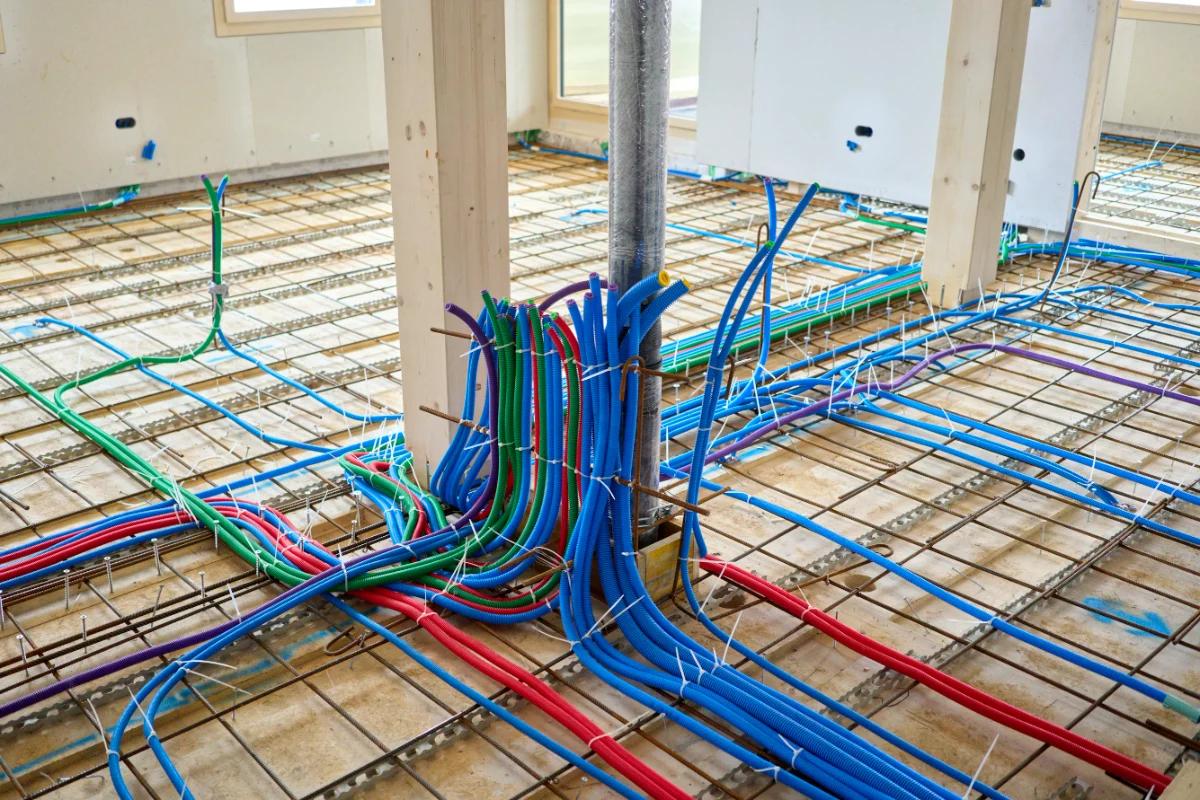
Floor Heating Systems (7.3): Hydronic (water-based) and electric underfloor heating systems, including PEX tubing, manifolds, thermostats, and insulation panels. Growing rapidly in residential and commercial retrofits.
Pipe Fittings & Valves (7.4): Elbows, tees, couplings, unions, flanges, ball valves, gate valves, check valves, and pressure-regulating valves in brass, stainless steel, PVC, and engineered polymers. Precision manufacturing and material certification are critical.
Water Purification Solutions (7.5): Filtration systems, reverse osmosis units, UV sterilization, water softeners, and point-of-use treatment devices — increasingly integrated into smart building water management.

Industry Dynamics: The sector is shaped by three megatrends: electrification (EV charging, heat pumps, building electrification), digitization (smart metering, leak detection, IoT-enabled building management), and sustainability (lead-free materials, recyclable polymers, low-carbon manufacturing). The industry is highly regionalized due to weight-to-value ratios, with manufacturers maintaining production facilities close to major construction markets.
What Are the Key Technologies, Materials, and Quality Standards in Plumbing & Electrical Systems?
The plumbing and electrical systems industry operates at the intersection of polymer chemistry, metallurgy, electrical engineering, and precision manufacturing — requiring sophisticated process control and rigorous quality standards.

1. Pipe Manufacturing Technologies:Extrusion: PVC, CPVC, HDPE, and PEX pipes are produced through continuous extrusion processes at high speeds (up to 100m/min). Multi-layer co-extrusion combines different polymers for specific properties — e.g., oxygen barrier layers for floor heating pipes. • Injection Molding: Pipe fittings are produced in high-cavitation injection molds (up to 128 cavities) with cycle times under 30 seconds. • Cross-linking: PEX pipes use peroxide (PEX-a), silane (PEX-b), or electron beam (PEX-c) cross-linking to improve temperature and pressure resistance.

2. Cable Manufacturing:Wire Drawing: Copper or aluminum rod is drawn through progressively smaller diamond dies to achieve the required conductor diameter. • Stranding: Multiple wires are twisted together for flexibility and current-carrying capacity. • Insulation Extrusion: Conductors are coated with PVC, XLPE (cross-linked polyethylene), or EPR (ethylene propylene rubber) in continuous vulcanization (CV) lines. • Armoring and Sheathing: Steel wire or tape armor for mechanical protection, followed by outer sheathing.

3. Quality Standards:ASTM: ASTM D1785 (PVC pipe), ASTM F876 (PEX), ASTM B3 (copper wire). • ISO: ISO 4427 (PE pipes), ISO 1452 (PVC-U pipes), ISO 9001 (quality management). • IEC: IEC 60228 (conductors), IEC 60502 (power cables). • NSF/ANSI 61: Drinking water system components — health effects. • UL: UL 83 (thermoplastic-insulated wires), UL 44 (thermoset-insulated wires). • Fire performance: IEC 60332 (flame retardance), IEC 61034 (smoke density), CPR (EU Construction Products Regulation).

4. Emerging Technologies:Non-destructive testing: Ultrasonic, X-ray, and eddy current inspection for quality assurance. • Smart pipes: Embedded fiber optic sensors for leak detection and structural health monitoring. • Green materials: Bio-based PVC, recycled copper/aluminum, lead-free brass alloys. • Prefabrication: Modular MEP (mechanical, electrical, plumbing) systems assembled off-site for faster construction.
What Should Buyers Consider When Sourcing Plumbing & Electrical Products?
Sourcing plumbing and electrical products — whether for a construction project, a wholesale distributor, or an industrial procurement team — requires evaluating technical specifications, regulatory compliance, supply chain reliability, and total lifecycle cost in a highly regulated and safety-critical industry.

1. Product Certifications & Compliance: Verify that products carry the required certifications for your target market — UL listing (US), CSA (Canada), CE marking (EU), CCC (China), AS/NZS (Australia/New Zealand). For water contact: NSF/ANSI 61, WRAS (UK), ACS (France), KTW/DVGW (Germany). For fire safety: CPR classification (EU), UL 94 flame rating. Non-compliant products can lead to project rejection, liability claims, and safety hazards.

2. Technical Specifications: Define precise requirements — pipe pressure ratings (PN6-PN25), temperature ratings, chemical resistance, UV stability, joint type (solvent weld, mechanical, push-fit, fusion), and dimensions. For cables: conductor material (copper vs. aluminum), insulation type (PVC, XLPE, LSZH), voltage rating, ampacity, and installation environment (indoor, outdoor, direct burial, conduit).

3. Supply Chain & Lead Times: Plumbing and electrical products are bulk commodities — transportation costs can exceed material costs. Evaluate supplier proximity to project sites, warehouse capacity, and delivery logistics. Long lead-time items (custom cable assemblies, large-diameter specialty pipes) require early ordering. Understand the supplier's raw material sourcing — copper and PVC resin prices are volatile.

4. Warranty & Lifecycle Cost: Evaluate warranty coverage (typically 10-25 years for pipes, 5-10 years for cables). Consider total lifecycle cost — installation labor, maintenance, and replacement frequency. Premium products with longer service life often have lower 50-year total cost of ownership.

5. Sustainability & ESG: Request Environmental Product Declarations (EPDs), recycled content percentages, and carbon footprint data. Green building certifications (LEED, BREEAM, Green Star) award points for sustainable material choices. Lead-free and low-VOC products are increasingly mandatory in developed markets.
Which Regions and Companies Lead the Global Plumbing & Electrical Systems Industry?
The global plumbing and electrical systems industry is dominated by industrial conglomerates from Europe, North America, and Asia — each region bringing distinct competitive advantages in manufacturing scale, technology leadership, and market access.

1. Europe — Technology & Premium Manufacturing: European manufacturers lead in high-value cables and precision pipe systems. Prysmian Group (Italy) is the world's largest cable manufacturer with €20B revenue, 100+ factories, and leadership in submarine cables and fiber optics. Nexans (France) with €7.8B revenue focuses on electrification. Georg Fischer (Switzerland), with 200+ years of heritage, dominates premium polymer piping and fluid control systems. European companies excel in R&D intensity, premium positioning, and sustainability leadership.

2. North America — Infrastructure Scale: Southwire Company (USA), the largest privately held cable manufacturer at ~$8.4B revenue, dominates North American building wire markets with its proprietary copper rod technology. Orbia/Wavin (Mexico/Netherlands), with $7.6B revenue, leads in polymer pipe systems through upstream chemical integration — from PVC resin to finished pipes. North American strength comes from massive domestic construction markets and integrated supply chains.

3. Asia-Pacific — Volume & Growth: Sumitomo Electric (Japan), a ¥4.7 trillion conglomerate with 288,000 employees, combines cable manufacturing with automotive, electronics, and renewable energy. LS Cable & System (South Korea) with ₩7.6 trillion revenue is expanding aggressively into North American markets. Hengtong Group (China), with ~¥670B revenue, is China's largest power and fiber optic cable manufacturer and a growing global force. ZTT Group (China), with $13.5B+ revenue, specializes in submarine cables, smart grids, and energy storage. China Lesso Group, Asia's largest plastic pipe manufacturer, operates 30+ factories producing 3.29 million tons annually.

4. Strategic Trends: The industry is consolidating rapidly — Prysmian's $3.9B Encore Wire acquisition and Nexans' Republic Wire purchase demonstrate the race for North American market share. AI data center construction is creating unprecedented demand for high-voltage and fiber optic cables. The shift toward prefabricated MEP systems and smart building integration is rewarding manufacturers who invest in digital capabilities alongside traditional manufacturing excellence.