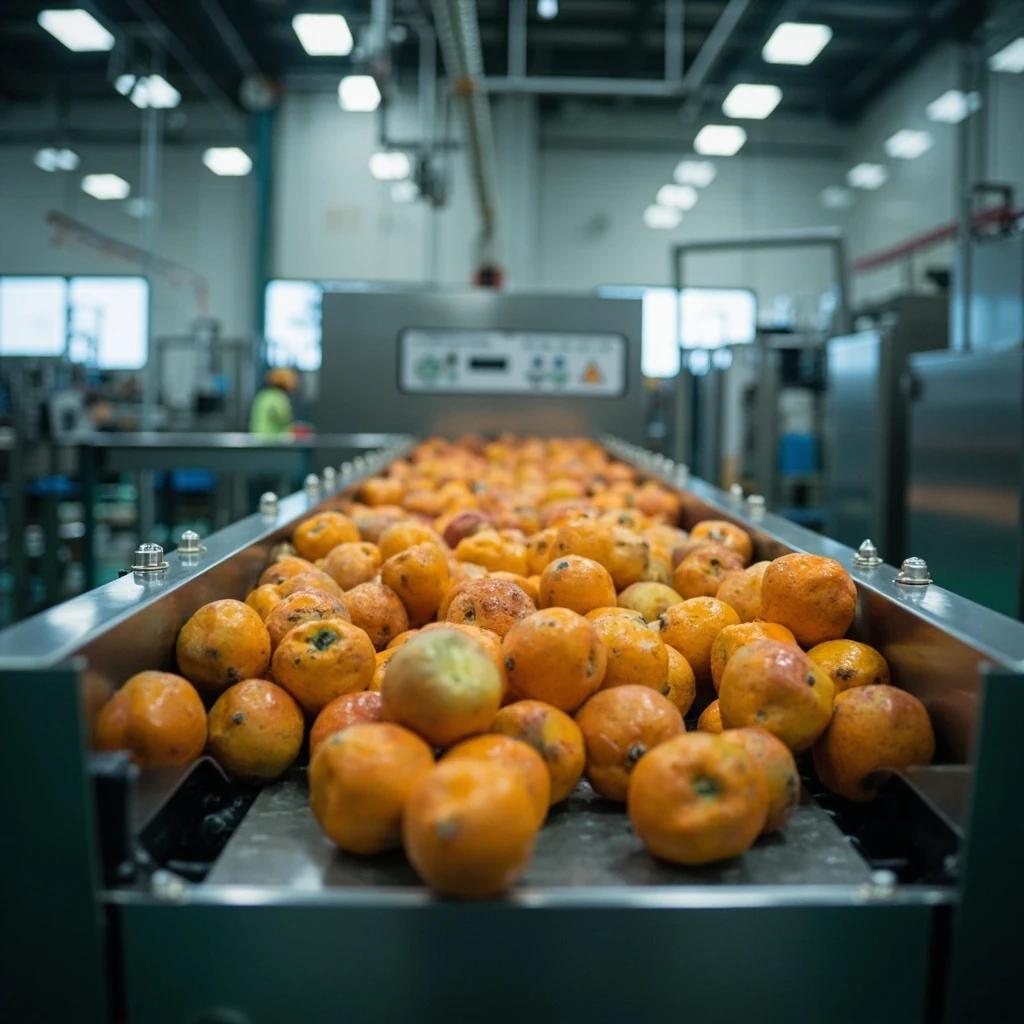
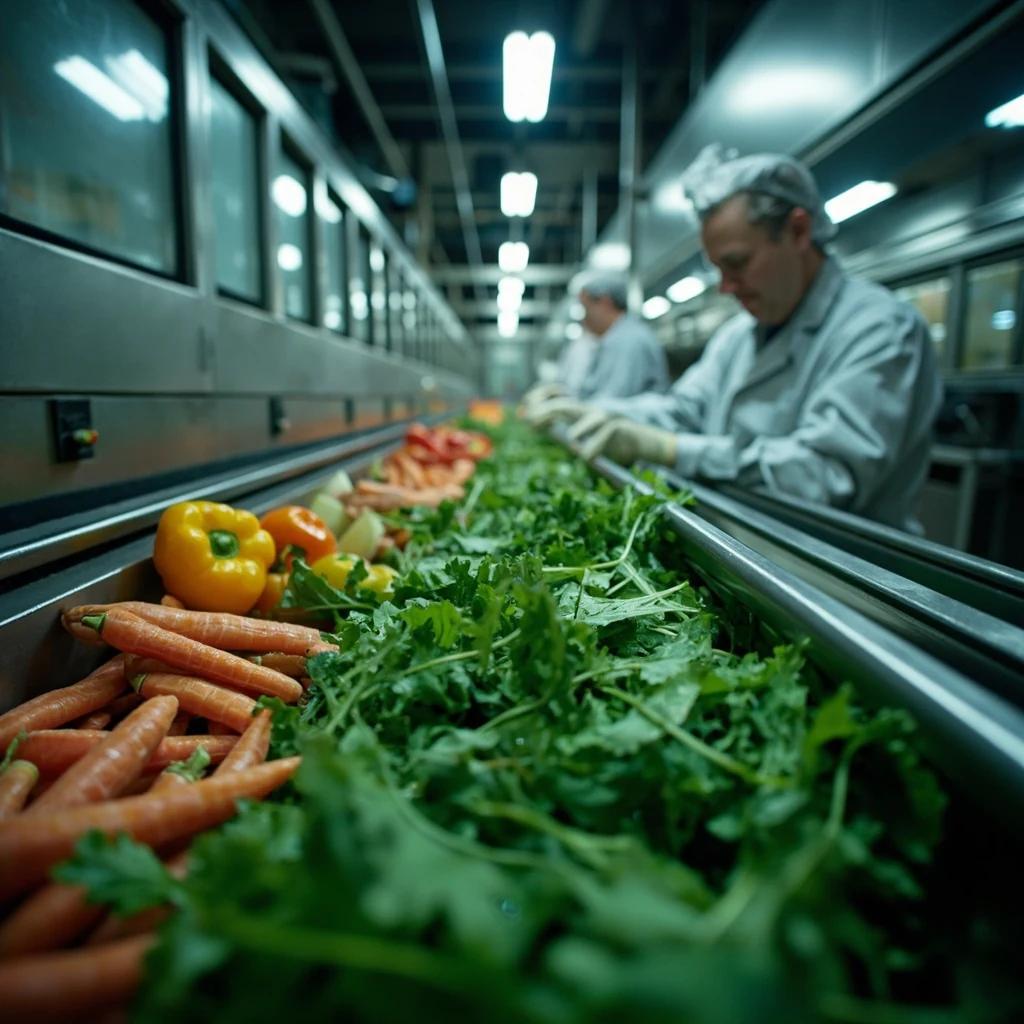
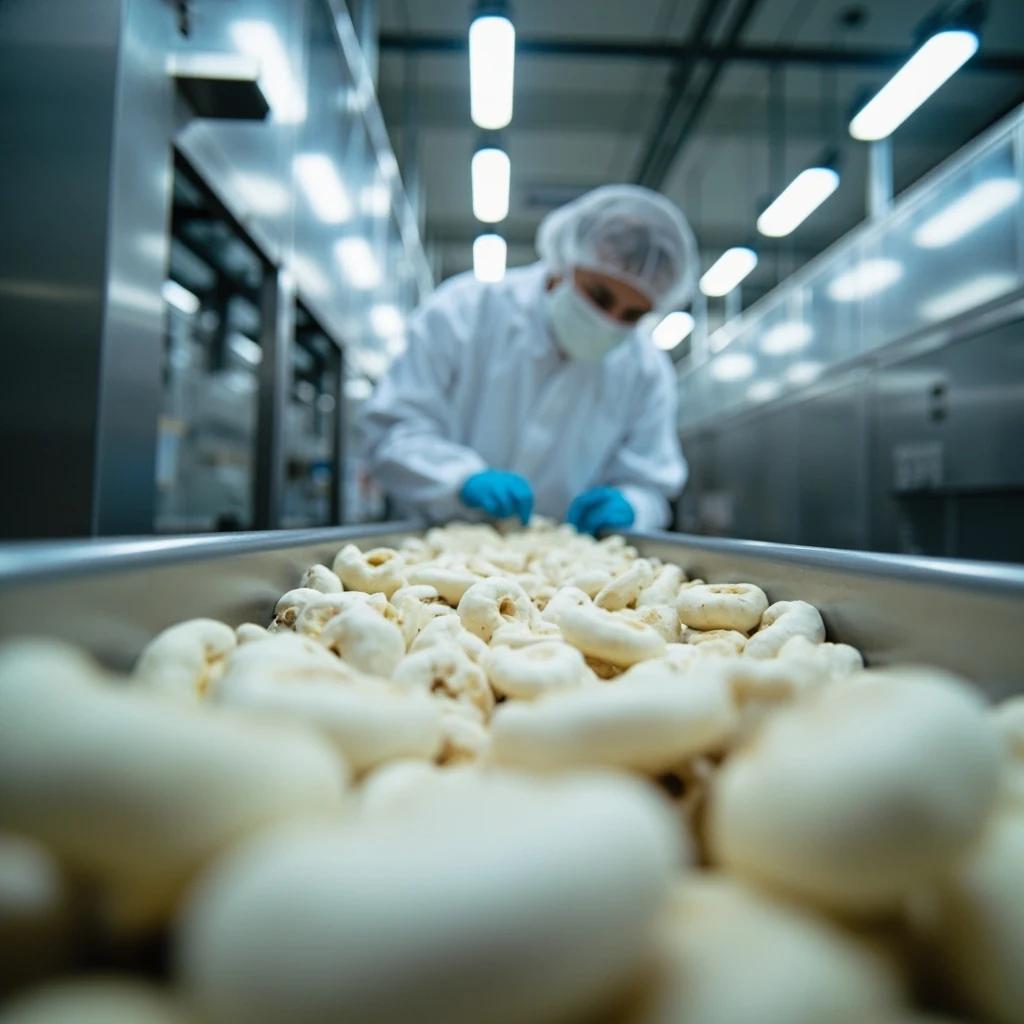
The two dominant production systems grow different species with different biology, and they force the operator to own different things, which is why a mushroom supplier's capacity has to be read against the system it uses rather than in the abstract. A mushroom is a fungus rather than a plant, and the two commercial approaches on this page barely resemble each other. In East Asia the volume crops are wood-rotting species: enoki, bunashimeji, king oyster and maitake. In Europe and North America the volume crop is Agaricus bisporus, the button mushroom, which grows on compost. That single biological difference decides where the cost sits and what a company has to build.
Bottle and bag rooms put the engineering inside the building. Substrate is mixed to a recipe from sawdust, bran and corn cobs, sterilised, filled into heat-resistant bottles or into bags, and inoculated with liquid spawn. The containers are stacked on multi-tier racks inside climate-controlled rooms where temperature, humidity, light and carbon dioxide are set by control systems rather than by weather, and the crop is harvested on a fixed cycle. This is why capacity in the East Asian model is quoted as a daily figure: Shanghai Snowey Bio-Technology runs 18 industrialised bases at 1,500 to 1,600 tonnes a day, above 550,000 tonnes a year, while Gansu Zongxing Mushroom Technology runs 16 bases at 1,150 tonnes a day, split between about 750 tonnes of enoki and 400 tonnes of button mushrooms, and Jiangsu Hualv Bio-Tech runs six parks at roughly 850 tonnes a day. Hokuto grows more than 70,000 tonnes a year on the same principle. The exposure attached to it is energy and bought-in inputs: Hokuto has absorbed higher Japanese electricity bills and dearer imported woodchips and corn cobs.
Shelf houses move the difficulty upstream into compost and downstream into the cold chain. Agaricus bisporus grows on composted straw and poultry litter rather than on sterilised sawdust, and that material has to be prepared in one, two or three phases, pasteurised and laid into beds before a single mushroom fruits. The competitive position therefore sits outside the growing room, in the recipe, the pasteurisation regime and the speed of the refrigerated route. Monaghan compounds its own compost and casing rather than buying either in and moves more than 3,000 tonnes of fresh mushrooms into European retail every week from six countries, and Monterey runs its farms with a composting front end attached. A supplier that buys compost is buying the part of the process that decides yield.
What each model owns is different, and so is what each can lose. A bottle or bag operation owns rooms, a spawn laboratory, a substrate mixer and a packing line, and it can change species by rewriting the recipe. A shelf house owns compost yards, casing, bed structures and refrigerated vehicles, and it is far more committed to the one species it grows. Neither owns the shelf that sells the crop, which is why route to market matters as much as tonnage. Costa supplies more than three quarters of Australia's fresh mushrooms from about 32,000 tonnes, a figure that describes the size of its market as much as its engineering, and BioFungi grows about 25,000 tonnes using the Western model and sells almost all of it through organic retail in Central and Western Europe. The two systems become comparable only once the species, the market and the unit of measurement are held constant.
Chinese capacity is counted in tonnes per day for a market that sits inside one border, while European and North American capacity is counted in tonnes per year for channels that pay more per kilo, and both curves are accurate descriptions of different businesses. The distance between them is not a gap in engineering competence. It is a difference in what each group optimises: volume per room against margin per pack, and domestic coverage against certification and export reach.
China measures output in tonnes per day and sells it at home. Shanghai Snowey Bio-Technology works 18 industrialised bases at 1,500 to 1,600 tonnes a day, above 550,000 tonnes a year and the largest enoki capacity anywhere, yet about 98% of its revenue is earned at home. Gansu Zongxing Mushroom Technology runs 16 bases at 1,150 tonnes a day for more than 400,000 tonnes a year and 99% domestic sales. Jiangsu Hualv Bio-Tech runs six parks at roughly 850 tonnes a day and more than 310,000 tonnes a year, with 98% of sales in China. The engineering behind those numbers is real, but the demand behind them is a single national market, and that is where the risk sits: Snowey carries heavy depreciation and reads a market in which regional supply and demand swing hard, Zongxing has seen schedules for some new lines held up by local planning decisions, and Hualv has no overseas capacity to offset a domestic downturn and depends on its newest parks reaching design output.
Europe and North America sell fewer tonnes into better-paying channels. Monaghan grows more than 200,000 tonnes a year, takes 85% or more of its revenue in Europe and 12% in North America, and moves more than 3,000 tonnes of fresh mushrooms into European retail every week. Monterey earns 90% or more of its revenue in North America on over 100,000 tonnes. Costa supplies more than three quarters of Australia's fresh mushrooms from about 32,000 tonnes. BioFungi is the smallest entrant here at about 25,000 tonnes and draws 95% or more of its income from organic retailers and processors in Central and Western Europe, where certification is the pricing mechanism. Yukiguni Maitake sells about 55,000 tonnes of mostly maitake, holds more than 60% of the Japanese maitake market and takes 92% of its sales at home, which is the premium-species version of the same argument.
The margin in fresh mushrooms is narrow, which is why tonnage alone settles nothing. A fresh mushroom has roughly seven to fourteen days of usable life and the category's average gross margin has sat between 15% and 25%, so a supplier that loses control of either energy or freight can lose the year. Hokuto has taken higher Japanese electricity bills and dearer imported woodchips and corn cobs, Monaghan absorbs British and European wage costs alongside volatile straw and poultry-litter prices, and Yukiguni Maitake has seen core EBITDA squeezed by substrate and freight costs. Scale protects against none of that on its own.
Capacity becomes comparable only after four things are fixed. The first is the unit: 550,000 tonnes a year and 1,500 tonnes a day describe the same business in two notations, and mixing them distorts any ranking. The second is the perimeter, since Costa's mushroom operation is a division inside a larger horticultural group rather than a standalone company. The third is the boundary between harvested and handled volume, because Scelta's 45,000 tonnes is intake at a processing plant rather than a crop lifted from a room. The fourth is currency and fiscal year, since yen, renminbi and euro accounts close on different dates and the dollar equivalents on this page are approximations.
Owned capacity in this industry is not only growing rooms, and Scelta Mushrooms belongs on this page because it owns the plants, the recipes and the research laboratory that turn bought-in button mushrooms into ingredients sold in more than 80 countries. The index gives production strength and facility scale a 40% weight and production concentration 25%, and a processor qualifies on both counts: its assets are factories and its turnover is entirely mushroom. Reading it as an anomaly misses where a growing share of the category's margin is assembled.
The ownership test asks what is on the balance sheet rather than what is in the field. Scelta runs four specialised plants with automated climate-controlled halls at Venlo, Kruiningen and Belfeld in the Netherlands, a research centre of its own and substrate technology it controls, and it processes more than 45,000 tonnes of button mushrooms a year with about 350 employees. It is privately held, so its revenue of about US$180 million is an estimate rather than an audited figure. Set that asset base beside a grower's and the difference is clear: no cropping land, no compost yard and no fleet of growing rooms, but cooking, slicing, blanching, freezing, drying and extraction capacity, which is where its capital sits.
Shelf life and formulation are the moat, not yield per square metre. Fresh mushrooms last about seven to fourteen days and the category's average gross margin has sat between 15% and 25%. Scelta replaces that constraint with a preservative-free retail pack that keeps for twelve months at ambient temperature, which takes refrigeration out of a long-haul order, and with umami extracts and a mushroom-derived salt replacer sold to food manufacturers rather than to shoppers. The margin is earned on formulation, and the same move is visible elsewhere: Monterey has doubled capacity at its extraction business to meet demand for functional mushroom ingredients, and Yukiguni Maitake has turned its own maitake into a plant-based meat ingredient.
The risk is upstream and it is structural rather than temporary. The boundary of what Scelta owns sits at the intake door, and the mushrooms that cross it are largely bought rather than grown, so the company carries a price exposure to the button mushroom market that a grower does not. It also carries a regulatory load that scales with reach rather than with headcount: 350 people serving more than 80 markets have to satisfy every labelling, additive and food-safety regime along the route, and Asia-Pacific already accounts for 22% of revenue, which ties a Dutch processor to freight rates and to demand in distant regions.
A processor and a grower have to be compared on the right measure. Processing tonnage is intake rather than harvest, so it cannot be read as capacity in the sense used for Snowey or Zongxing, and its utilisation depends on whether raw material is available and affordable in the first place. What it does show is where the money moves: a ranking that measured only growing rooms would treat this model as an absence, when in fact it is the part of the supply chain that converts a perishable crop into a shelf-stable ingredient and prices it accordingly.
Environmental specification has stopped being a claim a supplier makes and become an input a supplier must buy, because retailers and regulators now enforce it through long contracts and hard rules rather than through reputation. HEPA filtration, peat-free casing, recyclable packaging and cleaner energy are capital items whose payback is measured in continued shelf access, and each of them raises the cost of a tonne before it returns anything.
Peat is the clearest case, because a casing layer cannot be swapped without cost. Button mushrooms fruit on a casing soil traditionally built from peat, and European and British rules on peatland protection have turned that material into a liability. BioFungi has moved to a casing that contains no peat at all and grows under EU Organic rules at three plants with HEPA air filtration, which is part of why its cost per tonne sits above the average for this group. Monaghan became the first supplier in the United Kingdom to grow supermarket mushrooms on a fully peat-free system, and that switch was an industrial project rather than a packaging decision, because casing chemistry decides how the crop fruits and how much of it can be sold at all.
Air handling and packaging follow the same logic. Three HEPA-filtered plants allow BioFungi to grow organically without synthetic pesticides, and that certification is what lets 95% or more of its revenue come from organic retailers and processors in Central and Western Europe. Monaghan has moved to recyclable paper and bio-based packaging and holds a five-year agreement with Sainsbury's inside the retailer's £5 billion programme of long-term farm contracts. An agreement of that length converts compliance spending into a defensible position, which is exactly why it is signed with suppliers that have already funded the capital.
Automation and energy sit in the same budget line. Picking is the least automatable step in fresh mushroom production and labour costs have been rising in every market on this page. Costa, its capital freed by the 2024 buyout, has installed automated picking arms with 3D vision and solar generation at its Victorian sites, and Hokuto has automated picking in the same direction. Both are bets that a capital cost is cheaper than a wage bill over the life of the installation, and both depend on a company being able to raise or spend that money in the first place.
What this does to an entrant that cannot fund it. BioFungi is the smallest name here at about 25,000 tonnes a year and roughly 400 employees, and it carries the heaviest relative compliance load of the ten: organic certification, HEPA filtration, peat-free casing and three countries to supply. At the other end of the scale, Monterey spent 24 months having its spent mushroom compost certified organic, which converted a disposal cost into a saleable input rather than a marketing sentence. Compliance pays back when it yields a product or a contract; where it yields only a cost, it narrows the field to the companies able to absorb it.
Going private means one thing for Costa and something quite different for Monaghan, Scelta and BioFungi: a buyout removed a reporting obligation from a company that had one, while the others never had accounts to publish in the first place, and neither case says anything by itself about scale. The practical difference is about what an outside reader can verify, which is why the two situations have to be handled separately rather than folded into a single private category.
Costa's buyout replaced public reporting with an investment mandate. The group was taken private in 2024 by a consortium that includes Paine Schwartz Partners and Driscoll's, having previously traded in Australia under the code CGC. Delisting removed the obligation to explain results to a market every quarter, and it also removed the pressure to defend a half-yearly number, which is a real advantage for a business installing automated picking arms and solar generation at its Victorian mushroom sites, where the return arrives over years rather than over quarters. What a reader loses is the audited trail: the mushroom operation supplies more than three quarters of Australia's fresh mushrooms from about 32,000 tonnes, but those figures rest on company statements and trade reporting rather than on a filing.
Monaghan, Scelta and BioFungi were never public, so there is nothing to compare against. Monaghan is a family-controlled private unlimited company with roughly 3,500 employees, compounding its own compost and casing across six countries and publishing no audited group accounts. Scelta employs about 350 people at four processing plants and its revenue of about US$180 million is an estimate. BioFungi employs about 400 people and grows about 25,000 tonnes, with revenue estimated at about US$130 million. In each case the physical facts are firmer than the financial ones: plant counts, tonnage, certification and export reach can be checked against products on shelves, whereas revenue rests on the publisher named beside it.
The listed names give this page its audited anchors, and they are all filed in Tokyo or Shenzhen. Snowey (300511) and Hualv (300970) file with the Shenzhen ChiNext board, Zongxing (002772) with the Shenzhen main board, and Hokuto (1379) and Yukiguni Maitake (1375) with the Tokyo Stock Exchange Prime Market. Those filings carry the harder numbers: Hokuto's operating profit reached JPY 6.628 billion in its 2025 financial year, up 108.4%; Hualv lifted revenue 25.17% to RMB 1.292 billion and doubled net profit to RMB 110 million; Snowey returned to profit in 2025 with net profit of about RMB 29.8 million after a difficult stretch. None of that is available for the private half of the page.
Disclosure changes what can be verified rather than what exists. A supplier with no audited accounts can still own the compost yard, the rooms and the trucks, while a listed supplier can still be squeezed by electricity, substrate or freight, so the split should not be read as a quality signal in either direction. A supplier with no audited accounts can still own the compost yard, the rooms and the trucks, while a listed supplier can still be squeezed by electricity, substrate or freight. This ranking credits no company with the standing of a parent, an owner or a licensing partner, and membership of the Fortune Global 500 is never inferred from revenue: none of the ten is a member. Contract packing and traded goods are excluded as well, so every figure here describes what a company produces rather than what it moves.