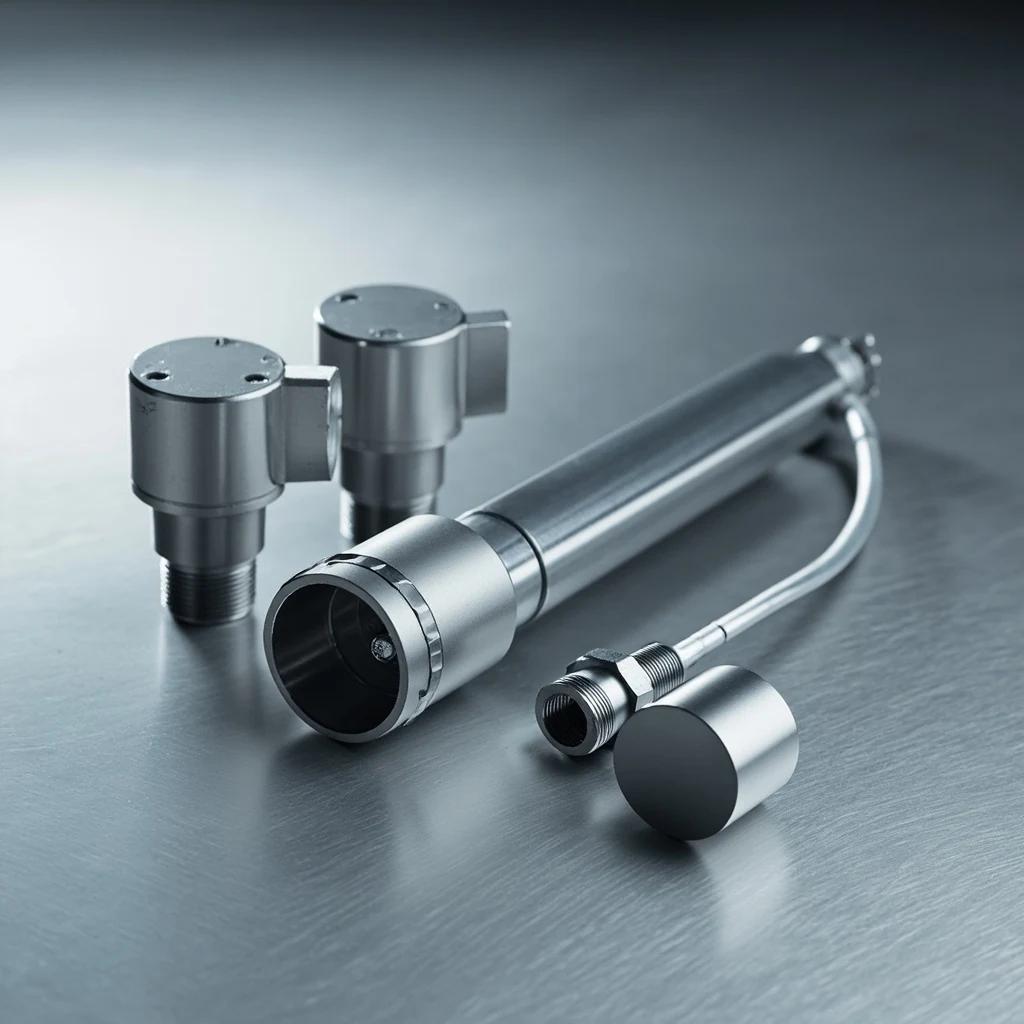
Because a teaching instrument is bought for the success of a whole class of untrained users rather than for the accuracy of one expert measurement, its specification is inverted relative to research equipment of nominally the same function.
The money goes where the research instrument does not. A research instrument can assume a competent operator: someone who recognises an implausible reading, guards against electrostatic discharge, holds a probe by its body rather than its cable, and stops when the signal looks wrong. A school instrument can assume none of that. Its cost sits in input protection that survives a pupil connecting a power supply where a signal belongs, in connectors that tolerate being pulled sideways, in enclosures that survive a trolley fall, in shielded and low-voltage internal design so that an inquisitive student never meets mains potential through a probe, and in a display and labelling scheme that makes the measurement legible across a crowded bench. IEC 61010-1 defines the safety requirements for electrical equipment for measurement, control and laboratory use, but the practical classroom target is stricter than the standard: the worst plausible misuse must produce a legible error message rather than a destroyed instrument, an injury, or a silent wrong answer that nobody in the room can detect.
Deliberately lower precision is an engineering choice, not a saving. The value of a research-grade instrument lies in resolution, stability and traceability, and it is calibrated and re-verified by people who understand uncertainty budgets. In a school, nobody in the room is qualified to notice calibration drift, so the manufacturer must either make the instrument self-checking, make it drift-tolerant, or specify a precision whose drift simply does not matter over a school year. Designing that tolerance is expensive: temperature compensation, guarding against contamination in electrodes and cells, mechanical stops on optical paths, over-range tolerance that does not destroy the sensing element, and firmware that refuses to print a number it cannot defend. A datasheet promising less accuracy but holding it across two hundred handling cycles is worth more to a school than one promising near state-of-the-art performance on a controlled bench, and the engineering behind the humbler number costs more per unit than the research version of the same function.
What a buyer should therefore ask. Ask what happens on the worst plausible misuse, not what the resolution is. Ask how drift is detected without a calibration laboratory, how the instrument behaves when a sensor is worn or contaminated, how many units behave identically when fifteen are delivered across three different school years, how long spare parts and consumables stay available, and whether a repair is possible on site or requires the instrument to leave the school for weeks. A research instrument is often supported for as long as a single grant or project lasts; a teaching instrument has to remain serviceable and interchangeable for the whole life of a syllabus, which is why the teaching version can cost more while being, on paper, the weaker device.
Because a wireless sensor removes the cable and the interface box but not the obligation to keep the instrument working, Bluetooth Low Energy moved part of the cost of ownership out of the equipment budget and into school information technology and logistics.
The technical case for the radio is genuine and narrow. Bluetooth Low Energy was designed for small payloads at low power, and it is natively supported by tablets, phones, Chromebooks and laptops that schools already own. A class can therefore be equipped without pulling cable to every bench, without one interface box per working group, and without a laptop per station; a sensor can be carried to a stream, a greenhouse or a fume hood. That removes a real constraint of the wired generation, where a lab was limited by how many interfaces the department had bought and how many cables had survived the year. The limitation is equally real: a low-power radio is comfortable with a temperature or pH reading every second and much less comfortable with a high-rate waveform, which is why wireless sensor families generally buffer measurements on board and send them in bursts rather than streaming continuously. Vernier, for example, built an entire sensor family, Go Direct, around this model.
The burden lands on functions that never appear on the purchase order. Pairing becomes a managed problem: thirty pupils, thirty sensors, one room, and a method needed to identify which of twelve identical units is missing from the trolley. Firmware becomes a lifecycle: a wireless sensor is a device with software versions, update channels and an application that must match, and a school that changes tablet model mid-year may discover the companion app no longer receives updates. Device policy becomes an information technology question: whether Bluetooth is permitted at all, whether tablet fleets are locked down by mobile device management, whether a pupil may pair a sensor to a personal phone, and who is allowed to install the application. Battery logistics become a procurement criterion rather than an afterthought: charging a class set overnight needs a rack, an outlet and a routine, and lithium cells age differently, so after three years a set of thirty sensors has thirty different remaining capacities and the phrase the reading looks low becomes a repeating interruption to lessons.
What changes in the buying decision. Total cost is now per class set per year rather than per unit: ask whether cells are replaceable by the school or only by the maker, whether the sensor operates while charging, whether charge state is visible at a glance from across the room, whether a teacher can complete a firmware update without administrator rights, how long the application will support the operating systems the school actually runs, and what happens to a fifteen-unit set when the maker ends support. A wired bench fails locally and visibly, and the failure is usually a cable; a wireless fleet fails in ways that look like software, which is precisely the kind of failure a science department cannot diagnose on its own.
Because a trainer must let an untrained hand reach parts that a production vehicle deliberately hides behind covers, service procedures and diagnostic interlocks, the teaching version concentrates hazards that the real system distributes across tooling, procedure and trained personnel.
The hazards are real and the model is less protected than the original. A traction inverter holds stored energy in its direct-current link capacitors, which can stay charged long after the system is de-energised, and the whole point of a training bench is to expose that circuit for measurement, so it cannot be sealed as tightly as a vehicle. A probe placed across the wrong two points produces an arc flash rather than a reading. On a road vehicle the high-voltage system is guarded by orange-coded cabling, a service disconnect, insulation monitoring, lockout and tagout practice and a manufacturer diagnostic routine; on a bench, a student can defeat an interlock with a jumper in seconds, which is exactly the behaviour a trainer must survive. Training equipment also carries features with no counterpart at all on a car: fault-insertion switches that open a phase, create a ground fault or simulate a failed sensor, and these must remain safe when thrown at the wrong moment, under load, or repeatedly by a class of twenty.
The applicable rules are written for equipment, not for cars. A road vehicle is placed on the market under vehicle type-approval legislation; a training bench is laboratory and machinery equipment, judged under IEC 61010-1 and, where testing and measuring circuits are involved, IEC 61010-2-030, together with the EU Low Voltage Directive 2014/35/EU, the Machinery Directive 2006/42/EC, now succeeded by the Machinery Regulation (EU) 2023/1230, and the EMC Directive 2014/30/EU. Where a rotating motor and coupling are exposed, the machinery route applies, and ISO 13850 governs the emergency stop. Conformity is demonstrated by CE marking backed by a technical file, a documented risk assessment and a declaration of conformity. On top of that, the college becomes the provider of work equipment and must carry its own risk assessment and teacher competence requirements, so responsibility for the same bench is stacked across maker, importer, school and teacher.
What that means for how such trainers are built and certified. Expect a discharge circuit with a visible indication that residual energy has fallen, energisation controlled by a key or a code, access panels interlocked so that the bus cannot be live while a guard is open, insulated and finger-safe measurement points, current-limited instrumentation on the bus, documented residual-energy times, an emergency stop that removes the bus and applies the bleed, and power supplies sized so that a lesson which does not require the full bus voltage is taught at a lower one. Interlocks should be testable rather than merely present. The deliverable is a CE-marked unit with a technical file and a risk assessment that a college can file and a teacher can read; a derated vehicle assembly with a warning label is not a training system, and the difference is a liability decision the buyer is making on behalf of every student in the room.
Because a school does not buy an instrument, it buys a lesson that has to work on the first attempt with the staff already on the payroll, the written and taught material around the hardware decides whether the product can be adopted at all.
The adoption test is pedagogical, not technical. Hardware is chosen by a head of science or a laboratory technician, but it lives or dies with a teacher who has forty-five minutes, no background in the technique, a syllabus to cover and thirty pupils to supervise. Without a laboratory manual keyed to what the class should see, teacher notes explaining the underlying physics and the likely sources of error, sample data showing what a good result actually looks like, assessment material mapped to the syllabus, and a way to handle the experiment that a non-specialist can follow, that teacher will simply avoid the instrument and use the tried alternative. A maker that ships a box and a datasheet has shipped a component, not a teaching product, and the missing material is more likely to block adoption than any missing specification.
Versioning is a manufacturing discipline, not a marketing one. When a sensor changes its range, its resolution, its connector, its application or even its response time, every experiment that referenced the old behaviour has to be found, re-tested and re-issued, in every language, in print and online. That is a change-control problem structurally identical to a bill of materials revision: a version number, release notes, verification that each experiment still produces the expected values, a reprint cycle, a translation matrix and a decision about what happens to the schools running the previous hardware. Content held in a marketing folder decays silently and is discovered by a teacher in front of a class; content held under change control moves with the hardware. The same discipline governs how the material is delivered, whether through printable files, an online platform, or integration with the school learning management system, and who owns it if the school stops buying.
What changes inside the company. Content has to be produced by in-house educators and instructional designers who have taught the subject, not written by a marketing department between campaigns. Professional development becomes a real function with staff who deliver training, run workshops in vacation periods and support teachers in their first term with the equipment. Technical support has to answer questions about a lesson and a result, not only about a part number. Product management must put curriculum deliverables on the same schedule and under the same release gates as hardware, so that a sensor cannot ship without its matching experiment set. Sales then quotes a whole package rather than a unit price, and the added cost of goods is carried deliberately, because it is what converts a working instrument into a usable course. A supplier that has never published a student-ready manual has told the buyer something important about how it understands its own business.
Because education procurement is slow, seasonal and service-heavy, only structural evidence such as organisation, named staff, dedicated product management and a publishing cadence distinguishes a real education business from an industrial product family that happens to be sold to schools.
Organisational and economic evidence. Start with disclosure: an annual report or accounts that break out the education segment, or at least a named division with its own management, budget and profit responsibility. Then look at how the products are made and sold: education-specific catalogues with school pack sizes such as sets of eight, fifteen or thirty, published list prices, consumables and spare parts, a reseller and tender channel accustomed to public procurement, and manufacturing or labelling steps aimed at low-voltage classroom use rather than at a factory floor. Where an industrial instrument has simply been re-badged, with lead times, calibration services and packaging designed for industrial customers, the school is a tail on somebody else's business, and that shows up later as order delays, unsuitable accessories and packaging that assumes a receiving department. A genuine line also appears where teachers gather: teacher conferences and education trade events, not the industrial fairs where the parent portfolio exhibits.
Behavioural evidence a buyer can measure without asking permission. Publication cadence is the strongest public signal: check the date on the newest student experiment, whether the manual matches the current hardware revision, whether software or application versions have a visible history and release notes, and whether superseded sensors have a documented replacement path. Support substance can be tested directly by sending the same pedagogical question, about a result that did not work rather than about a price, through the published support channel and observing who answers, at what level and how quickly; a marketing front replies with a brochure. Longevity signals matter just as much: the stated end-of-life policy, the supported operating systems and application versions, and the willingness to name reference schools in the buyer's own country and at the buyer's own level of education. Then telephone two of those references and ask what happened in year three, when the novelty had worn off and something broke.
The evidence that actually settles the question. Ask for a small set of facts that only a real business can produce from internal records within a week: the number of employees whose job is education, with their roles; the name and reporting line of the person who signs off curriculum content; the share of revenue or units attributable to education in the last financial year; the last three content releases with dates and a summary of what changed; the twenty-four month roadmap with named hardware and named curriculum deliverables; and the professional development sessions delivered in the past year with attendance. A supplier that answers these confidently is running an education business with its own cost structure. One that answers with adjectives, or cannot separate education from its other sales, is telling the buyer that the product will be supported for as long as it remains convenient, which is a material risk for a purchase that has to stay serviceable across a ten-year replacement cycle.