VerityRank

Explore Subcategories

Top 10 Mining & Minerals Companies

HomeMining & MineralsTop 10 Mining & Minerals Companies

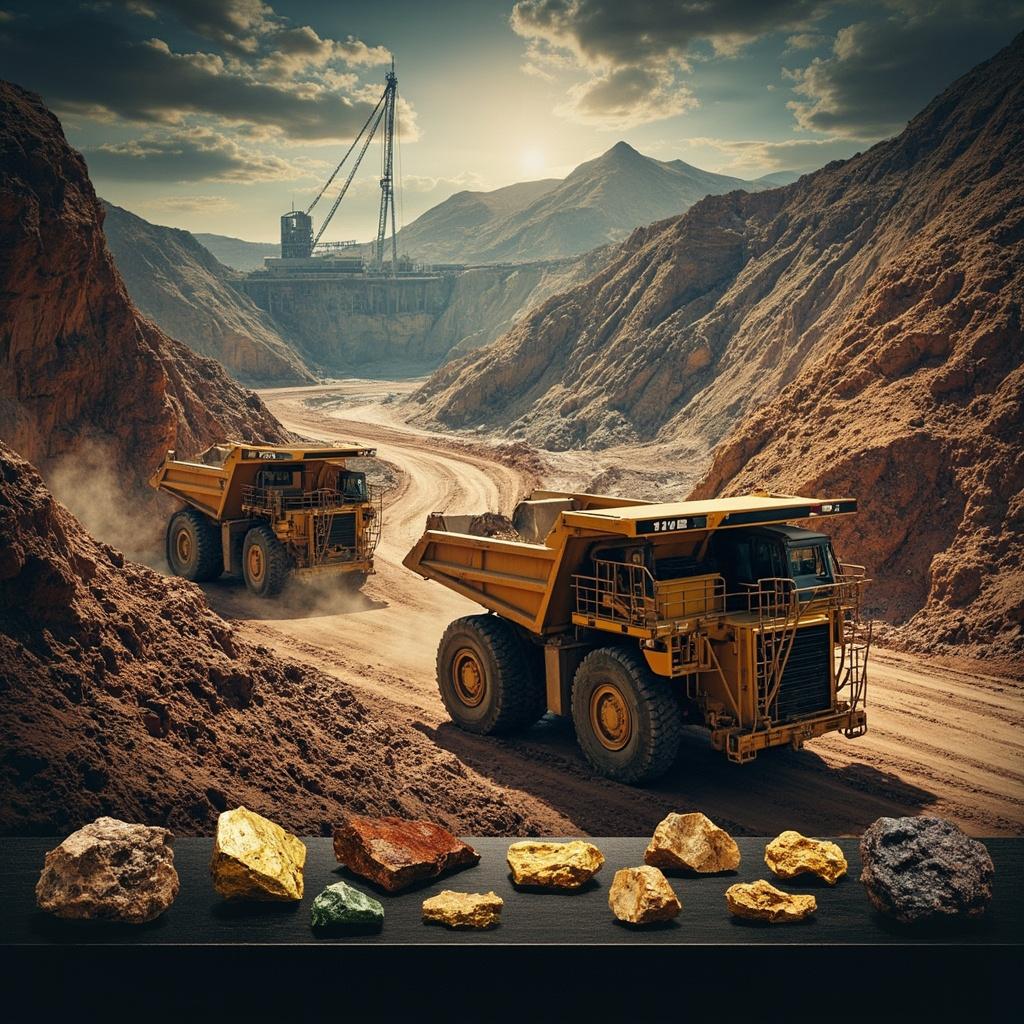
The global mining and minerals industry stands at a historic crossroads in 2025, with the world's top 40 mining companies generating combined revenues exceeding $700 billion while navigating an unprecedented structural transformation. According to PwC's Mine 2025 Report, global mining EBITDA margins contracted from 24% to 22% amid inflationary pressures, yet forward-facing commodity producers — particularly in copper, lithium, and rare earths — are experiencing a generational demand supercycle driven by the energy transition. The industry is undergoing a fundamental shift from traditional bulk commodities toward future-oriented minerals essential for electrification, battery storage, and advanced manufacturing.

The competitive landscape of the mining and minerals sector in 2025 reveals a stark divergence between winners and losers. Gold-focused producers like Zijin Mining achieved 32% EBITDA growth on record bullion prices, while diversified giants such as BHP, Rio Tinto, and Glencore deployed tens of billions in M&A to secure lithium, copper, and critical mineral assets. Industrial mineral specialists Imerys, Sibelco, and Omya demonstrated remarkable operational resilience through pricing discipline and strategic acquisitions, while China Minmetals leveraged its fully integrated mine-to-market value chain to consolidate China's position in global critical mineral supply chains. RHI Magnesita reinforced its dominance in the refractory sector through the transformative $430 million Resco Group acquisition, expanding North American revenue by 22%.

Our Ranking Methodology

VerityRank evaluates mining and minerals companies across four equally weighted dimensions:

Brand Influence & Global Revenue (25%): Consolidated financial performance, market capitalization, and brand recognition among downstream industrial B2B purchasers.

Core Business Portfolio Coverage (25%): Breadth and depth of mineral product categories served, with premium weighting for future-oriented commodities (copper, lithium, rare earths, high-purity quartz).

Supply Chain Vertical Integration (25%): Degree of mine-to-market control, including owned mining assets, in-house processing and refining facilities, and logistics infrastructure.

Sustainability & ESG Performance (25%): GISTM tailings compliance, carbon emissions trajectory, water stewardship, and social license to operate.

Data Sources

This ranking is compiled from publicly available data including PwC Mine 2025 Report (PwC Mine 2025), company annual reports and regulatory filings, S&P Global Market Intelligence, national geological surveys, and industry trade publications. All financial data reflects the most recent fiscal year (FY2024-2025) as reported by each company.

Disclaimer: The data in this ranking is compiled from third-party authoritative sources, including national statistical agencies, university-affiliated research institutions, AI-driven global consumer sentiment analysis, and publicly listed company financial reports. The ranking results are based on a multi-dimensional algorithm model and are intended for reference and market decision support only. They do not constitute direct investment advice or brand endorsement.

Top 10 Rankings

2026.05 Edition
1
Glencore plc

Glencore plc

Glencore is the world's largest integrated commodity trading and mining company, headquartered in Baar, Switzerland. Operating across more than 35 countries with approximately 150,000 employees, the company generated $215 billion in revenue in FY2025 through its unique dual-pillar model combining industrial mining assets with a global marketing and trading network. Glencore holds dominant positions across copper, cobalt, zinc, and nickel markets, ranking as the world's largest cobalt trader and among the top global copper producers with approximately 1 million tonnes of annual own-source copper production.

Strengths: Unparalleled global commodity trading infrastructure spanning 50+ countries enables seamless market access and price optimization; dominant market shares in cobalt (~25% of global trade), zinc (~15%), and copper (~10%) create structural pricing power; fully integrated supply chain from mining through logistics to end-user delivery generates value capture across the entire commodity chain; exceptional revenue scale at $215 billion secures Fortune Global 500 top-20 ranking with total assets exceeding $120 billion; proprietary self-production assets combined with world-class marketing intelligence provide unique advantages in commodity cycle management.
Weaknesses: Significant exposure to thermal and metallurgical coal creates ESG divestment pressure and persistent valuation discount from sustainability-focused institutional investors; industrial EBITDA declined 6% in FY2025 due to weakening steel and energy coal benchmark prices; commodity price volatility directly impacts quarterly earnings stability; complex multi-jurisdictional operations in high-risk geographies including the Democratic Republic of Congo introduce regulatory and political risk; legacy environmental liabilities from historical mining operations require ongoing capital allocation for remediation.

Brand

Glencore

Founded

1974

Workforce

150,000

Presence

35+ countries across 6 continents

Facilities

150+ mining and processing sites across 35+ countries

Headquarters

Switzerland

Key Product Categories
Mining & Minerals CompaniesMetallic Ore Raw Materials IndustryPrecious Metal Ores IndustryFerrous Metal Ores IndustryNon-Ferrous Metal Ores IndustryLight Rare Metal Ores IndustryConductive & EMI Shielding IndustryMining & Minerals CompaniesMining & Minerals CompaniesMetallic Ore Raw Materials IndustryPrecious Metal Ores IndustryFerrous Metal Ores IndustryNon-Ferrous Metal Ores IndustryLight Rare Metal Ores IndustryConductive & EMI Shielding IndustryMining & Minerals Companies
2
China Minmetals Corporation

China Minmetals Corporation

China Minmetals Corporation is China''s premier state-owned metals and minerals conglomerate, headquartered in Beijing, China. With total assets exceeding CNY 1.3 trillion (USD 180 billion) and annual revenue of approximately CNY 833.2 billion (USD 115 billion), the company operates a uniquely integrated value chain spanning geological exploration, mining, smelting, metallurgical engineering (via its subsidiary MCC), and global commodity trading. It employs over 200,000 people across operations in 60+ countries, positioning it as one of the world''s largest diversified metals and mining enterprises.

Strengths: Full value chain integration from mine-to-market provides unmatched supply chain resilience; strategic resource portfolio with commanding positions in tungsten, antimony, rare earths, and expanding lithium/cobalt/nickel assets critical for the energy transition; metallurgical engineering dominance through China MCC Group enables turnkey mine construction capabilities globally; state-backed financial strength ensures access to low-cost capital for strategic acquisitions; diversified revenue base across metals, engineering, and trading cushions commodity cycle volatility.
Weaknesses: Geopolitical exposure in overseas operations (South America, Africa) creates occasional community relations and strike risks; state-owned enterprise bureaucracy can slow decision-making compared to private-sector competitors; coal and steel legacy assets face increasing ESG divestment pressure.

Brand

Brand

Founded

1950

Workforce

190,000

Presence

60+ countries across Asia, Africa, South America, and Oceania

Facilities

100+ mining and metallurgical operations across 60+ countries

Headquarters

China

Market

State-owned enterprise (Fortune Global 500)

Key Product Categories
Mining & Minerals CompaniesMetallic Ore Raw Materials IndustryPrecious Metal Ores IndustryFerrous Metal Ores IndustryNon-Ferrous Metal Ores IndustryLight Rare Metal Ores IndustryMining & Minerals ManufacturersMining & Minerals CompaniesMining & Minerals CompaniesMetallic Ore Raw Materials IndustryPrecious Metal Ores IndustryFerrous Metal Ores IndustryNon-Ferrous Metal Ores IndustryLight Rare Metal Ores IndustryMining & Minerals ManufacturersMining & Minerals Companies
3
BHP Group Limited

BHP Group Limited

BHP Group is the world's largest diversified mining company by market capitalization, dual-headquartered in Melbourne, Australia and London, United Kingdom. Operating across more than 25 countries with approximately 80,000 employees and contractors, BHP generated $65 billion in revenue in FY2025, driven by world-class assets in iron ore, copper, coal, and nickel. The company's Pilbara iron ore operations in Western Australia and the Escondida copper mine in Chile — the world's largest copper mine — form the cornerstone of its portfolio, while autonomous truck fleets and driverless rail systems position it as the industry benchmark for production efficiency and safety performance.

Strengths: Industry-leading operational scale with 257 million tonnes of annual iron ore production and copper output exceeding 2 million tonnes in FY2025; exceptional capital allocation framework and disciplined investment approach deliver superior shareholder returns even through commodity downturns; proprietary logistics infrastructure including heavy-haul railways and deep-water port facilities create permanent cost advantages; first global listed mining company to achieve gender-balanced workforce (minimum 40% women and 40% men) in 2025; comprehensive automation and digitalization programs deliver superior safety metrics and operational productivity.
Weaknesses: Heavy revenue concentration on China (~60% of sales) creates significant single-market dependency and geopolitical risk exposure; legacy Samarco dam failure (2015) continues to impose financial provisions and legal complexities on FY2025 earnings; metallurgical coal portfolio faces increasing ESG scrutiny and potential stranded-asset risk in a decarbonizing global economy; limited exposure to battery minerals beyond nickel constrains participation in the fastest-growing energy transition segments; capital-intensive project pipeline including the Jansen potash development requires sustained high commodity prices to deliver target returns.

Brand

BHP

Founded

1885

Workforce

80,000

Presence

25+ countries across 6 continents

Facilities

30+ mining operations globally

Headquarters

United Kingdom

Key Product Categories
Mining & Minerals CompaniesMetallic Ore Raw Materials IndustryFerrous Metal Ores IndustryNon-Ferrous Metal Ores IndustryLight Rare Metal Ores IndustryConductive & EMI Shielding IndustryMining & Minerals CompaniesMining & Minerals ManufacturersMining & Minerals CompaniesMetallic Ore Raw Materials IndustryFerrous Metal Ores IndustryNon-Ferrous Metal Ores IndustryLight Rare Metal Ores IndustryConductive & EMI Shielding IndustryMining & Minerals CompaniesMining & Minerals Manufacturers
4
Rio Tinto Group

Rio Tinto Group

Rio Tinto is one of the world's largest and most technologically advanced mining and metals companies, dual-headquartered in London, United Kingdom and Melbourne, Australia. Operating across more than 35 countries with approximately 57,000 employees, Rio Tinto generated $54 billion in revenue in FY2025 through a portfolio anchored by iron ore, aluminum, copper, and an expanding lithium business. The company operates the world-class Pilbara iron ore operations producing over 340 million tonnes annually, alongside the Oyu Tolgoi copper-gold mine in Mongolia and a fully integrated aluminum value chain from bauxite mining through smelting. Rio Tinto's 2025 acquisition of Arcadium Lithium marked a transformative entry into the battery minerals sector.

Strengths: Global-scale iron ore operations producing over 340 million tonnes annually with industry-leading automation including autonomous trucks and the AutoHaul driverless railway system; fully integrated aluminum value chain spanning bauxite mining, alumina refining, and aluminum smelting with 3.2 million tonnes of annual production capacity; transformative Arcadium Lithium acquisition delivering 57,000 tonnes of lithium carbonate equivalent capacity in 2025, positioning the company for the energy transition megatrend; Oyu Tolgoi underground copper-gold mine represents one of the world's largest copper growth projects with multi-decade production potential; comprehensive climate action plan with detailed Scope 1, 2, and 3 emissions reporting demonstrates sustainability governance maturity.
Weaknesses: Iron ore revenue remains disproportionately dependent on Chinese steel demand (~45% of total revenue), creating vulnerability to any structural slowdown in Chinese construction activity; Oyu Tolgoi underground expansion faces ongoing capital expenditure overruns and complex stakeholder negotiations with the Mongolian government; Arcadium Lithium integration carries significant execution risk as the company enters the unfamiliar lithium extraction and processing industry; historical cultural heritage management controversies (Juukan Gorge) continue to require reputational rebuilding with indigenous communities; exposure to Guinea's Simandou iron ore project introduces frontier-market political and infrastructure risk.

Brand

Rio Tinto

Founded

1873

Workforce

57,000

Presence

35+ countries across 6 continents

Facilities

60+ mining and processing operations across 35+ countries

Headquarters

United Kingdom

Key Product Categories
Mining & Minerals CompaniesMetallic Ore Raw Materials IndustryFerrous Metal Ores IndustryNon-Ferrous Metal Ores IndustryGlass Substrate Raw Materials & Industrial Base Glass IndustryLight Rare Metal Ores IndustryMining & Minerals CompaniesMining & Minerals ManufacturersMining & Minerals CompaniesMetallic Ore Raw Materials IndustryFerrous Metal Ores IndustryNon-Ferrous Metal Ores IndustryGlass Substrate Raw Materials & Industrial Base Glass IndustryLight Rare Metal Ores IndustryMining & Minerals CompaniesMining & Minerals Manufacturers
5
Zijin Mining Group Co., Ltd.

Zijin Mining Group Co., Ltd.

Zijin Mining is China's largest and fastest-growing multinational mining corporation, headquartered in Shanghang County, Fujian Province. With operations spanning more than 15 countries and approximately 50,000 employees, the company generated $50 billion in revenue in FY2025, driven by world-class gold, copper, zinc, and lithium assets. Zijin Mining made history in 2025 by becoming the first Chinese and Asian mining company to exceed 1 million tonnes of annual copper production (reaching 106.84 million tonnes), while its gold output of 60 tonnes cemented its position as China's largest gold producer. The company's proprietary low-grade ore processing technology and contrarian M&A strategy have enabled its meteoric rise from a local Fujian mine to a global mining powerhouse.

Strengths: Industry-leading low-grade ore processing technology enables profitable extraction from deposits competitors consider uneconomic, creating unique acquisition opportunities; remarkable production growth trajectory with copper output growing at 24% compound annual rate to exceed 1 million tonnes in 2025; strategic global asset portfolio spanning the Kamoa-Kakula copper complex (DRC, world's fourth-largest copper mine), Čukaru Peki copper-gold project (Serbia), and Julong Copper Mine (Tibet); diversified commodity exposure across gold, copper, zinc, and lithium provides natural hedge against individual commodity price cycles; strong Chinese domestic market position with state-backed financial capacity supporting ambitious international expansion.
Weaknesses: Rapid international expansion into high-risk jurisdictions including the DRC, Serbia, and Papua New Guinea elevates geopolitical and sovereign risk exposure; gearing ratio rising to 38.24% reflects increased debt burden from aggressive acquisition strategy; brand recognition in Western markets remains significantly below established competitors despite rapidly growing production scale; foreign exchange volatility from multinational operations impacts earnings predictability; environmental compliance standards across diverse operating jurisdictions require ongoing management attention as ESG expectations intensify globally.

Brand

Zijin Mining

Founded

1986

Workforce

50,000

Presence

15+ countries across Asia, Africa, Europe, and the Americas

Facilities

30+ mining projects across 15+ countries

Headquarters

China

Key Product Categories
Mining & Minerals CompaniesMetallic Ore Raw Materials IndustryPrecious Metal Ores IndustryNon-Ferrous Metal Ores IndustryGold IndustryLight Rare Metal Ores IndustryMining & Minerals CompaniesMining & Minerals ManufacturersMining & Minerals CompaniesMetallic Ore Raw Materials IndustryPrecious Metal Ores IndustryNon-Ferrous Metal Ores IndustryGold IndustryLight Rare Metal Ores IndustryMining & Minerals CompaniesMining & Minerals Manufacturers
6
Doce River Valley Company(Vale)

Doce River Valley Company(Vale)

Vale is the world's largest iron ore and nickel producer, headquartered in Rio de Janeiro, Brazil. Operating across more than 30 countries with approximately 70,000 employees, Vale generated $45 billion in revenue in FY2025, anchored by its unparalleled iron ore operations in Brazil's Carajás mineral province. The company produces over 320 million tonnes of iron ore annually, including premium high-grade fines and pellets that command price premiums in global steel markets. Vale's nickel operations, primarily in Canada and Indonesia, position it as a critical supplier to the electric vehicle battery supply chain, while its copper division adds further diversification to the base metals portfolio.

Strengths: World's largest iron ore producer with 320 million tonnes annual capacity from the highest-grade deposits in the Carajás mineral province; premium product portfolio including high-grade fines, pellets, and direct-reduction-grade ore commands structural price premiums over benchmark indices; world's largest nickel producer with approximately 200,000 tonnes annual output serving both stainless steel and battery-grade markets; comprehensive post-Brumadinho safety transformation including full GISTM compliance and 81% disaster compensation completion has substantially reduced legal and reputational overhang; integrated mine-to-port logistics system including proprietary railways and deep-water terminals provides permanent cost advantages in Brazilian operations.
Weaknesses: Extreme revenue concentration in iron ore (~75% of revenue) creates outsized exposure to Chinese steel demand cycles and iron ore price volatility; Brazilian operational base concentrates geopolitical, regulatory, and logistics risk in a single jurisdiction despite international diversification efforts; Brumadinho tailings dam disaster legacy continues to impose financial provisions, legal liabilities, and reputational rehabilitation costs; nickel operations in Indonesia face evolving regulatory frameworks around raw mineral export policies; environmental scrutiny around Amazon-adjacent mining operations constrains expansion optionality in Brazil's northern mineral provinces.

Brand

Vale

Founded

1942

Workforce

70,000

Presence

30+ countries globally

Facilities

30+ mines and processing facilities across 30+ countries

Headquarters

Brazil

Key Product Categories
Mining & Minerals CompaniesMetallic Ore Raw Materials IndustryFerrous Metal Ores IndustryNon-Ferrous Metal Ores IndustryLight Rare Metal Ores IndustryEnergy Conversion IndustryMining & Minerals CompaniesMining & Minerals ManufacturersMining & Minerals CompaniesMetallic Ore Raw Materials IndustryFerrous Metal Ores IndustryNon-Ferrous Metal Ores IndustryLight Rare Metal Ores IndustryEnergy Conversion IndustryMining & Minerals CompaniesMining & Minerals Manufacturers
7
Imerys S.A.

Imerys S.A.

Imerys is the world's leading industrial mineral solutions provider, headquartered in Paris, France. Operating across more than 40 countries with approximately 18,000 employees, Imerys generated €5.5 billion in revenue in FY2025 through an unmatched portfolio of over 20 industrial minerals processed into thousands of high-value-added products. The company dominates global markets for kaolin, calcium carbonate, talc, bentonite, and specialty alumina, serving diverse end-markets including paper, plastics, construction, cosmetics, pharmaceuticals, and environmental applications. Imerys has strategically expanded into energy transition minerals, including its landmark EMILI lithium project in France that has attracted French government co-investment.

Strengths: Unmatched industrial mineral portfolio spanning over 20 mineral types and 1,500+ product formulations creates formidable barriers to entry and customer switching costs; global operational footprint with 120+ mining sites and 150+ processing facilities across 40+ countries enables localized supply with global scale advantages; powerful pricing discipline demonstrated by 1.3% year-over-year price increases in FY2025 despite weak demand in European and North American construction markets; strategic diversification into energy transition minerals including the EMILI lithium project backed by the French government positions the company for structural growth; €50-60 million structural cost reduction program demonstrates proactive operational efficiency management in challenging macroeconomic conditions.
Weaknesses: Revenue base remains significantly smaller than major metal mining competitors at €5.5 billion, limiting absolute R&D investment scale; heavy exposure to cyclical European and North American construction and industrial activity (~40% of revenue from these regions) creates vulnerability to regional economic downturns; fragmented global industrial minerals market limits pricing power in commoditized product segments; acquiring Great Lakes Minerals and Chemviron assets involves integration execution risk and cultural alignment challenges across geographies; mineral reserves are geographically dispersed requiring ongoing exploration expenditure to maintain long-term resource base.

Brand

Imerys

Founded

1880

Workforce

18,000

Presence

40+ countries globally

Facilities

120+ mining sites and 150+ processing facilities across 40+ countries

Headquarters

France

Market

Euronext Paris: NK

Key Product Categories
Mining & Minerals CompaniesMetallic Ore Raw Materials IndustryRefractory & High-Temperature Resistant Materials IndustryCalcium Carbonate Powders IndustryTalc Powders IndustryBentonite Clays IndustryMining & Minerals ManufacturersMining & Minerals CompaniesMining & Minerals CompaniesMetallic Ore Raw Materials IndustryRefractory & High-Temperature Resistant Materials IndustryCalcium Carbonate Powders IndustryTalc Powders IndustryBentonite Clays IndustryMining & Minerals ManufacturersMining & Minerals Companies
8
Sibelco NV

Sibelco NV

Sibelco NV is a Belgium-based global leader in high-purity quartz (HPQ), specialty silica sand, and industrial minerals, headquartered in Antwerp, Belgium. The company operates 200+ production sites across 30+ countries with a workforce of approximately 10,000 employees. Sibelco''s North Carolina Spruce Pine mine produces the world''s purest quartz essential for semiconductor manufacturing and photovoltaic crucibles, giving it near-monopoly control over this critical supply chain. Through the landmark acquisition of Strategic Materials Inc (SMI) in 2025, Sibelco now operates the world''s largest glass recycling platform processing 5 million tonnes of cullet annually across 66 sites.

Strengths: Strategic monopoly over HPQ supply — without Sibelco''s Spruce Pine quartz, global semiconductor and solar industries would face immediate disruption; circular economy transformation through SMI acquisition positions it as the indispensable decarbonization partner for glass manufacturers; geographic diversification across Europe, Americas, and Asia-Pacific mitigates regional demand shocks; century-long operational expertise in mineral processing creates insurmountable technical barriers; vertically integrated recycling-to-raw-material model lowers customer CO2 emissions by 3% per 10% cullet addition.
Weaknesses: Single-source dependency at Spruce Pine creates catastrophic supply risk from natural disasters (Hurricane Helene disrupted operations); cyclical construction end-market exposure in traditional silica sand segment; limited public financial disclosure as a private company reduces transparency for ESG assessments.

Brand

Brand

Founded

1872

Workforce

10,000

Presence

30+ countries across Europe, Americas, and Asia-Pacific

Facilities

200+ production sites across 30+ countries

Headquarters

Belgium

Market

Euronext Brussels: BE0944264663

Key Product Categories
Mining & Minerals CompaniesMetallic Ore Raw Materials IndustryGlass Substrate Raw Materials & Industrial Base Glass IndustryEnergy Conversion IndustryCalcium Carbonate Powders IndustryMining & Minerals ManufacturersMining & Minerals CompaniesMining & Minerals ManufacturersMining & Minerals CompaniesMetallic Ore Raw Materials IndustryGlass Substrate Raw Materials & Industrial Base Glass IndustryEnergy Conversion IndustryCalcium Carbonate Powders IndustryMining & Minerals ManufacturersMining & Minerals CompaniesMining & Minerals Manufacturers
9
Omya International AG

Omya International AG

Omya International AG is a Swiss family-owned global leader in industrial minerals, specialty chemicals, and polymer distribution, headquartered in Oftringen, Switzerland. The company operates 175+ plants across 50+ countries and employs approximately 9,000 people. Omya dominates the global market for ground calcium carbonate (GCC) used in paper, plastics, paints, and agriculture. In 2025, the company launched a new Performance Polymers Distribution division following the acquisition of Distrupol, expanding from pure mineral supply into integrated mineral-polymer solutions. Its unique on-site plant model — building production facilities directly at customer locations — has become an industry benchmark for B2B mineral supply chain efficiency.

Strengths: Unrivaled GCC market dominance with mining rights to premium calcium carbonate deposits globally; on-site plant model creates deep customer lock-in through co-located production facilities reducing logistics costs; diversified end-market exposure across paper, plastics, construction, agriculture, and water treatment; family-owned stability enables long-term strategic investments without quarterly earnings pressure; vertical expansion into polymer distribution transforms Omya from filler supplier to full-solution partner.
Weaknesses: Private company opacity limits detailed financial and ESG performance benchmarking; low-margin commodity GCC products face pricing pressure from regional competitors; heavy reliance on European manufacturing base exposes the company to regional industrial slowdowns.

Brand

Brand

Founded

1884

Workforce

9,000

Presence

50+ countries globally

Facilities

180+ production sites across 50+ countries

Headquarters

Switzerland

Market

Private (family-owned)

Key Product Categories
Mining & Minerals CompaniesMetallic Ore Raw Materials IndustryCalcium Carbonate Powders IndustryTalc Powders IndustryBentonite Clays IndustryMining & Minerals ManufacturersMining & Minerals CompaniesMining & Minerals ManufacturersMining & Minerals CompaniesMetallic Ore Raw Materials IndustryCalcium Carbonate Powders IndustryTalc Powders IndustryBentonite Clays IndustryMining & Minerals ManufacturersMining & Minerals CompaniesMining & Minerals Manufacturers
10
RHI Magnesita NV

RHI Magnesita NV

RHI Magnesita NV is the global market leader in refractory products and solutions, formed through the merger of Austria''s RHI and Brazil''s Magnesita. Headquartered in Vienna, Austria, the company operates 47 production sites and 70+ sales offices across 35+ countries, employing approximately 13,500 people. RHI Magnesita produces over 3 million tonnes of refractory materials annually for high-temperature industrial processes including steelmaking, cement production, glass manufacturing, and non-ferrous metal processing. The 2025 acquisition of Resco Group for EUR 271 million significantly expanded its North American footprint, adding 9 plants and 2 raw material sites while boosting regional revenue by 22%.

Strengths: Unquestioned global refractory leadership with the largest production capacity and broadest product portfolio; Local-for-Local strategy through Resco acquisition creates tariff-resistant regional supply chains in North America; circular economy leadership with 15.9% refractory recycling rate exceeding industry targets, reducing CO2 emissions to 1.54t per tonne; backward integration into magnesite and dolomite raw material mines secures cost advantages over competitors; essential supplier status — no steel, cement, or glass can be produced without refractories.
Weaknesses: High correlation with global steel production cycles creates earnings volatility during industrial downturns; heavy European manufacturing concentration exposes margins to regional energy cost inflation; significant acquisition debt from Resco integration increases financial leverage risk.

Brand

Brand

Founded

1834 (RHI) / 2017 (merger)

Workforce

16,000

Presence

20+ countries across Europe, Americas, Asia, and Africa

Facilities

47 production sites across 20+ countries

Headquarters

Austria

Market

LSE: RHIM
Key Product Categories
Mining & Minerals CompaniesMetallic Ore Raw Materials IndustryRefractory & High-Temperature Resistant Materials IndustryThermal Insulation Materials IndustryMineral Wool Materials IndustryMining & Minerals ManufacturersMining & Minerals CompaniesMining & Minerals ManufacturersMining & Minerals CompaniesMetallic Ore Raw Materials IndustryRefractory & High-Temperature Resistant Materials IndustryThermal Insulation Materials IndustryMineral Wool Materials IndustryMining & Minerals ManufacturersMining & Minerals CompaniesMining & Minerals Manufacturers

Frequently Asked Questions

How Do We Generate Our Mining & Minerals Rankings?
Our rankings are built on data, not opinions.

We evaluate mining and minerals companies through a rigorous multi-dimensional framework that combines financial performance analysis (revenue, EBITDA margins, market capitalization), operational scale assessment (production volumes, mine-life reserves, processing capacity), brand influence measurement (B2B procurement preference, supply chain criticality scores, media sentiment analysis), and ESG compliance verification (GISTM tailings standards, carbon intensity, water stewardship). Each dimension receives equal 25% weighting, and the composite score ranges from 0-100.

Data sources include: PwC Mine 2025 Report, S&P Global Market Intelligence, company annual reports and regulatory filings (SEC, LSE, SSE, ASX), USGS Mineral Commodity Summaries, and national geological surveys. We cross-reference at least three independent sources for each data point used in scoring. Our methodology is reviewed quarterly and updated to reflect evolving industry standards and stakeholder expectations.

What makes our approach unique: Unlike simple revenue-based rankings, our model specifically rewards companies with diversified mineral portfolios, strong vertical integration (mine-to-market control), and demonstrable progress toward sustainable mining practices. Companies that own and operate their entire production chain — from geological exploration through to finished mineral products — receive significantly higher scores than those relying on contract mining or toll processing arrangements.

Transparency commitment: While individual company scores are proprietary, we publicly disclose our methodology framework, data sources, and weighting criteria. Companies can request a detailed scorecard breakdown by contacting our research team. Rankings are updated annually with quarterly reviews to capture material corporate events such as mergers, acquisitions, and significant operational changes.
What Defines a World-Class Mining & Minerals Company in 2025?
World-class mining and minerals companies in 2025 are defined by their ability to navigate the energy transition while maintaining operational excellence. The most successful performers share five critical attributes that separate them from the thousands of mid-tier and junior miners globally.

First, future-oriented commodity exposure. Top-ranked companies have systematically reweighted their portfolios toward copper, lithium, rare earths, and high-purity quartz — the minerals essential for electrification, battery storage, semiconductors, and renewable energy infrastructure. Rio Tinto''s $6.7 billion Arcadium Lithium acquisition and Glencore''s expanding copper portfolio exemplify this strategic pivot away from declining thermal coal assets.

Second, mine-to-market vertical integration. Leading players such as China Minmetals and BHP control every link in the value chain — from geological exploration and mine development through smelting, refining, and logistics — creating insurmountable cost advantages and supply chain security for downstream customers. BHP''s privately-owned rail and port infrastructure in Western Australia delivers iron ore at costs that competitors cannot match.

Third, technological and digital leadership. Rio Tinto''s fully autonomous "AutoHaul" heavy rail network and fleet of driverless haul trucks have redefined mining productivity benchmarks. Companies investing more than 3% of revenue in R&D and digital transformation consistently outperform peers on safety, recovery rates, and operating margins.

Fourth, ESG performance and social license. Following the catastrophic tailings dam failures of the past decade, the Global Industry Standard on Tailings Management (GISTM) has become non-negotiable. Companies achieving full GISTM compliance — such as Vale with its 81% Brumadinho compensation completion — earn significant rating premiums.

Fifth, balance sheet strength and capital discipline. The mining cycle is unforgiving to over-leveraged operators. Top companies maintain net debt-to-EBITDA ratios below 1.5x and generate sufficient free cash flow to fund growth capex, dividends, and strategic M&A through commodity price cycles.
How Is the Global Mining Industry Being Reshaped by the Energy Transition?
The global mining industry is undergoing its most profound transformation since the Industrial Revolution, driven by the energy transition''s insatiable demand for critical minerals. According to the International Energy Agency (IEA), achieving net-zero emissions by 2050 will require a 6-fold increase in mineral inputs compared to today''s consumption levels, with demand for lithium projected to grow 40x, graphite 25x, and cobalt and nickel 20x.

Copper: The metal of electrification. An electric vehicle requires approximately 83 kg of copper — four times more than a conventional internal combustion engine vehicle. Offshore wind turbines consume roughly 8 tonnes of copper per megawatt of capacity. With global copper demand projected to reach 50 million tonnes annually by 2035 (versus 26 million tonnes today), companies with large-scale, low-cost copper operations — Freeport-McMoRan, BHP, and Glencore — are positioned for sustained structural demand growth.

The lithium supply race. Albemarle, SQM, and now Rio Tinto (via Arcadium Lithium) are engaged in a global race to scale lithium production from approximately 1 million tonnes of lithium carbonate equivalent (LCE) in 2024 to over 4 million tonnes by 2030. The challenge is not resource availability but processing capacity, with lithium conversion facilities requiring 3-5 years from construction to commercial production.

Rare earths and geopolitics. China''s dominance of the rare earth supply chain — controlling approximately 60% of mining and 90% of processing — has become a critical national security concern for Western nations. This has catalyzed billions in government investment to develop alternative rare earth supply chains in the US, Australia, and Europe, creating new opportunities for diversified producers.

The M&A super-cycle. 2024-2025 has witnessed the most active mining M&A market in history, with BHP''s ultimately unsuccessful Anglo American bid, Rio Tinto''s Arcadium acquisition, and Glencore''s EVR deal collectively representing over $100 billion in transaction value. This consolidation is concentrating critical mineral supply among fewer, larger players — fundamentally reshaping competitive dynamics for decades to come.
What Should Industrial Buyers Consider When Selecting Mining & Minerals Suppliers?
Industrial procurement of minerals and metals requires a fundamentally different evaluation framework than consumer brand selection. For manufacturers of steel, batteries, electronics, glass, and construction materials, the choice of mineral supplier directly impacts production costs, product quality, and supply chain resilience. Four critical factors should guide B2B procurement decisions in the mining sector.

Supply security and mine-life reserves. The most critical metric for any long-term supply agreement is the remaining mine life of the producer''s reserves. Copper mines with less than 15 years of remaining reserves, lithium brines facing water depletion, or rare earth operations dependent on single geological formations create unacceptable supply continuity risk. Leading producers such as BHP (Escondida: 50+ year reserve life) and China Northern Rare Earth (Bayan Obo: 100+ year reserves) offer unmatched supply security.

Processing and purity capabilities. The value-add in modern mining lies increasingly in processing rather than extraction. A lithium producer that can deliver battery-grade lithium hydroxide (99.5%+ purity) commands significant premiums over one selling spodumene concentrate. Similarly, Sibelco''s ability to produce IOTA-grade high-purity quartz (99.998% SiO2) for semiconductor crucibles places it in a category of one. Buyers should evaluate a supplier''s full processing chain capability, not just mining output.

Logistics and delivery reliability. Mining operates in some of the world''s most logistically challenging environments — from the high Andes (2,500-5,000m elevation) to the Australian outback and Congolese rainforest. Suppliers with owned and operated transport infrastructure (private rail, dedicated ports, slurry pipelines) consistently achieve higher on-time delivery rates than those dependent on third-party logistics providers in remote locations.

ESG compliance and supply chain transparency. Downstream manufacturers — particularly in the automotive and electronics sectors — face increasing regulatory requirements to demonstrate supply chain due diligence under frameworks including the EU Battery Regulation, Uyghur Forced Labor Prevention Act (UFLPA), and forthcoming EU Critical Raw Materials Act. Suppliers offering full chain-of-custody documentation, third-party audited ESG reports, and mineral provenance certification provide essential compliance assurance.
Which Mining Companies Lead in Sustainability and ESG Performance?
ESG performance has evolved from a peripheral concern to a core competitive differentiator in the global mining industry, directly impacting companies'' access to capital, regulatory approvals, and social license to operate. Our analysis identifies four distinct tiers of ESG leadership based on GISTM tailings compliance, carbon reduction trajectory, water stewardship, community relations, and workforce diversity metrics.

Tier 1: Comprehensive ESG Leaders. BHP stands out as the first global mining company to achieve gender-balanced workforce targets (40%+ women, 40%+ men) while simultaneously reducing Scope 1 and 2 emissions by 5% year-over-year. Rio Tinto has published detailed Scope 1, 2, and 3 emissions reports with independently verified decarbonization pathways aligned to the Paris Agreement. Vale has achieved full GISTM compliance across all tailings facilities and has completed 81% of Brumadinho compensation obligations — transforming what was the industry''s worst ESG crisis into a case study in remediation and governance reform.

Tier 2: Strong Performers with Targeted Gaps. RHI Magnesita has achieved industry-leading refractory recycling rates of 15.9% — exceeding its own 15% target — reducing its carbon footprint to 1.54 tonnes CO2 per tonne of product while simultaneously lowering raw material costs. Sibelco''s glass recycling platform now processes 5 million tonnes of cullet annually, enabling glass manufacturers to reduce energy consumption by 3% for every 10% increase in recycled content.

Tier 3: Transitioning Legacy Operators. Glencore faces the industry''s most significant coal transition challenge, with its thermal coal portfolio generating intense pressure from ESG-focused investors despite the company''s market-leading copper and cobalt positions essential for the energy transition. China Minmetals is accelerating digital mine deployment and green smelting technologies across its operations, though transparency on specific environmental metrics remains below Western peer standards.

The circular economy frontier. The most exciting ESG development in mining is the emergence of urban mining and mineral recycling — recovering critical minerals from end-of-life batteries, electronic waste, and industrial byproducts. Companies investing in this space, including Sibelco (glass recycling) and RHI Magnesita (refractory recycling), are creating circular business models that decouple revenue growth from virgin resource extraction.