Because the losses were accounting events, not demand events — and because the demand that did arrive was not the demand they had tooled for.
Global light-vehicle production actually rose in 2025, by about 3.9% to 93.0 million units, with China up 10.2%. Several of the largest suppliers nevertheless reported net losses, and the reason in almost every case was the same: charges taken against capacity and programmes built for battery-electric volume that did not materialise on schedule.
ZF lost EUR 2.1 billion, driven by a one-time charge of roughly EUR 1.6 billion after it negotiated the early cancellation of electric powertrain programmes it had concluded would not reach profitability. Forvia reported a EUR 2.1 billion loss after about EUR 1.85 billion of non-cash exceptional charges to rationalise plants and write down businesses it intends to exit. Magna absorbed impairments on European capacity and on assembly work tied to the collapse of EV start-up Fisker, though it stayed profitable.
Set against that, DENSO lifted operating profit 6.5% to JPY 552.5 billion and CATL grew net profit 42% to RMB 72.2 billion — both because they were selling what customers actually bought: hybrid components and batteries, rather than dedicated battery-electric drive units.
The lesson is that a supplier's result in a transition year is determined less by whether the market grew than by whether the mix of what it makes matches the mix of what gets built. VerityRank assesses the same distinction through its core-part revenue concentration dimension.
Disclaimer: Rankings are compiled from publicly available filings and independent research. VerityRank does not accept payment for inclusion or position.
It is the part a vehicle cannot be built without, and that carries enough engineering content to defend a price.
Every car contains several thousand components, and the overwhelming majority are commodity items — fasteners, hoses, brackets, trim — where competition is on price and unit margin is measured in cents. This ranking is concerned with the layer above that: systems whose development cost is measured in hundreds of millions, whose failure is a safety or warranty event, and whose specification is decided years before production starts.
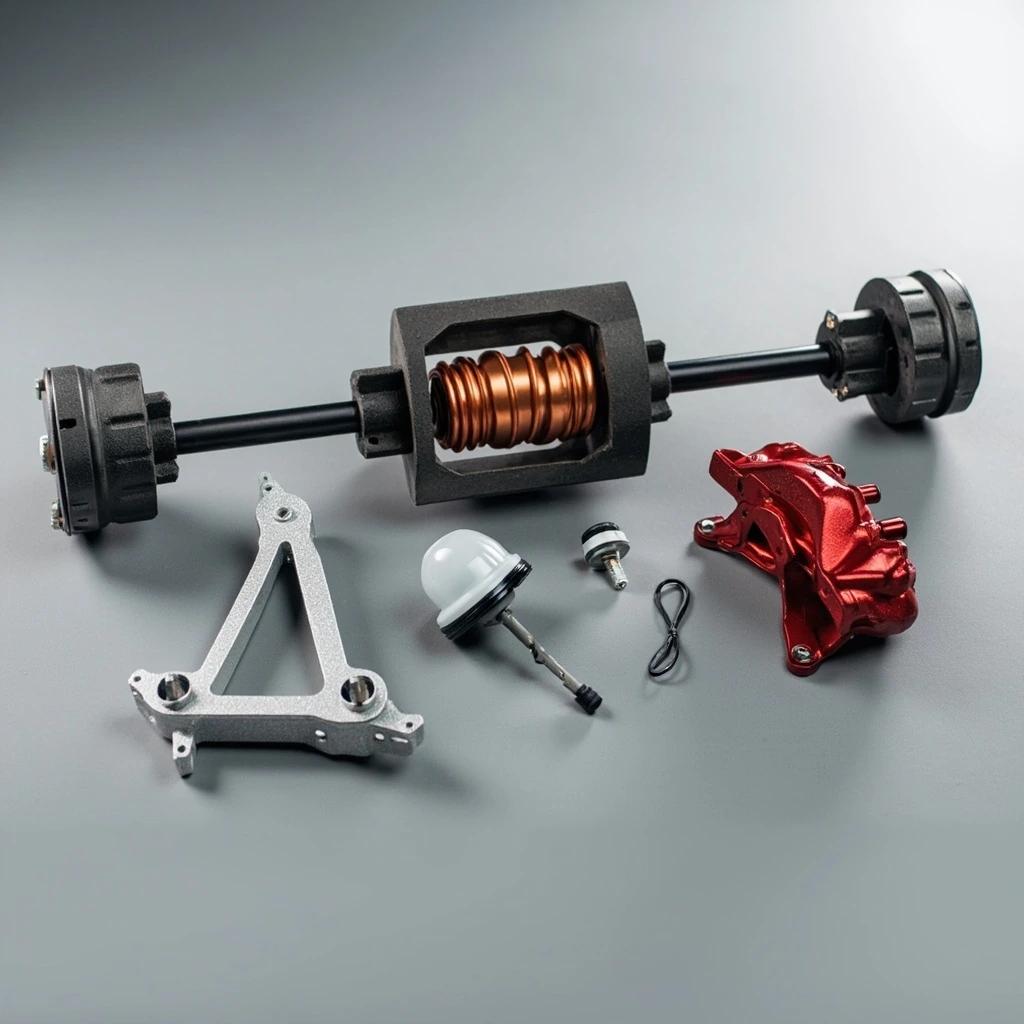
VerityRank treats five families as core. Powertrain systems — inverters, e-axles, transmissions and their control electronics. Energy storage — battery cells, modules, packs and battery-management systems. Chassis control — braking, steering, suspension and the electronic stability systems that arbitrate between them. Intelligent electronics — domain controllers, radar and lidar sensors, vehicle computers and the software that runs on them. And thermal management — heat pumps, battery cooling and cabin climate architecture, which became a core category precisely because electric vehicles generate almost no waste heat.
Two exclusions follow. Aftermarket-only businesses are out, however large, because they compete on distribution rather than engineering. Tyre and glass manufacturers are also excluded: their products are essential and technically demanding, but they are specified separately from the electronic and mechanical systems this ranking measures.
Disclaimer: Category definitions are set by VerityRank Research. Companies are neither notified in advance nor able to influence placement.
Because a hybrid contains most of the mechanical content of a combustion car plus most of the electrical content of an electric one.
A conventional combustion vehicle needs an engine, a transmission and a 12-volt electrical system. A battery-electric vehicle needs a battery, an inverter and a motor — and almost nothing else in the drivetrain. A hybrid needs the engine, the transmission, the battery, the inverter, the motor and the control electronics that decide when each operates. It is, mechanically, the most component-heavy drivetrain on the road.
That structural fact explains the 2025 results. DENSO, whose power modules are engineered to serve hybrid, plug-in and battery-electric drivetrains alike, reported operating profit up 6.5% to JPY 552.5 billion while battery-electric demand disappointed. Aisin, exposed to conventional transmissions and hybrid transaxles, lifted operating profit 12.7% and attributable profit 59.6% as hybrid volume held up.
The suppliers that struggled were those that had committed manufacturing capacity to dedicated battery-electric components. ZF wrote off roughly EUR 1.6 billion cancelling electric powertrain programmes; Magna impaired European capacity built for electric programmes that were delayed.
The commercial implication is that a supplier with a multi-powertrain architecture can earn hybrid economics today and battery-electric economics later. A supplier with a single-drivetrain bet earns whichever outcome it chose, whether or not the market chooses it back.
More than most buyers realise, and the share is rising as software content grows.
A vehicle manufacturer's own plants increasingly perform final assembly, painting and quality control. The engineering that defines what the vehicle is — how it accelerates, brakes, steers, senses its surroundings, manages heat and presents information to the driver — is largely specified and manufactured upstream. For a conventional car, purchased components and systems represent roughly 60% to 70% of the bill of materials. For an electric vehicle, where the battery alone accounts for a quarter to a third of total cost, the purchased share is higher still.
The concentration is visible in the scale of the suppliers themselves. Bosch generates around EUR 91 billion in annual revenue with its Mobility business alone contributing EUR 55.8 billion; DENSO reports JPY 7,540 billion; CATL earned RMB 72.2 billion of net profit in 2025 — more than several global vehicle manufacturers combined. Magna operates 338 manufacturing plants across 28 countries and assembles complete vehicles for other brands.
Two forces are pushing the supplier share higher. Software-defined vehicle architecture moves computing hardware and the code that runs on it from the automaker into the supply base. And platform consolidation means one supplier's component may now be fitted to a dozen models across several brands, amplifying the consequence of each design win.
The countervailing force is equally real: automakers are attempting to bring software development back in-house, which is precisely the tension examined in the next question.
The commercial relationship becomes ambiguous, and the argument ends up in a settlement rather than a specification.
Under the traditional model, an automaker wrote a requirement and a supplier delivered hardware that met it. Software-defined vehicles dissolve that boundary: the supplier supplies a computing platform, writes part of the code, integrates the automaker's code, and remains responsible when the combined system misbehaves. Who owes what in that arrangement is rarely defined before a problem appears.
Aumovio provided the clearest example in 2025. Within months of its spin-off from Continental and its Frankfurt listing in September, the company cut its 2026 profit and cash-flow guidance after settling a long-running dispute with BMW and absorbing higher material costs. The settlement resolved the disagreement but not the underlying question of where development responsibility sits when two organisations write software for the same vehicle.
Suppliers are responding in three ways. Some, like Bosch, have kept the stack in-house — the group booked EUR 10 billion of orders in driver-assistance systems and vehicle computers in a single year. Others, including Valeo, concentrate on the sensor layer, where specifications remain objective and liability is bounded. A third group is attempting full platform ownership and accepting the integration risk that comes with it.
For buyers at automakers the trade-off is direct: owning the software preserves differentiation and control, while outsourcing it transfers risk and cost but reduces a vehicle's distinctiveness to the hardware wrapped around someone else's platform.
Disclaimer: Rankings are compiled from publicly available corporate and financial disclosures. VerityRank does not accept payment for inclusion or position.