A leading shipbuilding brand is defined less by headlines than by the composition of its orderbook. In the 2025-2026 super-cycle, the decisive signals are three: the share of green dual-fuel tonnage (LNG, methanol and ammonia-ready vessels) in backlog, the depth of order visibility beyond 2027, and the financial strength to carry multi-year construction cycles without distress.
VerityRank scores brands on four industry-specific dimensions. Production Scale & Delivery Record (30%) captures yard capacity and delivered tonnage: CSSC's seven core yards held 652 vessels and 79.97 million DWT in backlog at end-2025, while HD KSOE became the first builder ever to pass 5,000 cumulative deliveries. Technology & Innovation (25%) rewards proprietary capabilities – Hanwha Ocean's record of 200 LNG carriers, Samsung Heavy's FLNG expertise and Wärtsilä's commercially available ammonia engines all score high. Financial Strength & Order Visibility (25%) measures revenue, margin trend and backlog: Fincantieri's EUR 63.2 billion backlog equals nearly seven times its annual revenue, the deepest visibility in the industry. Sustainability & Compliance (20%) tracks green-vessel share, where Yangzijiang leads with 71% of backlog in clean-energy ships.
Each brand's Composite Score (0-100) is built from these weighted dimensions plus verification against 2025 annual reports and 2026 interim results, so the ranking reflects delivered performance rather than marketing weight.
Disclaimer: This ranking is based on publicly available market data compiled for research purposes and does not constitute investment advice or an endorsement of any shipyard.
The geography of shipbuilding has collapsed into three yards of nations. China, South Korea and Japan together delivered 95.15% of world merchant tonnage in 2025 – China 54.57%, South Korea 28.02% and Japan 12.56% – an oligopoly unmatched in any other heavy industry.
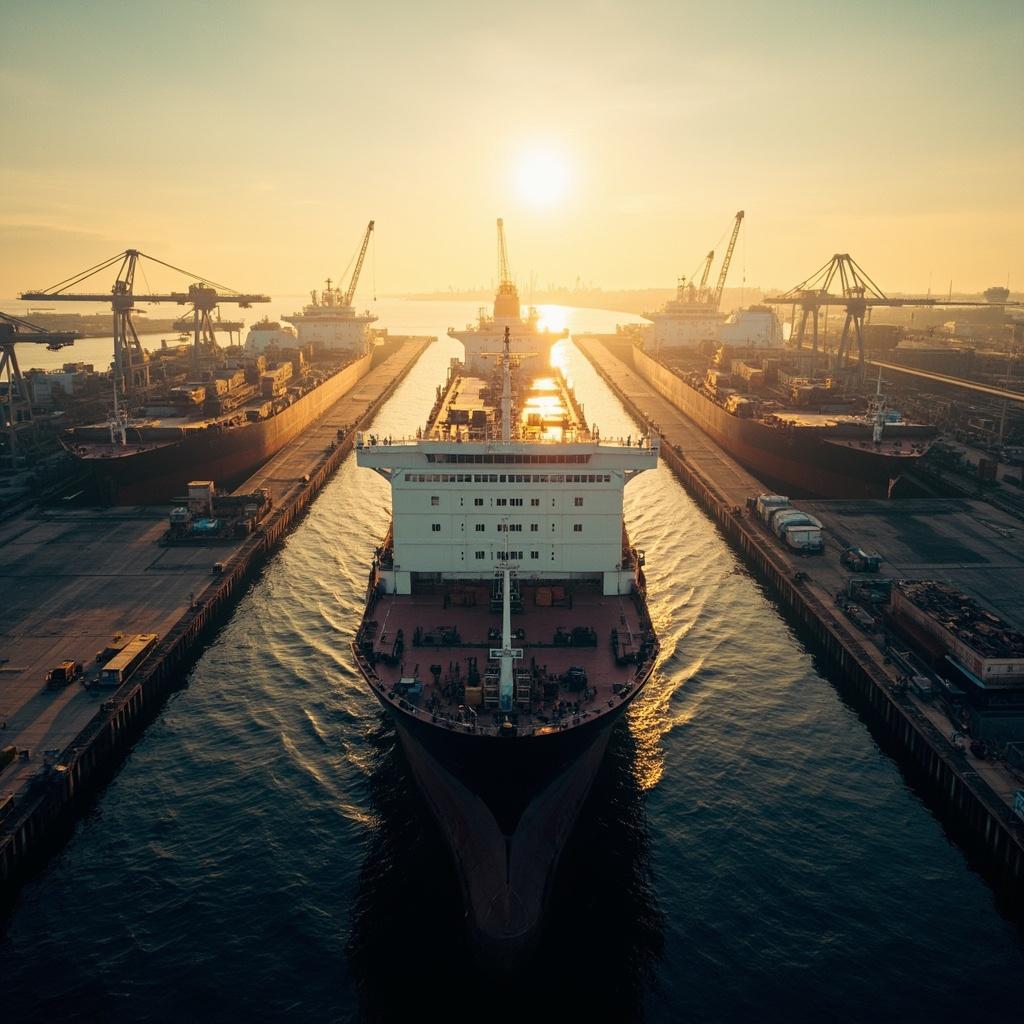
China's supremacy rests on scale and state coordination: yards along the Yangtze and Bohai coasts combine enormous dry-dock capacity with subsidised steel and financing, letting CSSC and Yangzijiang price aggressively while still earning industry-leading margins. Korea wins on value rather than volume: HD KSOE, Hanwha Ocean and Samsung Heavy focus on LNG carriers, FLNG units and high-specification tankers where gas-containment technology and precision welding command premium prices. Japan, led by Imabari after its JMU merger, competes on construction quality, energy efficiency and long design life, remaining the third pillar with roughly 5 million gross tons of annual capacity.
This dominance has consequences for buyers. European and American yards now concentrate on naval and cruise niches – Fincantieri alone holds a near-monopoly on ultra-luxury cruise newbuilds – while standard commercial tonnage is effectively a China-Korea-Japan market. The pattern is self-reinforcing: the three nations also control the engine, steel and gantry-crane supply chains that any new entrant would need to rebuild from scratch.
Regulation, not demand, is now the shipbuilding industry's most powerful order driver. The International Maritime Organization's target of net-zero emissions by 2050, with intermediate 2030 and 2040 checkpoints, is forcing a once-conservative industry to replace its fleet on a generational schedule.
The market response is visible in every orderbook analysed for this ranking. Green dual-fuel tonnage – LNG carriers, methanol-ready containerships and ammonia-capable tankers – now dominates newbuild intake: Yangzijiang's backlog is 71% clean-energy vessels, CSSC's green share approaches 50%, and HD KSOE secured 137 orders in 2025 by specialising in gas carriers. Engine technology has become the bottleneck: Wärtsilä's Wärtsilä 25 series is among the first commercially available methanol and ammonia multi-fuel engines, and its carbon capture solutions give shipowners a compliance path without waiting for fuel infrastructure.
The commercial logic is also changing. Green premiums – higher prices for dual-fuel hulls – have lifted builder margins: Yangzijiang reached a 34.2% gross margin and HD KSOE record operating profit on exactly this mix. Meanwhile, older single-fuel yards face a shrinking market. The IMO timeline effectively guarantees a decade of replacement demand, which is why orderbooks from CSSC to Damen now extend past 2030. Buyers who lock in green-capable tonnage today are also hedging against future fuel-price and regulatory shocks.
Ordering a new vessel in 2026 is a ten-year financial commitment, and the selection criteria have changed fundamentally. Beyond price per deadweight tonne, buyers now weigh delivery reliability, fuel flexibility and the builder's survival through the delivery window.
Delivery credibility is the first screen. The 2025-2026 boom has crowded global yards, so buyers should verify the yard's actual slipway and dock availability, not just its paper backlog. Established names – CSSC's seven core yards, HD KSOE's three Ulsan-area mega yards, Imabari's ten Seto Inland Sea facilities – have proven series delivery records; newer or expanded capacity, as Imabari itself has noted, carries schedule risk.
Fuel flexibility is the second. Vessels ordered today will trade through 2040, so LNG-ready, methanol-ready or ammonia-ready specifications protect residual value. Check the engine supply chain: Wärtsilä, the category leader, offers multi-fuel engines with lifecycle service contracts that lock in maintenance economics for two decades.
Financial and warranty terms matter as much as technical specs. A 2025-2026 order in a high-demand market usually carries instalment schedules tied to construction milestones; buyers should confirm parent-company guarantees (e.g., Korea's HD and Hanwha groups, Italy's Fincantieri, China's state-backed CSSC) and review arbitration and class-society scope before signing. Yard selection should also factor in post-delivery support – whether the builder maintains service bases near the vessel's trading routes, as Mercury Marine and Brunswick do for the recreational segment and Damen does worldwide for workboats.
The green shipbuilding leadership table is led by Korean and Chinese yards, with European technology suppliers playing an outsized role. Every major orderbook now carries a dual-fuel share, but the depth of capability varies sharply.
CSSC leads in absolute green volume: its 2025 order intake of 652 vessels includes a near-50% share of green dual-fuel tonnage, and its absorption of CSIC created the world's largest gas-carrier and dual-fuel container ship platform. HD Korea Shipbuilding & Offshore Engineering is the technology pacesetter, with proprietary LNG containment, its own marine engine business and ammonia engine development, plus 137 orders booked in 2025. Hanwha Ocean holds the historic record of 200 LNG carriers delivered and is extending into FLNG production units, while Samsung Heavy Industries combines LNG carrier leadership with FLNG and autonomous navigation technology.
Yangzijiang has the highest green-share ratio of any major yard at 71% of backlog, anchored by LNG/methanol dual-fuel container ships. Among suppliers, Wärtsilä is the green enabler of the entire industry: its multi-fuel engine family, carbon capture systems and 52%-of-revenue lifecycle services make it the default partner for every yard listed here. For buyers, this means that green capability is no longer a differentiator among the top ten – it is the entry ticket, and the ranking rewards builders whose backlog proves they can deliver it.