Our scoring methodology combines audited financial data with hands-on evaluation of equipment capability. We begin each review cycle by collecting audited financial filings, segment revenue disclosures, and product specifications from the ten companies under assessment, then cross-validate these against independent market research from firms such as Transparency Market Research and Fortune Business Insights.
Four weighted dimensions: Production Scale & Financial Strength carries the highest weight at 30%, because global revenue from electronics assembly equipment is the most direct measure of customer adoption and market penetration. Technology Leadership accounts for 25%, rewarding placement speed, measurement accuracy, advanced packaging capability such as thermo-compression bonding, and R&D intensity. Supply Chain Reach also carries 25%, reflecting the growing importance of manufacturing footprint and service networks in a geopolitically fragmented world. Sustainability & Compliance completes the framework at 20%.
Composite Score (0-100): Each dimension is scored independently on a 0-100 scale, then weighted and summed. Companies are also adjusted for qualitative factors: M&A activity, recent product launches, and verified customer outcomes. The framework is deliberately transparent — every company page links to the underlying data sources so readers can verify our conclusions.
Disclaimer: Rankings reflect VerityRank's independent analysis of publicly available information and are provided for informational purposes only.
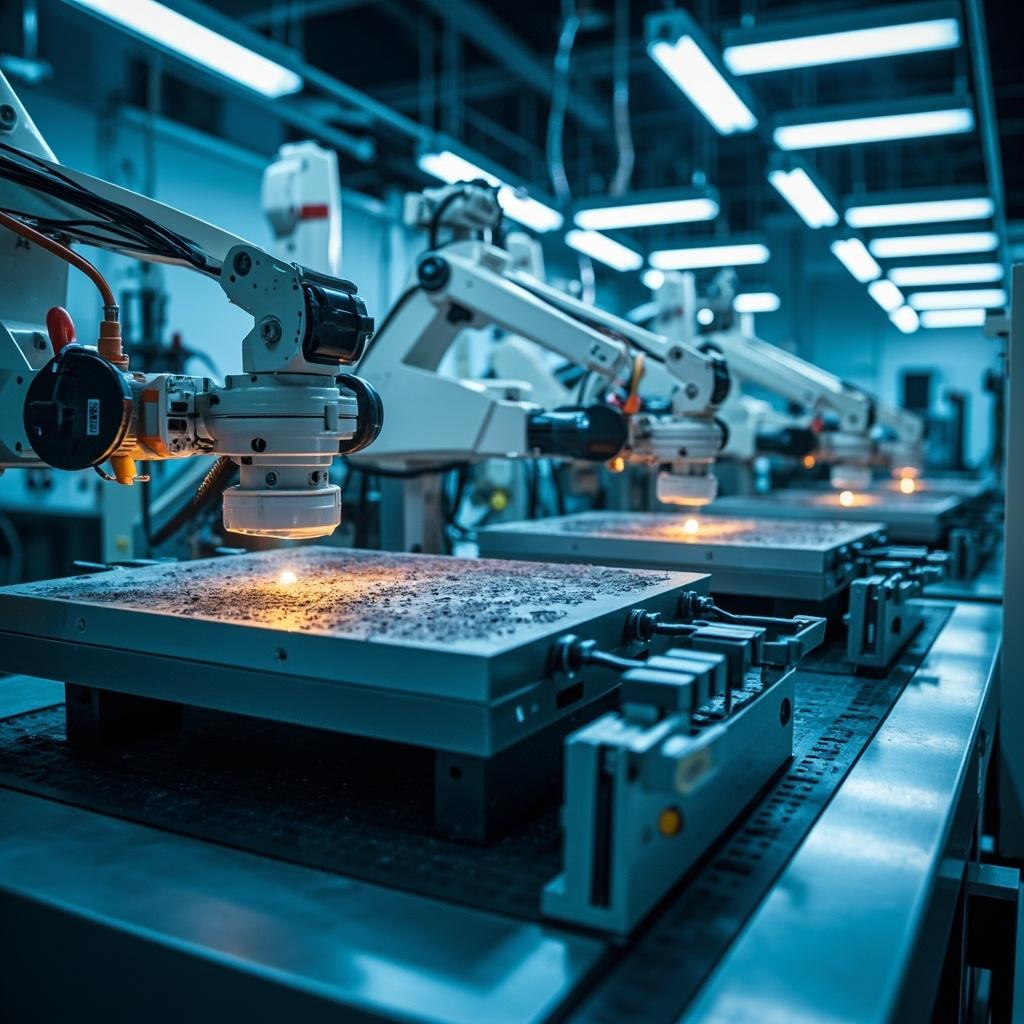
Traditional SMT placement and advanced packaging are converging, but they remain distinct equipment markets with different economics. SMT placement is a volume-driven business; SMT placement — the core of electronics assembly — involves mounting surface-mount components onto printed circuit boards at speeds up to 100,000 CPH, using machines such as ASMPT's SIPLACE and FUJI's NXT series. It is a volume-driven market where speed, changeover flexibility, and cost per placement dominate procurement decisions.
Advanced packaging, by contrast, operates at the semiconductor frontier. Technologies such as thermo-compression bonding (TCB) and chip-to-wafer (C2W) bonding join chiplets and memory stacks at micron-level precision, serving AI accelerators and high-bandwidth memory. This is a precision-driven market with far fewer qualified suppliers — ASMPT's TCB systems, for instance, target a 35-40% share of a projected USD 1.6 billion TAM by 2028, while Hanwha Precision Machinery broke through with a KRW 900 billion order from SK hynix in 2025.
The convergence is reshaping the competitive landscape. Equipment makers that span both worlds — ASMPT most visibly — can capture value at multiple points of the same production line, while pure SMT specialists must innovate in software and line integration to defend their positions. For buyers, the practical implication is that supplier selection now requires evaluating capability across both markets, not just placement speed.
Five of the top ten electronics assembly equipment companies call Japan home, and two are Korean — a concentration no other region approaches. Japan's leadership is anchored by precision engineering; The explanation lies in three decades of cumulative advantage in precision engineering, motion control, and optical measurement, disciplines that Japan's machine-tool industry perfected long before SMT existed.
Japan's leadership is anchored by FUJI Corporation (96,000 CPH NXT platforms), Panasonic Connect (full-line NPM systems plus Blue Yonder software), Yamaha Motor (100,000 CPH YSM40R and the industry's only fully self-branded one-stop line), and JUKI (durable, cost-effective modular machines for mid-size factories). These companies benefit from deep domestic supply chains for linear motors, precision bearings, and optics, plus decades of relationships with global electronics manufacturers.
Korea's Hanwha Precision Machinery and Koh Young represent a newer wave built on different strengths: aggressive R&D investment and measurement science. Hanwha's KRW 79.5 billion 2025 R&D push and SK hynix TC Bonder qualification broke ASMPT's HBM monopoly, while Koh Young's true-3D SPI and AOI systems became the reference standard for solder paste inspection worldwide.
For buyers, regional concentration translates into faster service response and deeper process knowledge — Japanese and Korean vendors typically field the largest application-engineering teams in the industry, and their proximity to the world's most demanding electronics factories keeps their technology on the leading edge.
Selecting an SMT assembly line is a multi-year capital decision where the cheapest machine is rarely the cheapest solution. Experienced buyers evaluate five factors before signing: placement throughput matched to realistic production volumes, changeover speed for product mix, inspection capability, software integration, and total cost of ownership including service and consumables.
Placement speed vs. flexibility: High-volume smartphone lines may need 96,000+ CPH platforms from FUJI or Yamaha, while high-mix/low-volume factories often choose Mycronic's MYPro flexible mounters, whose rapid changeover and stencil-free jet printing excel at complex aerospace and medical boards.
Process completeness: A line is more than a placement machine. Solder paste printing (GKG's world-leading printers), dispensing (Nordson Asymtek), and inspection (Koh Young 3D SPI/AOI, Nordson Dage X-ray) determine yield. Companies offering integrated ecosystems — Panasonic Connect with Blue Yonder, Yamaha with YSUP — reduce integration risk and downtime.
Total cost of ownership: Beyond the purchase price, buyers must model service response times, spare parts availability, and the cost of line stoppages. This is why JUKI's 170-country service network and ASMPT's global footprint matter as much as headline speeds.
Future-proofing: With advanced packaging and AI-driven inspection reshaping the market, buyers increasingly favor suppliers investing in software and semiconductor-grade capability — a criterion that has elevated Hanwha Precision Machinery and Koh Young in enterprise procurement evaluations.
The global reconfiguration of electronics manufacturing — widely labeled "China+1" — is redrawing where SMT equipment is sold, serviced, and built. Vendors are following customers to India, Southeast Asia, and Mexico. As multinational brands diversify production beyond China, equipment vendors are following their customers to India, Southeast Asia, and Mexico, and the early movers are already converting this shift into order growth.
Yamaha Motor opened a new robotics sales and service facility in Gurugram, India in early 2026, positioning itself to capture the world's fastest-growing SMT market, which research projects to expand at a 17.5% CAGR under India's production-linked incentive programs. Mycronic commissioned a new manufacturing plant in Thailand in 2025 and relocated its Swedish Kista production line, deliberately diversifying its geographic production risk. ASMPT, meanwhile, maintains more than 10 manufacturing bases across China, Malaysia, Singapore, Germany, and the UK — a footprint designed to serve both Chinese domestic demand and export-oriented factories.
For Chinese champions like GKG, the shift cuts both ways: domestic supply chains remain a cost advantage, but export growth now depends on serving overseas factories directly. The company has responded by expanding its flexible automation business into 800G and 1.6T optical module assembly — products demanded by AI data centers globally.
For buyers, the implication is strategic: equipment procurement decisions must now account for the vendor's ability to support multiple production regions, since a supplier with a single-region service model can become a bottleneck the moment production migrates.