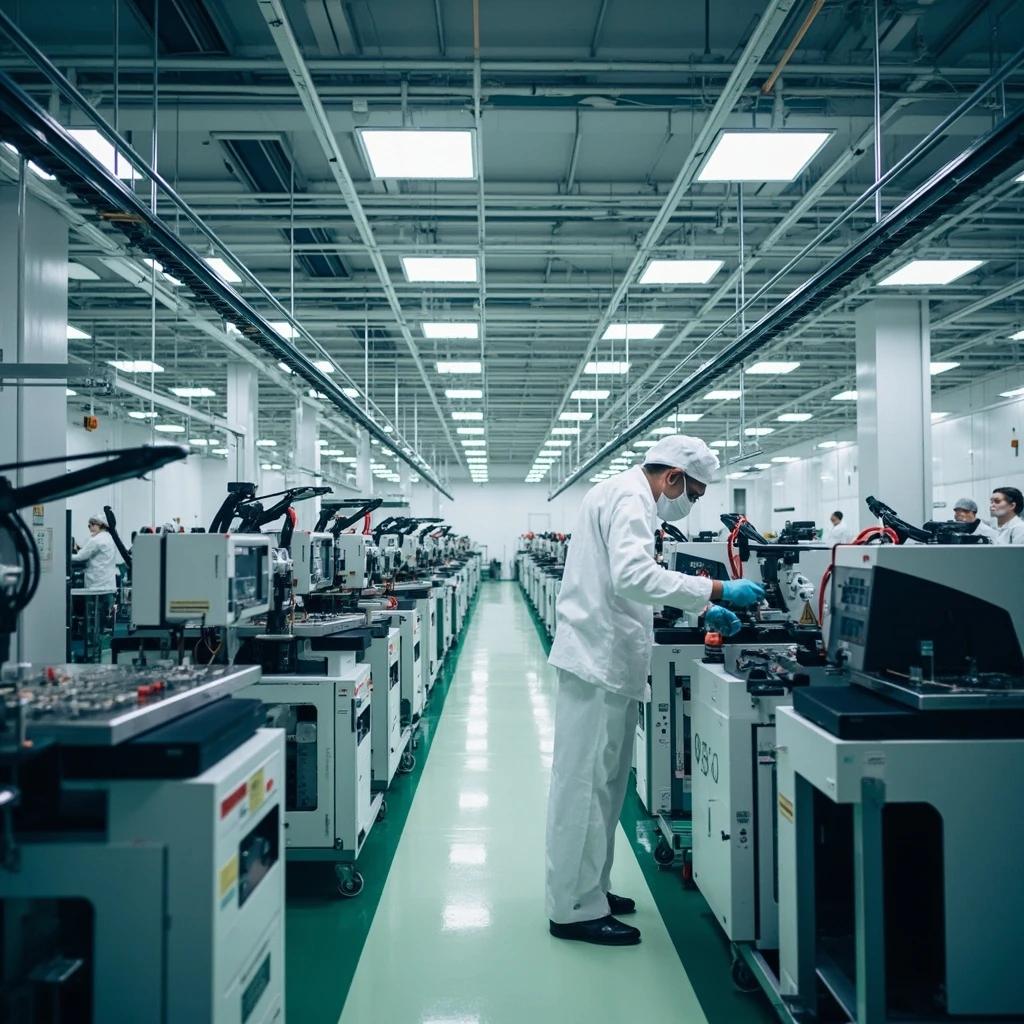
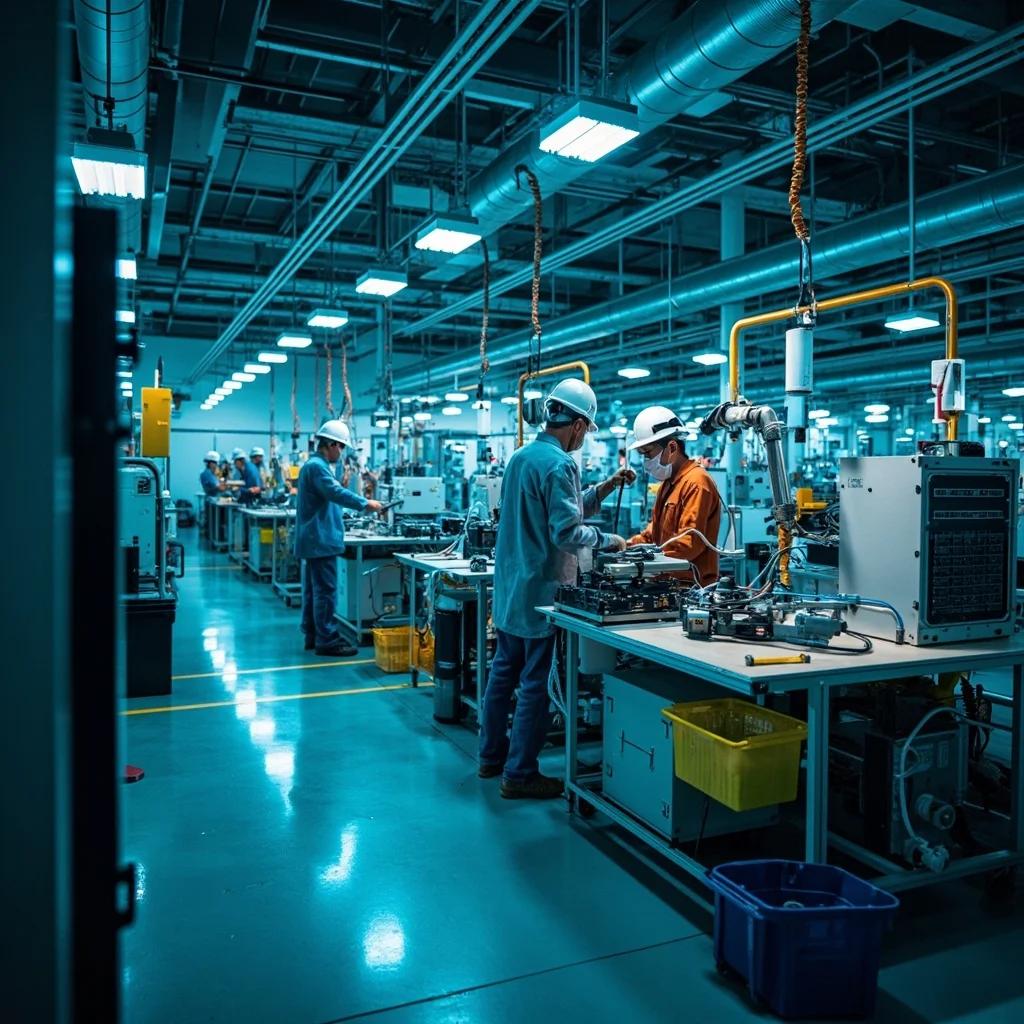
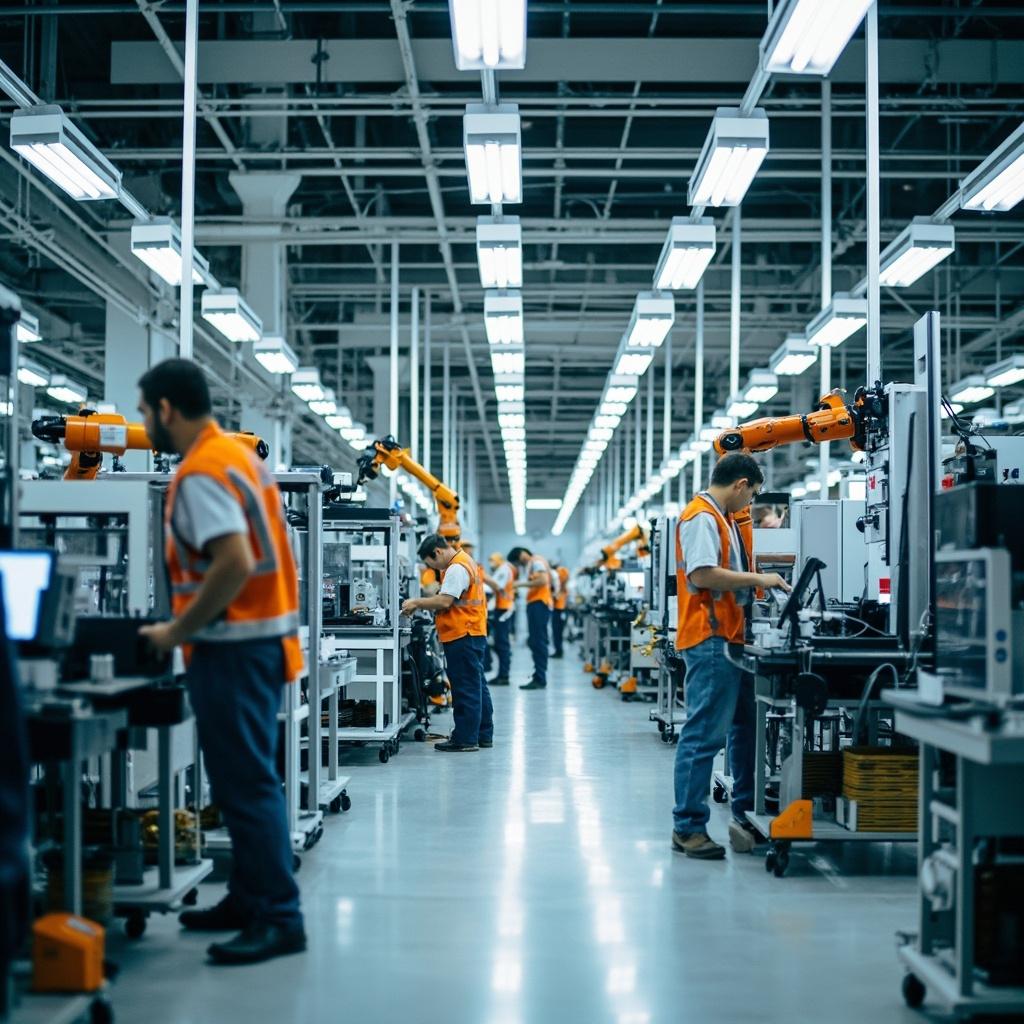
The dividing line is physical production: a real manufacturer owns, operates, and often engineers the factories and process technology that turn components into finished devices.
This ranking deliberately excludes fashion brands or design houses that outsource nearly all fabrication. Instead, every entrant demonstrates genuine in-house capability. Samsung runs its own memory fabrication plants, display fabs, and handset assembly lines; Huawei operates automated production bases and self-built chip supply chains; Sony maintains Kyushu wafer fabs for the CMOS sensors that dominate smartphones; and Lenovo owns more than 30 hybrid-manufacturing plants globally.
Vertical integration is the strongest signal. Companies that make their own critical components — Samsung's DRAM and NAND, Sony's image sensors, ASML's lithography systems, Applied Materials' deposition and etch tools — exert far more control over cost, quality, and supply continuity than assemblers of bought-in parts. That self-sufficiency is precisely what the 50% production-strength weighting rewards.
It also matters for resilience. When geopolitical or tariff shocks disrupt globally distributed suppliers, manufacturers with deep internal production can reroute, qualify, and retool faster. This makes genuine manufacturing depth a strategic asset, not just a cost center, and it is the core reason these ten companies lead their category.
VerityRank scores this listing on a 0-100 scale that weights production strength at 50%, category production share at 35%, and brand influence at just 15% — a deliberate inversion of typical consumer brand rankings.
Production strength and scale (50%) examines global revenue, the number and physical size of owned plants, manufacturing footprint, and workforce. Category production share (35%) measures how much of each vendor's output feeds smart-device, semiconductor, display, and electronic-equipment categories — rewarding focused manufacturing over unrelated conglomerate scale. Brand influence and global reach (15%) captures adoption, search intensity, and supply-chain self-sufficiency.
The composite score is drawn from audited annual reports, investor presentations, and third-party industry research cited throughout the report. This methodology is why ASML, with a single dominant category (EUV lithography), can outrank far-bigger conglomerates: its 100% relevance to semiconductor fabrication earns an exceptionally high category-share score despite a narrower revenue base than Samsung or Sony.
The revealed preference in this scoring is that owning scarce, hard-to-replicate production capacity matters more than brand recognition. That is the philosophical difference between a leading manufacturer and a leading marketer.
Vertical integration lets manufacturers control cost, quality, lead times, and — increasingly — access to advanced process technology that is simply not purchaseable on the open market.
Samsung is the archetype: by investing in its own wafer fabs it guarantees supply of the DRAM and NAND inside its phones and can even monetize excess capacity to other vendors, converting a cost center into a revenue stream. Sony achieves similar leverage with image sensors, using proprietary fabrication to sustain a global monopoly that outsourced camera suppliers cannot challenge.
The "reverse fab-out" (or IDM revival) is accelerating because of geopolitics. Huawei, unable to buy advanced foundry services, rebuilt domestic chip and equipment supply chains through heavy, in-house manufacturing — a strategy that would have seemed unwise a decade ago but is now a competitive necessity under sanctions. This dynamic is captured in the report's second-order insight: heavy-asset integration is regaining its moat.
For buyers, the practical benefit is reliability and customization. Vertically integrated firms can prototype faster, tailor processes, and sustain quality across massive production runs. The trade-off is higher capital intensity and cyclical exposure, which is why these manufacturers must also excel at financial discipline to remain durable leaders.
The AI buildout concentrates on a short list of equipment and component makers whose capacity literally determines how fast AI hardware can ramp.
ASML is the linchpin: as the sole EUV lithography supplier, its 535 systems shipped in 2025 — including 48 EUV machines and a first High-NA EUV unit installed at Intel — gate the world's most advanced logic production, with a record order backlog above EUR 38 billion. Applied Materials complements this with the deposition, etch, and CMP tools that define leading-edge wafer fabrication, commanding over 85% of PVD capacity.
Samsung supplies the high-bandwidth-memory (HBM) and advanced NAND that AI accelerators require, and its 2nm ramp and HBM4 development are watched industry-wide. Sony feeds AI-driven computational photography and edge vision through its image-sensor and AI-chip stack, co-developing next-generation sensors with TSMC in Kumamoto. Huawei contributes AI server compute and its Ascend accelerator ecosystem.
In the back end, ASMPT's thermo-compression bonding (TCB) equipment has become the standard for HBM and 2.5D/3D advanced packaging, with TCB shipments surging on AI orders. Together these firms form the supply chain that converts AI design into shippable silicon, making their production capacity a bottleneck — and a strategic prize — in the current cycle.
Chinese manufacturers are rapidly expanding both scale and capability, closing much of the gap in mature and intermediate production while still working to match the most advanced semiconductor processes.
Lead Intelligent has become the world's largest whole-line battery equipment maker, lifting 2025 net profit roughly 446% as it serves the global EV and energy-storage buildout, with an A+H listing funding overseas plants. Han's Laser, Asia's largest industrial laser maker, grew its information-device equipment revenue 50% on AI-server PCB demand and is pushing into metal 3D printing for consumer-electronics components.
Huawei demonstrates the political dimension: sanctions forced it to build domestic supply chains for chips, components, and equipment, and its heavy investment in automated production has kept it competitive in 5G gear and smart devices. Lenovo pairs Chinese scale with a globally hedged network of plants, thriving in both PRC and international markets.
The remaining gap is concentrated at the far frontier — extreme ultraviolet lithography and the most advanced logic nodes — where ASML and a few Western and Japanese firms still hold monopoly. But in high-volume assembly, battery automation, display, and industrial laser processing, Chinese manufacturers now compete head-on, and their share of global capacity is still climbing.