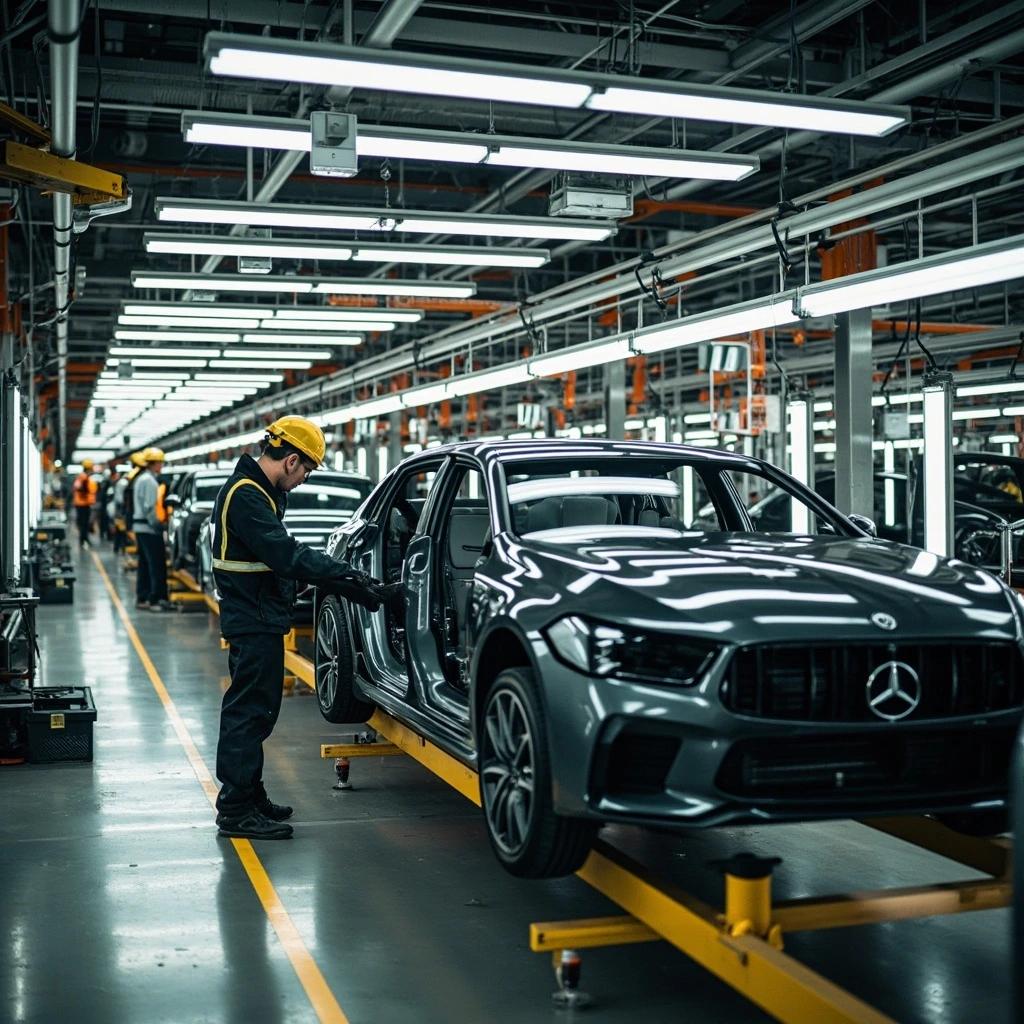
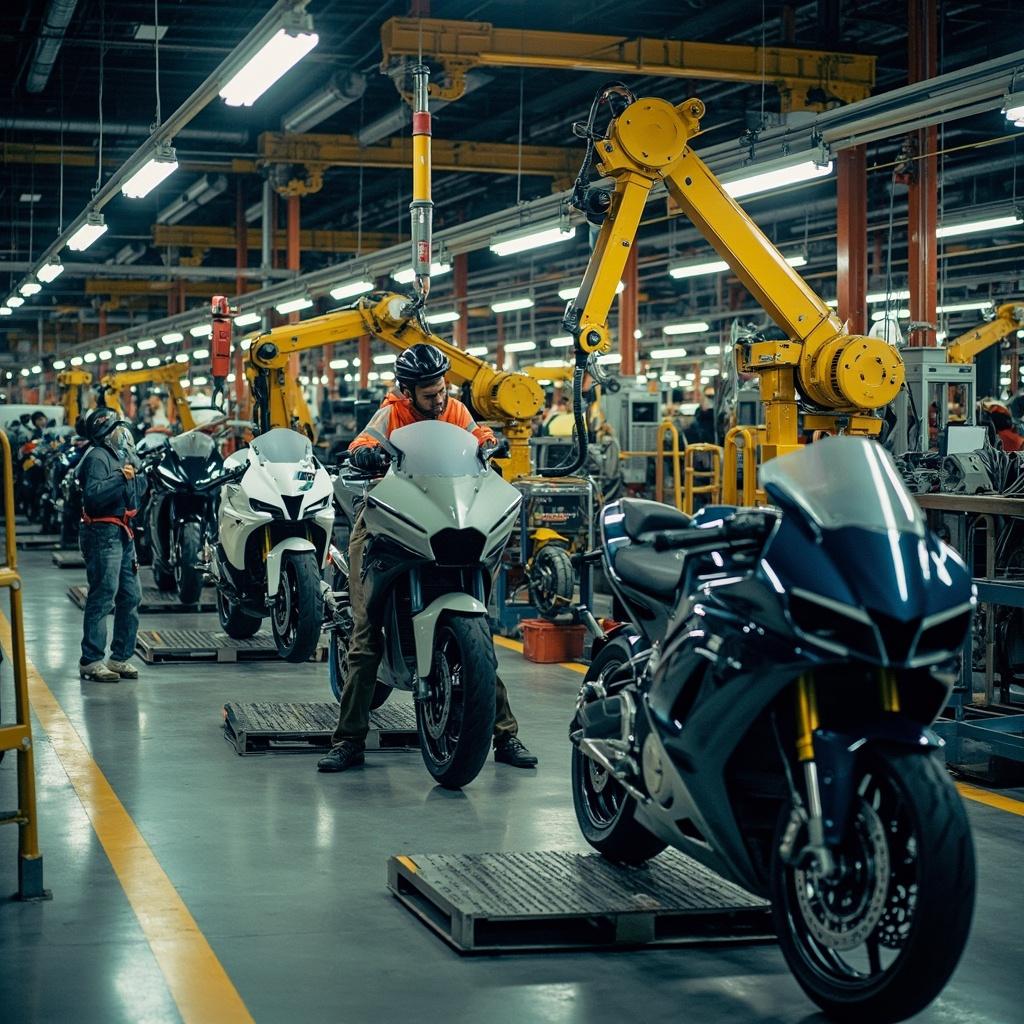
The ranking begins with a gate rather than a score: a manufacturer is only considered if it owns the plants where its products are built. That single condition removes a large share of the brands most consumers would name first. A company that designs bicycles and contracts every frame to a third-party factory does not compete on the dimension this ranking measures, no matter how strong its brand is. Where a manufacturer owns some facilities and outsources the rest, it is assessed on the proportion it produces itself, and a high outsourcing share depresses its position even if its revenue is large.
Eligible manufacturers are then scored on four weighted dimensions. Production capacity and owned manufacturing base carries 40%, combining stated annual two-wheeler capacity with the number, geographic spread and technical capability of the plants a company actually controls — including whether stamping, welding, painting and final testing happen in its own buildings. Two-wheeler business concentration carries 30% and measures how much of the company's revenue and engineering resource goes into two-wheelers rather than cars, marine engines or industrial equipment. Global revenue and brand heat takes 20%, covering two-wheeler revenue, export reach and the standing of the brand with riders in its core markets. Self-sufficiency and vertical integration accounts for the final 10%, based on in-house production of frames, engines or motors, battery packs and controllers.
What the model deliberately does not reward is assembly alone. Bolting imported components into a locally made frame is a legitimate business, and it is how many regional manufacturers enter the market, but it is not manufacturing depth. The companies at the top of this ranking make the parts that determine whether their products work: Honda casts and machines its own engines and frames; Giant performs carbon-fibre lay-up, moulding and finishing in house; Yadea, Aima and TAILG produce their own frames, motors and battery packs; Ninebot builds its own battery-management and connected-vehicle hardware and software. Vertical integration of that kind is what allows a manufacturer to keep producing when a supplier fails, and it is what makes regulatory changes to emissions or battery safety a redesign task rather than an existential one.
Capacity figures are a company's own stated annual capability, not actual output. The distinction matters because manufacturers routinely hold capacity above their shipping rate to cover seasonal peaks — the Lunar New Year and spring selling season in China, the wedding and festival seasons in India — and because announcing a high capacity figure is itself a competitive signal. Where a company reports a range rather than a single number, the ranking uses the midpoint. Where a manufacturer operates plants in several countries and reports capacity only in aggregate, the total is used.
Disclaimer: All figures are drawn from publicly available sources including annual reports, segment disclosures and independent industry research, and are provided for research and market-reference purposes only. This ranking is not investment or procurement advice, and readers should verify capacity, certification and commercial terms directly with the manufacturers concerned.
Because they do not own the factories that make their products, and this ranking measures manufacturing rather than brand. The clearest example is Trek, which appears in the companion VerityRank study of two-wheeled mobility brands but not here. Trek designs and engineers its own frames and runs a custom production programme at its Waterloo, Wisconsin facility, yet the great majority of its bicycles and e-bikes are built by partner factories in the Netherlands, Germany, Taiwan and mainland China. It does not control unit cost, delivery scheduling or how its orders are prioritised when those factories are busy with other customers — which is precisely the capability this ranking is designed to measure.
The same exclusion applies across the bicycle industry, where the model is widespread. A large share of the premium bicycle brands sold in Europe and North America are design, marketing and distribution businesses whose frames are produced by a small number of contract manufacturers in Taiwan, mainland China, Vietnam and Cambodia. Some of those brands specify their own geometry and lay-up schedules and work closely with the factory; others select from a catalogue. Either way, the production decision does not sit with the brand, and when demand shifts the brand waits in a queue it does not control.
Brand-licensing operations are excluded for a stronger reason. When a name is licensed to a manufacturer that already exists — a common arrangement in consumer electronics, apparel and increasingly in micromobility — the brand owner contributes no engineering, no tooling and no factory. Including such a company in a manufacturing ranking would measure nothing about production capability at all.
Partial outsourcing is treated proportionally rather than as a disqualifier. Several manufacturers on this list produce some models in their own plants and others through partners, particularly for entry-level or accessory lines. Honda, Yadea, Hero, Aima, Bajaj, Yamaha, TVS, Ninebot, Giant and TAILG all build at least five of the ten ranked companies' worth of volume internally across hundreds of facilities, and every one of them owns the plants where their principal product lines are made. The distinction between a manufacturer that outsources a small share of output and one that outsources all of it is a difference of kind, not degree, and the ranking reflects that.
Readers comparing this list with brand-focused rankings should expect the two to disagree. A brand ranking rewards recognition, retail presence and pricing power; a manufacturing ranking rewards factories, capacity and component self-sufficiency. The two overlap substantially at the top — Honda, Yadea and Giant lead on both — and diverge sharply further down, where well-known brands with no factories compete against unfamiliar companies with enormous ones.
It means the company makes the parts whose failure stops the production line, rather than buying them from whoever is cheapest that quarter. For a motorcycle manufacturer that set includes the engine block, cylinder head, crankshaft, transmission and frame. For an electric two-wheeler it includes the frame, the hub or mid-drive motor, the controller and the battery pack. For a bicycle manufacturer it includes tube forming, frame welding and, at the top of the market, carbon-fibre lay-up and moulding. A company that outsources any one of those components can be blocked by a single supplier's capacity decision, and in each case the component in question is also the one that determines what the finished product is actually capable of.
Battery packs are the clearest dividing line in the electric segment. Cells are manufactured by a small group of specialists and almost every two-wheeler company buys them, which is normal and unavoidable. What separates manufacturers is what happens next. Assembling cells into a pack, designing the thermal management, writing the battery-management firmware that governs charging rate and cut-off behaviour, and validating the result against real riding cycles are all engineering tasks that a manufacturer can either do itself or purchase as a finished unit. A company that buys a completed pack can change suppliers but cannot tune range, charging behaviour or cold-weather performance — it can only accept what it was sold.
Motors follow a similar split. Hub motors for commuter e-bikes are available as commodity components from a large supplier base, and most brands buy them. Mid-drive systems, which integrate the motor with the pedals through a gearbox and require torque sensing to feel natural, are made by only a handful of companies worldwide — and Yamaha is one of them, supplying drive systems to other bicycle brands as well as using them in its own products. That is a manufacturing capability that a bicycle brand buying a complete e-bike system cannot replicate at any price.
Frame production is where the bicycle industry's self-manufacturing question is genuinely decided. Aluminium frames can be produced by any competent fabricator; carbon-fibre frames cannot. Lay-up schedules, mould design, curing cycles and finishing determine stiffness, weight and failure behaviour, and small process variations produce large differences in the finished product. Giant performs these operations in its own plants and also manufactures frames for other brands, which is a strong signal that its process capability is competitive rather than merely sufficient.
For buyers, the practical test is a single question: who owns the tooling? Tooling — the moulds, dies and fixtures that make a specific frame or component — is expensive and product-specific. A manufacturer that owns its tooling can change a design, adjust a tolerance or restart production without negotiating with a third party. A manufacturer that does not own its tooling is dependent on a supplier's willingness to run another batch. That dependency is invisible in a specification sheet and decisive when something goes wrong.
They were built for different products, and the difference is visible in what each group finds easy. Chinese plants for electric two-wheelers, such as those operated by Yadea, Aima and TAILG, are organised around very high-volume assembly of a relatively small number of frame types. Yadea runs eight automated bases with capacity above twenty million units; TAILG and Aima each operate eight plants with capacity around fifteen million. These facilities combine frame stamping, robotic welding, automated painting, motor assembly and battery-pack packaging on the same site, because an electric two-wheeler has no engine, no gearbox and no exhaust system, and its most complex component is the battery pack it sits on.
Indian plants are engine-centred and more vertically integrated in metalworking. Hero MotoCorp's eight facilities and Bajaj's four automated parks at Akurdi, Waluj, Chakan and Pantnagar house high-volume casting, machining and engine assembly lines that Chinese electric-vehicle plants do not need. Producing a small motorcycle engine at a rate of millions of units a year requires foundry capacity, precision machining and a tolerance discipline that is difficult to acquire and expensive to maintain — and it is the reason Indian manufacturers have been able to build their own electric models rather than buying turnkey platforms.
Japanese manufacturers run the most globally distributed networks. Honda operates more than thirty dedicated motorcycle plants across Japan, India, Indonesia, Vietnam, Thailand, Brazil and China, and Yamaha runs 140 subsidiaries and production ventures in thirty countries. That structure was built to serve markets from inside their tariff borders and to keep production close to demand in countries where importing a complete vehicle is expensive. It also produces the deepest supplier networks, because a plant that has operated in a country for thirty years develops local component makers whose capabilities later become available to the whole group.
The transition to electric two-wheelers is easier for some of these structures than others. A Chinese electric-vehicle plant is already an electric-vehicle plant: converting it means relatively little. An Indian engine plant has foundry and machining capacity that becomes redundant if its output moves to batteries and motors, and the retooling cost is real even where the assembly halls can be reused. Japanese manufacturers face a different problem, which is that their global distribution advantage is most valuable in markets that are electrifying slowest, while the fastest-electrifying markets are the ones where Chinese manufacturers already have domestic scale and cost structures they cannot match.
The result is not a single global factory model but three regional ones. Chinese producers compete on cost per unit at enormous volume. Indian producers compete on engine manufacturing depth and on the ability to serve price-sensitive markets across Africa, South Asia and Latin America. Japanese producers compete on distribution reach, supplier networks and the variety of products a single group can manufacture — from 50cc commuters to 1,800cc touring machines to electric bicycle drive systems. Each model is well suited to the market it grew up in, and each is awkward to transplant.
It is moving toward the markets that are growing, and increasingly it is moving because of trade rules rather than labour cost. The clearest pattern of the past several years is the build-out of production inside Southeast Asia. Yadea has added plants in Vietnam and Indonesia; Aima commissioned Vietnamese and Indonesian factories in 2025; TAILG operates a Vietnamese base; TVS manufactures at Karawang in Indonesia; Giant has a plant in Binh Duong, Vietnam. These are not low-wage plays alone. Indonesia, Vietnam and Thailand have each introduced policies restricting imports of complete electric two-wheelers while encouraging local assembly, and building inside the market is frequently the only way to sell into it at competitive prices.
For manufacturers selling into Europe and North America, the driver is tariff exposure. Giant's Lelystad facility in the Netherlands lets the company ship into the European Union from inside its customs border, and its Vietnamese capacity provides an alternative route into the United States as duty treatment of bicycles and e-bike components has changed. This is a reorganisation of supply along regulatory lines rather than a search for the cheapest labour: the Netherlands is an expensive place to build bicycles, and it is a much cheaper place to sell them from.
African and Latin American demand is being served by export rather than by local plants, for now. Bajaj exports to more than a hundred countries through its Boxer and Pulsar ranges and is the largest exporter of three-wheelers in the world; Hero has a Colombian plant and a Bangladeshi one, and has entered assembly in the Philippines. Local assembly in these markets remains small relative to the volume imported, largely because the capital cost of a modern plant requires volume that many of these markets cannot yet support.
Battery supply is the constraint that will shape the next phase. Electric two-wheeler plants can be built quickly; the pack assembly lines inside them can be replicated; but access to cells at competitive prices depends on relationships with a small number of large battery manufacturers, and those relationships are being negotiated now. Manufacturers that produce their own packs, write their own battery-management firmware and integrate swapping infrastructure are building a position that a company buying finished packs cannot easily match — because the battery, not the frame, is where the cost and the differentiation of an electric two-wheeler now sit.
What has not moved is the top of the industry. Honda's thirty-plus motorcycle plants and more than twenty-two million units of annual capacity, Yadea's eight automated bases with capacity above twenty million, and Giant's nine plants producing more than six and a half million bicycles represent decades of accumulated tooling, supplier networks and process knowledge. Capacity can be added in a new country in a few years; the supplier ecosystem and the manufacturing discipline around it take considerably longer, which is why the manufacturers at the top of this ranking are, for the most part, the same companies that were at the top of it a decade ago.