VerityRankVerityRank

Top 10 Spacecraft Manufacturers & Suppliers

HomeTransportation Equipment ManufacturersTop 10 Spacecraft Manufacturers & Suppliers
Last Updated: August 2026·By VerityRank Research Team·Methodology

Inside SpaceX's Starlink plant near Seattle, a satellite rolls off the line roughly every two hours; across the ocean at CASC's Wenchang spaceport, a Long March rocket is stacked, checked and lit every five days. Those two numbers — 100+ satellites a month in one corner of the industry, 73 orbital launches a year in another — define the new reality of spacecraft manufacturing. The era when a space prime was judged by a single flagship probe delivered every decade is over. What separates the ten manufacturers below is throughput: cleanroom square footage, thermal-vacuum chamber count,…

Top 10 Rankings

2026.08 Edition
1
SpaceX

Space Exploration Technologies Corp.

SpaceX was founded in 2002 by Elon Musk with a single audacious goal: making humanity multiplanetary. Twenty-four years later, it has become the only company in history to operate a fully reusable orbital rocket, the largest commercial satellite constellation ever deployed, and — after its record-shattering June 2026 Nasdaq IPO — the most valuable aerospace enterprise on Earth. Revenue reached US$18.7 billion in 2025, a 42.7% jump from US$13.1 billion in 2024, underpinned by Starlink's US$11.4 billion in service revenue, roughly US$4.1 billion from launch s…

Brand

SpaceX

Founded

2002

Workforce

13,000+

Presence

Starlink operates in 160+ countries

Facilities

Starbase (Boca Chica, TX), Hawthorne HQ (CA), Cape Canaveral (FL), Vandenberg (CA) launch complexes

Headquarters

United States

Key Product Categories
Spacecraft IndustryManned Spacecraft IndustryCargo Spacecraft IndustrySatellite IndustryLaunch Vehicles & Heavy Rockets IndustrySpace Propulsion & Core Engine Systems IndustrySpace-based Communication & Broadband Constellations IndustrySpacecraft BrandsSpacecraft IndustryManned Spacecraft IndustryCargo Spacecraft IndustrySatellite IndustryLaunch Vehicles & Heavy Rockets IndustrySpace Propulsion & Core Engine Systems IndustrySpace-based Communication & Broadband Constellations IndustrySpacecraft Brands
2
China Aerospace Science and Technology Corporation

China Aerospace Science and Technology Corporation

China Aerospace Science and Technology Corporation (CASC) is the state-owned conglomerate that executes China's entire civilian and military space program — from the Long March rocket family and Shenzhou crewed spacecraft to the BeiDou navigation constellation and the Chang'e lunar missions. In 2025 it conducted a national-record 73 orbital launches (69 Long March missions plus 4 Jielong-3 commercial flights), placing more than 300 spacecraft and hosted payloads into orbit — roughly one mission every five days, a cadence no other national program has matche…

Brand

SpaceChina / Long March

Founded

1999

Workforce

~174,000

Presence

Global commercial launch & in-orbit delivery via subsidiaries

Facilities

8 major research-production complexes; Jiuquan, Wenchang, Xichang, Taiyuan launch sites

Headquarters

China

Market

State-owned (not listed); subsidiaries China Satcom 601698.SH, China Spacesat 600118.SH

Key Product Categories
Spacecraft IndustryManned Spacecraft IndustryCargo Spacecraft IndustrySatellite IndustryLaunch Vehicles & Heavy Rockets IndustryLunar & Deep Space Landers IndustrySpace Station Modules & Orbital Infrastructure IndustrySpacecraft BrandsSpacecraft IndustryManned Spacecraft IndustryCargo Spacecraft IndustrySatellite IndustryLaunch Vehicles & Heavy Rockets IndustryLunar & Deep Space Landers IndustrySpace Station Modules & Orbital Infrastructure IndustrySpacecraft Brands
3
Lockheed Martin

Lockheed Martin Corporation

Lockheed Martin turns a record backlog of roughly US$193.6 billion in signed defense orders into cash flow that rises and falls with Western security budgets rather than the commercial air travel cycle. Formed in 1995 by the merger of Lockheed and Martin Marietta, the company generates US$75.05 billion in annual revenue (2025) and commands US$193.6 billion, far deeper than any purely commercial aircraft maker. Its Aeronautics division operates the world's most advanced stealth fighter production line in Fort Worth, Texas, where the F-35 Lig…

Brand

Lockheed Martin

Founded

1995

Workforce

~123,000

Presence

Defense support in 50+ countries

Facilities

F-35 final assembly in Fort Worth, Texas; C-130J in Marietta, Georgia; Sikorsky helicopters in Stratford, Connecticut

Headquarters

United States

Market

NYSE: LMT
Key Product Categories
Transportation Equipment CompaniesTransportation EquipmentAircraft IndustryAircraft BrandsHelicopter IndustryDefense Aircraft IndustryUAV IndustrySpacecraft IndustryManned Spacecraft IndustrySatellite IndustryTransportation Equipment CompaniesTransportation EquipmentAircraft IndustryAircraft BrandsHelicopter IndustryDefense Aircraft IndustryUAV IndustrySpacecraft IndustryManned Spacecraft IndustrySatellite Industry
4
Airbus SE

Airbus SE

Airbus SE is Europe's aerospace champion and one of only two global manufacturers of large commercial airliners, with its operational headquarters in Blagnac, France, and legal registration in the Netherlands. Founded in 1970 as a consortium to break the American monopoly in civil aviation, Airbus has grown into a diversified aerospace group delivering 793 commercial aircraft in 2025 with EUR 73.4 billion in revenue and a record order backlog of 8,754 aircraft — enough to sustain production for more than a decade.

Brand

Airbus

Founded

1970

Workforce

~166,900

Presence

Customers in over 100 countries

Facilities

Final assembly lines in Toulouse, Hamburg, Tianjin, Mobile

Headquarters

France

Market

Euronext Paris: AIR

Key Product Categories
Transportation Equipment CompaniesTransportation Equipment ManufacturersAirport & Port Ground Support Equipment (GSE) IndustrySpecial Purpose Vehicles IndustryShips & Marine Vessels Industry​Commercial Vehicles Industry​Transportation Equipment CompaniesTransportation EquipmentAircraft IndustryAircraft BrandsTransportation Equipment CompaniesTransportation Equipment ManufacturersAirport & Port Ground Support Equipment (GSE) IndustrySpecial Purpose Vehicles IndustryShips & Marine Vessels Industry​Commercial Vehicles Industry​Transportation Equipment CompaniesTransportation EquipmentAircraft IndustryAircraft Brands
5
The Boeing Company

The Boeing Company

The Boeing Company is the world's largest aerospace company and one of only two manufacturers of large commercial jetliners, headquartered in Arlington, Virginia. Founded in 1916 by William Boeing in Seattle, the company has grown into a global leader spanning commercial airplanes, defense systems, space exploration, and aviation services, generating US$89.5 billion in revenue in 2025 and delivering 600 commercial aircraft — its highest output since 2018.

Strengths:

Duopoly market position – B…

Brand

Boeing

Founded

1916

Workforce

~170,000

Presence

Customers in more than 150 countries

Facilities

Final assembly in Everett, Renton, Seattle, South Carolina

Headquarters

United States

Market

NYSE: BA
Key Product Categories
Transportation Equipment CompaniesTransportation Equipment ManufacturersAirport & Port Ground Support Equipment (GSE) IndustrySpecial Purpose Vehicles IndustryShips & Marine Vessels Industry​Commercial Vehicles Industry​Transportation Equipment CompaniesTransportation EquipmentAircraft IndustryAircraft BrandsTransportation Equipment CompaniesTransportation Equipment ManufacturersAirport & Port Ground Support Equipment (GSE) IndustrySpecial Purpose Vehicles IndustryShips & Marine Vessels Industry​Commercial Vehicles Industry​Transportation Equipment CompaniesTransportation EquipmentAircraft IndustryAircraft Brands
6
Northrop Grumman

Northrop Grumman Corporation

Northrop Grumman is the quiet power behind some of the most consequential machines in space: the James Webb Space Telescope, the Cygnus cargo spacecraft that keeps the ISS resupplied, and the solid rocket boosters that will lift America's next crewed lunar missions. The company's 2025 revenue reached US$41.95 billion (up 2% year over year), with its Space Systems segment contributing US$10.77 billion — roughly a quarter of total sales — and a record company-wide backlog of US$95.7 billion providing rare earnings visibility in a defense sect…

Brand

Northrop Grumman

Founded

1994

Workforce

~95,000

Presence

Serves NATO and allied nations (25+ countries)

Facilities

Space Park (Redondo Beach, CA); sites across US; high-precision military satellite assembly

Headquarters

United States

Market

NYSE: NOC
Key Product Categories
Spacecraft IndustryManned Spacecraft IndustryCargo Spacecraft IndustrySatellite IndustryLaunch Vehicles & Heavy Rockets IndustrySpace Propulsion & Core Engine Systems IndustrySpacecraft BrandsSpacecraft IndustryManned Spacecraft IndustryCargo Spacecraft IndustrySatellite IndustryLaunch Vehicles & Heavy Rockets IndustrySpace Propulsion & Core Engine Systems IndustrySpacecraft Brands
7
Thales Group

Thales Group

Thales Group entered space not through rockets but through the precision electronics that make satellites function — and through Thales Alenia Space (TAS), its 67/33 joint venture with Italy's Leonardo that is Europe's largest satellite prime. The group's 2025 revenue climbed to €22.14 billion (up 8.8% organically), with adjusted EBIT of €2.74 billion and a 12.4% margin. TAS contributed ~€2.36 billion in consolidated sales (up 7.6%), building more than half of the International Space Station's pressurized modules — including the beloved Cupola observation d…

Brand

Thales / Thales Alenia Space

Founded

2000

Workforce

~85,000 (TAS ~8,000)

Presence

Operations in 68 countries

Facilities

Thales Alenia Space: 14-17 industrial sites across 7 European countries

Headquarters

France

Market

Euronext Paris: HO

Key Product Categories
Spacecraft IndustrySatellite IndustryLunar & Deep Space Landers IndustrySpace Station Modules & Orbital Infrastructure IndustrySpace-based Communication & Broadband Constellations IndustrySpacecraft BrandsSpacecraft IndustrySatellite IndustryLunar & Deep Space Landers IndustrySpace Station Modules & Orbital Infrastructure IndustrySpace-based Communication & Broadband Constellations IndustrySpacecraft Brands
8
Mitsubishi Heavy Industries

Mitsubishi Heavy Industries, Ltd.

Mitsubishi Heavy Industries, Ltd. is Japan's premier heavy-engineering conglomerate and a technological ceiling for large gas turbines, nuclear islands, and integrated chemical-plant EPC delivery. In FY2025 the group booked ¥4,974.1 billion in revenue and saw orders surge 20% to ¥7,653.6 billion, propelled by North American and Asian demand for GTCC combined-cycle plants and nuclear power equipment, with free cash flow climbing to ¥893.4 billion.

Mitsubishi Heavy Industries also anchors Japan's national space capability: its Nagoya Ae…

Brand

Mitsubishi Heavy Industries

Founded

1884 (reorganized 1950)

Workforce

~77,274-78,793

Presence

69 countries

Facilities

12 core works in Japan + 10 global gas turbine manufacturing/repair bases

Headquarters

Japan

Market

TSE Prime: 7011

Key Product Categories
Energy & Chemical Equipment CompaniesPower Transmission Systems CompaniesFluid Handling Equipment CompaniesIndustrial Automation Systems CompaniesHVAC Systems CompaniesCritical Machinery Components CompaniesMaterial Handling Equipment CompaniesEnergy & Chemical Equipment ManufacturersSpacecraft IndustryCargo Spacecraft IndustryEnergy & Chemical Equipment CompaniesPower Transmission Systems CompaniesFluid Handling Equipment CompaniesIndustrial Automation Systems CompaniesHVAC Systems CompaniesCritical Machinery Components CompaniesMaterial Handling Equipment CompaniesEnergy & Chemical Equipment ManufacturersSpacecraft IndustryCargo Spacecraft Industry
9
Rocket Lab

Rocket Lab USA, Inc.

Rocket Lab is the only launch company besides SpaceX to have scaled routine orbital operations — and the only one operating its own private launch pads on two continents. Founder Peter Beck, rejected by NASA twice before building his own rockets, has guided the company to ~US$0.6 billion in 2025 revenue through an end-to-end "space as a service" model: Electron rockets, the Photon satellite bus, reaction wheels, star trackers, solar cells and even launch pads are designed and built in-house across California, New Zealand and Colorado. A series of surgical a…

Brand

Rocket Lab

Founded

2006

Workforce

2,000-2,500

Presence

Operations in US, New Zealand, Canada, Germany

Facilities

Long Beach HQ (CA); Mahia Launch Complex (NZ, 2 pads); Wallops Flight Facility (VA, 1 pad)

Headquarters

United States

Key Product Categories
Spacecraft IndustrySatellite IndustryLaunch Vehicles & Heavy Rockets IndustrySpace Propulsion & Core Engine Systems IndustrySpace-based Communication & Broadband Constellations IndustrySpacecraft BrandsSpacecraft IndustrySatellite IndustryLaunch Vehicles & Heavy Rockets IndustrySpace Propulsion & Core Engine Systems IndustrySpace-based Communication & Broadband Constellations IndustrySpacecraft Brands
10
OHB SE

OHB SE (formerly OHB Technology AG)

OHB SE is Germany's quiet space champion and one of just three satellite prime contractors trusted by the European Space Agency. From its founding in 1981 as a small Bremen engineering firm, OHB has grown into the builder of more than 22 Galileo navigation satellites, the MTG next-generation meteorological constellation, Germany's SAR-Lupe radar reconnaissance satellites and the Hera planetary-defense mission — a portfolio almost 100% concentrated in spacecraft hardware. In FY2025 the company grew revenue 21% to €1.25 billion, lifted adjusted EBITDA to €126…

Brand

OHB

Founded

1981

Workforce

~3,466

Presence

ESA programs; customers across Europe and international markets

Facilities

Bremen HQ and Munich assembly sites (Germany); subsidiaries in Sweden and Italy with large cleanrooms and thermal-vacuum test centers

Headquarters

Germany

Market

XETRA Frankfurt: OHB (93% held by KKR, take-private in progress)

Key Product Categories
Spacecraft IndustrySatellite IndustryLunar & Deep Space Landers IndustrySpace Station Modules & Orbital Infrastructure IndustrySpace Propulsion & Core Engine Systems IndustrySpacecraft BrandsTransportation Equipment ManufacturersTransportation EquipmentSpacecraft IndustrySatellite IndustryLunar & Deep Space Landers IndustrySpace Station Modules & Orbital Infrastructure IndustrySpace Propulsion & Core Engine Systems IndustrySpacecraft BrandsTransportation Equipment ManufacturersTransportation Equipment

Frequently Asked Questions

How Do We Evaluate and Score Spacecraft Manufacturers?
Ranking spacecraft manufacturers is fundamentally different from ranking brands, because the evidence is physical: square meters of cleanroom, tons of friction-stir welders, and satellites that actually reach orbit.

VerityRank evaluates the ten leading manufacturers on three pillars weighted for industrial reality: Production Strength & Scale (50%), Category Production Share (30%), and Brand Heat & Financial Performance (20%). Production strength is measured by owned factory footprint, high-grade cleanroom area, thermal-vacuum and EMC chamber availability, AIT (assembly, integration and test) sites, workforce, and the in-house self-manufacturing rate of propulsion systems, reaction wheels, star trackers and large composite structures. Companies that only design and outsource assembly are excluded outright.

Category Production Share penalizes conglomerates whose space revenue is a minority of sales: a pure specialist like Rocket Lab or OHB scores higher here than a diversified giant. The final output is a VerityRank Score (0-100) reflecting who physically builds — not merely brands — the machines that leave Earth.

Disclaimer: Rankings reflect publicly available data as of 2025-2026 and are informational only; they are not investment recommendations.
What Manufacturing Capabilities Define Top Spacecraft Producers?
What separates a true spacecraft manufacturer from an assembler is control of the critical chain: engines, structures, attitude hardware and thermal management built in-house.

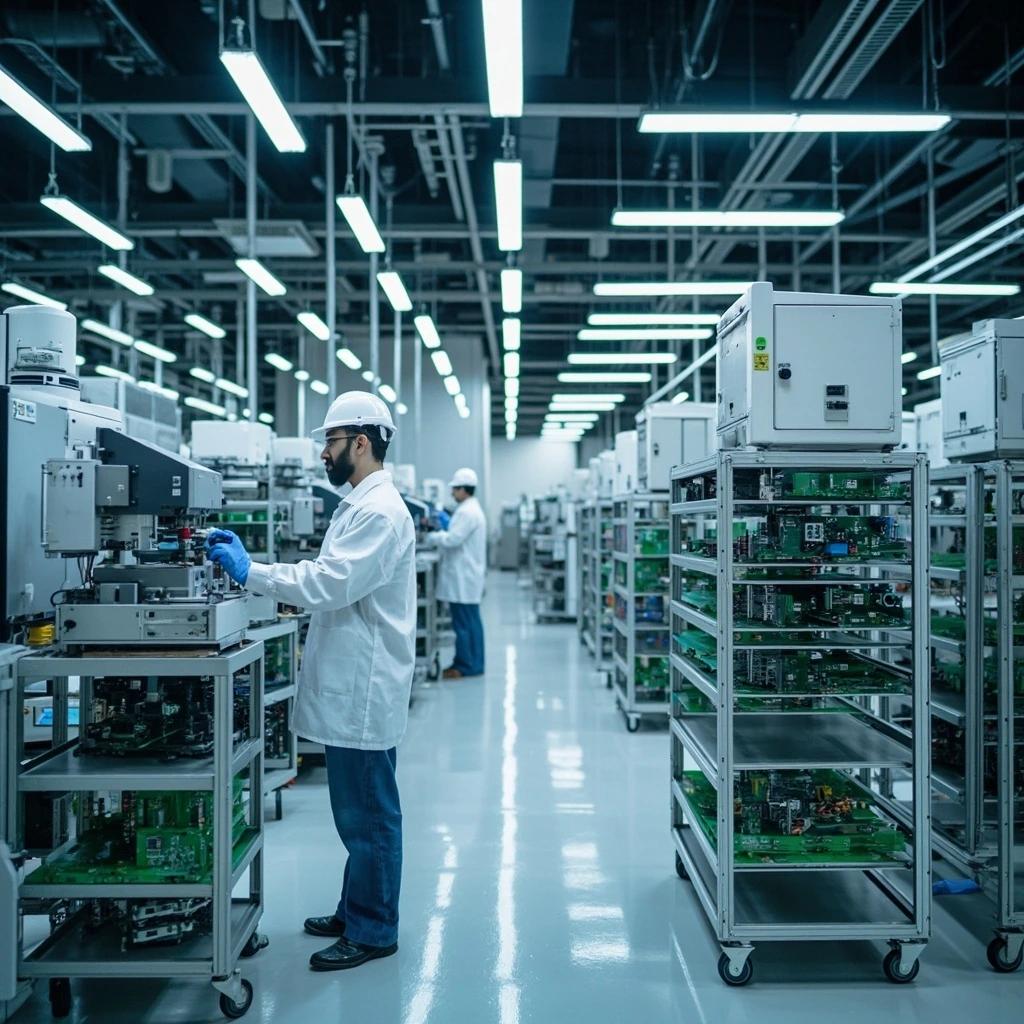
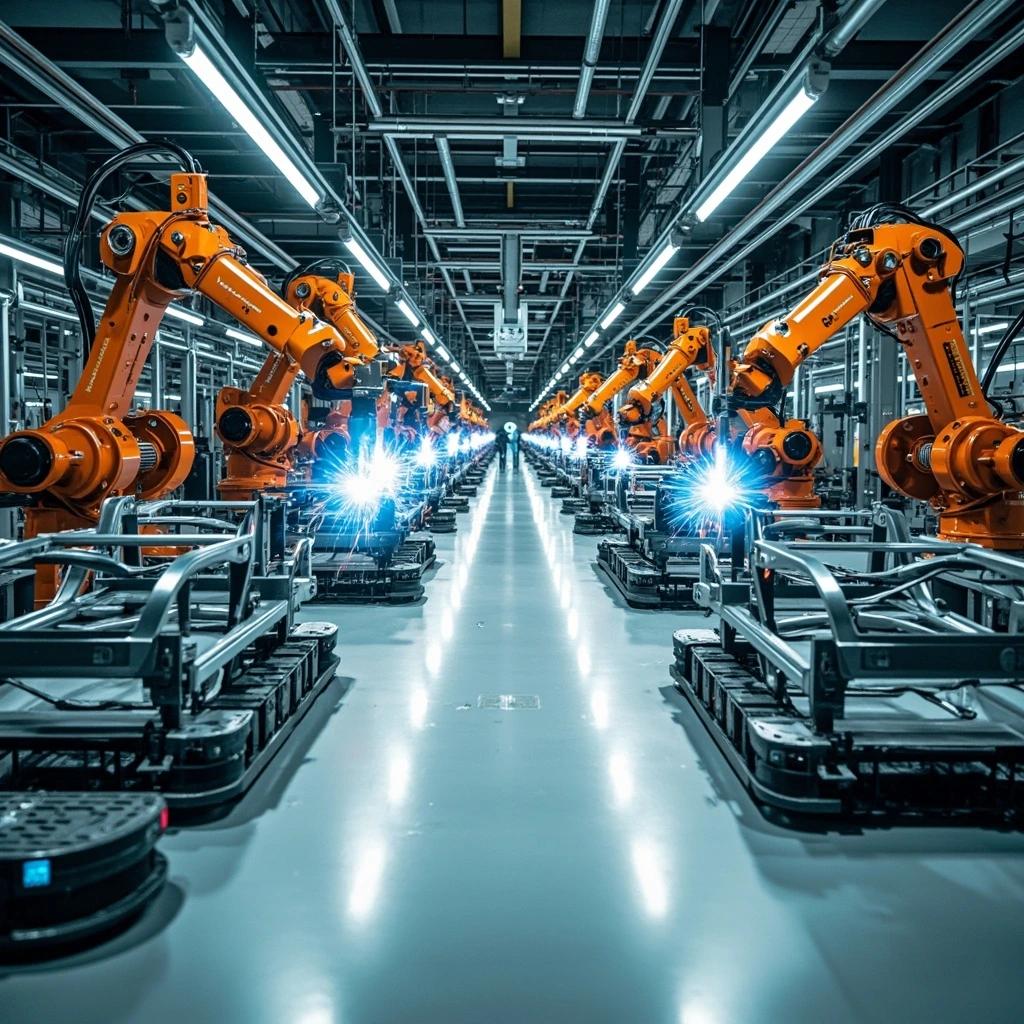
The leaders share five capabilities. First, engine and propulsion in-house: SpaceX builds Merlin and Raptor engines on automated lines, Rocket Lab 3D-prints Rutherford engines, and Northrop Grumman casts America's strategic solid rocket motors. Second, large-structure welding: Boeing's Michoud facility uses the world's largest vertical friction-stir welder to form SLS fuel tanks, while MHI's Nagoya works welds aluminum-lithium cryogenic tanks for H3. Third, cleanroom satellite assembly: SpaceX's Redmond plant produces multiple Starlink satellites daily; OHB and Thales Alenia Space run multi-ton GEO satellite assembly in European cleanrooms.

Fourth, component-level vertical integration: Rocket Lab manufactures its own reaction wheels, star trackers, solar cells and separation rings — exactly where rivals get burned by third-party lead times. Fifth, AIT and environmental testing: thermal-vacuum chambers, shake tables and EMC darkrooms that qualify hardware before launch, where Airbus Bremen, CASC's CAST and Lockheed's Littleton facility all excel.
What Trends Are Shaping Spacecraft Manufacturing?
Five trends are reshaping spacecraft manufacturing in 2025-2026, and all five reward factories over design studios.

First, LEO serial production: Starlink's 100+ satellites-per-month cadence and Europe's IRIS² program are forcing satellite primes to convert from bespoke GEO craft to assembly-line small buses. Second, vertical-integration consolidation: Boeing re-acquired Spirit AeroSystems for US$4.7 billion and Rocket Lab bought Mynaric, Sinclair Interplanetary and SolAero — the industry is bringing critical suppliers back in-house. Third, reusable-launch throughput: Falcon 9 boosters flying 20+ times and CASC's Long March 10B VTVL net-catch recovery are collapsing per-launch cost, raising demand for satellites to fill the new capacity.

Fourth, defense-space primacy: with SpaceX winning a US$1.6 billion Space Force order and CASC executing 73 launches in 2025, government space budgets are flowing disproportionately to manufacturers with sovereign production lines. Fifth, orbital edge computing: SpaceX's US$3.2 billion AI-related revenue in 2025 signals satellites becoming data centers, forcing thermal-management and high-power solar-array redesigns across the entire manufacturing base.
Why Does Vertical Integration Matter More Than Outsourcing in Space?
Why did the report exclude design-and-outsource companies and favor vertical integration? Because in space, a third-tier supplier defect can destroy a billion-dollar mission.

Boeing's Starliner program is the cautionary tale: valve and parachute issues originating with sub-tier suppliers caused years of delays, fixed-price cost overruns and a reputational crisis. The industry's response is in-sourcing. SpaceX achieves an in-house self-manufacturing rate above 80% — from Raptor engines and heat-shield tiles to phased-array antennas and laser terminals. Rocket Lab, after spending hundreds of millions acquiring SolAero and ASI, now builds its own reaction wheels, star trackers, solar arrays and flight software, with a 74%-hardware backlog mix. Northrop's solid-propulsion plants are sole-source for US strategic launch.

The logic is simple: orbital environments are unforgiving, launch windows are expensive, and every outsourced component is a potential single point of failure. The ten manufacturers ranked above control enough of the critical chain to qualify as genuine builders — the firmest moat in the modern space economy.
How Often Are These Rankings Updated — and Where Is the World's Spacecraft Production Capacity?
How often are spacecraft manufacturer rankings updated — and where is the world's largest spacecraft production capacity?

VerityRank updates this ranking every 6-12 months, aligned with annual report cycles (fiscal-year results are finalized between Q1 and Q2), with interim adjustments when major mergers or production milestones occur — as with the planned Airbus-Thales-Leonardo space combination and SpaceX's 2026 IPO. Each refresh re-scores factory capacity, backlogs and in-house manufacturing rates.

On capacity, the global center of gravity has shifted to three poles: the United States (SpaceX's Hawthorne, Redmond, Boca Chica and Cape Canaveral network; Lockheed's Littleton; Boeing's Michoud; Northrop's Promontory and Redondo Beach), China (CASC's eight research-production complexes across Beijing, Shanghai, Xi'an and Sichuan), and Europe (Airbus Bremen/Toulouse, Thales Alenia Cannes/Rome/Turin, OHB Bremen). Japan's MHI Nagoya completes the picture as the fourth pole. Buyers should check production-site footprints and cleanroom certifications before committing — capacity, not brochures, is the true supply signal.