VerityRankVerityRank

Top 10 Civil Engineering Machinery Manufacturers & Suppliers

HomeMachinery & Equipment ManufacturersTop 10 Civil Engineering Machinery Manufacturers & Suppliers
Last Updated: August 2026·By VerityRank Research Team·Methodology

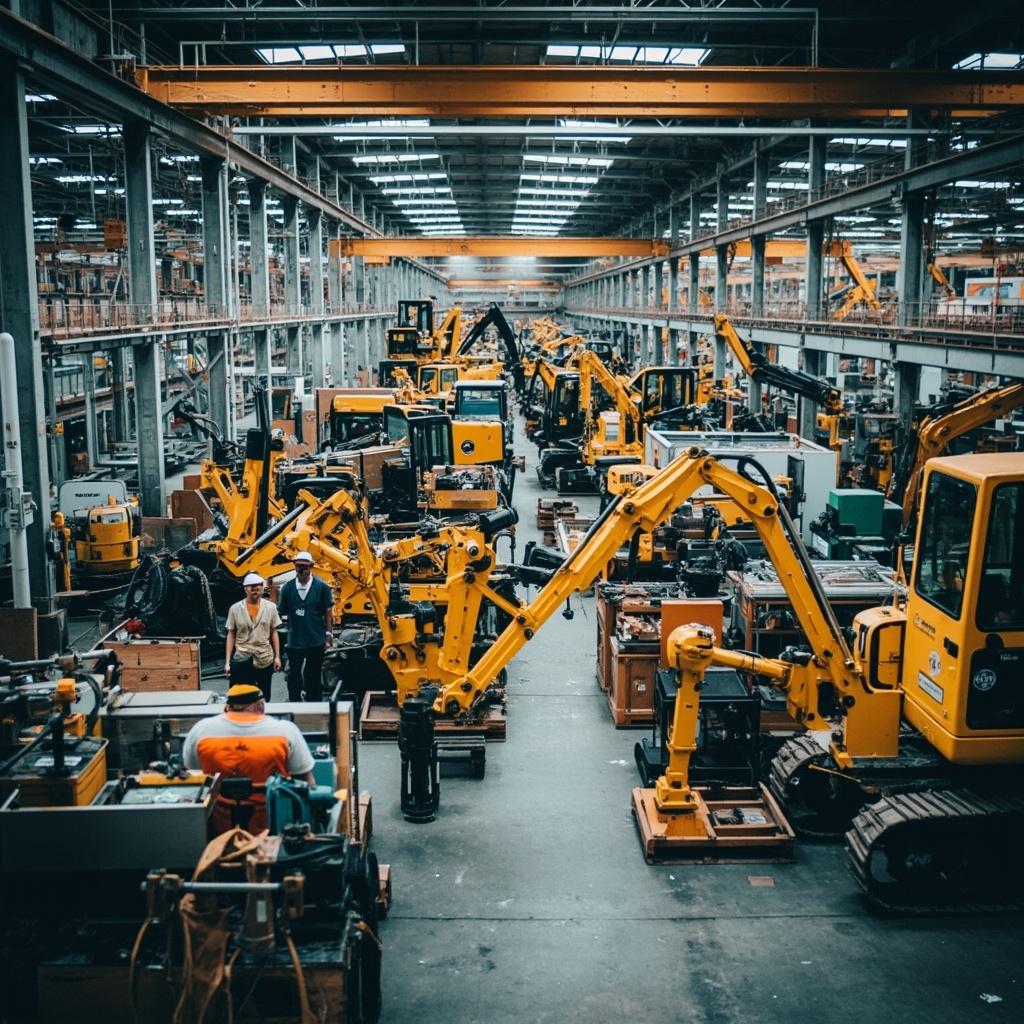
A 100-tonne excavator begins life as iron ore, passes through a foundry, a forge, a machining hall and three assembly plants, and ends up digging a subway tunnel on the other side of the planet. That supply chain is the real product of the world's leading civil engineering machinery manufacturers — and in 2025 the top 50 of them generated a record $246.6 billion in revenue, up 3.8% year-on-year on KHL's Yellow Table. Caterpillar alone reported $67.6 billion in total 2025 sales with $8.88 billion in net income, while China's XCMG crossed RMB 100 billion in …

Top 10 Rankings

2026.08 Edition
1
Caterpillar Inc.

Caterpillar Inc.

Caterpillar Inc. (CAT) is the undisputed king of global construction and mining equipment, headquartered in Irving, Texas. Founded in 1925, the company autonomously casts engine blocks, precision-machines hydraulic cylinders, and forges ultra-large drive shafts across 180+ global facilities. Reporting record revenue of $67.6 billion in FY2025 with a $63 billion order backlog, Caterpillar operates through 500+ independent dealers in 190+ countries with ~118,000 employees, and its construction industry segment alone generated $37.5 bi…

Brand

Caterpillar (CAT)

Founded

1925

Workforce

~118,000

Presence

190+ countries

Facilities

180+ Production Base

Headquarters

United States

Market

NYSE: CAT
Key Product Categories
Machinery & Equipment CompaniesMachinery & Equipment ManufacturersEnergy & Chemical Equipment IndustryPower Transmission Systems IndustrySemiconductor Manufacturing Equipment Industry​New Energy Systems IndustryPLC Control Systems IndustryIndustrial Automation Systems IndustryPower Transmission IndustryMechanical Power Transmission Components IndustryMachinery & Equipment CompaniesMachinery & Equipment ManufacturersEnergy & Chemical Equipment IndustryPower Transmission Systems IndustrySemiconductor Manufacturing Equipment Industry​New Energy Systems IndustryPLC Control Systems IndustryIndustrial Automation Systems IndustryPower Transmission IndustryMechanical Power Transmission Components Industry
2
Komatsu Ltd.

Komatsu Ltd.

Komatsu Ltd. is one of the world's two dominant heavy construction and mining equipment manufacturers, headquartered in Tokyo, Japan. Founded in 1921, the company operates 71 manufacturing bases across 17 countries with ~66,697 employees serving customers in 140+ countries. Komatsu achieved ¥4.13 trillion ($27.8 billion) in FY2025 revenue, with its construction, mining and utility equipment business contributing ~$27.1 billion and holding roughly an 11% share of the global market. Its Smart Construction digital platform and…

Brand

Komatsu

Founded

1921

Workforce

~66,697

Presence

140+ countries

Facilities

71 manufacturing bases across 17 countries

Headquarters

Japan

Market

TYO: 6301
Key Product Categories
Machinery & Equipment CompaniesMachinery & Equipment ManufacturersIndustrial Automation Systems IndustryAdvanced Medical Equipment Manufacturers & SuppliersIndustrial Ceramic Substrates & Components CompaniesSemiconductor Manufacturing Equipment Industry​Construction Tools & Equipment ManufacturersDoors & Windows Systems ManufacturersPlumbing & Electrical Systems ManufacturersIndustrial Ceramic Substrates & Components Manufacturers & SuppliersMachinery & Equipment CompaniesMachinery & Equipment ManufacturersIndustrial Automation Systems IndustryAdvanced Medical Equipment Manufacturers & SuppliersIndustrial Ceramic Substrates & Components CompaniesSemiconductor Manufacturing Equipment Industry​Construction Tools & Equipment ManufacturersDoors & Windows Systems ManufacturersPlumbing & Electrical Systems ManufacturersIndustrial Ceramic Substrates & Components Manufacturers & Suppliers
3
XCMG Group

XCMG Construction Machinery Co., Ltd.

XCMG Construction Machinery Co., Ltd. is China's largest heavy machinery manufacturer, headquartered in Xuzhou, Jiangsu Province. Founded in 1943, XCMG has forcefully risen to global #3 in the KHL Yellow Table 2026, surpassing John Deere with roughly $14.2 billion in construction machinery sales (5.8% global share). The company achieved a historic milestone with RMB 100.8 billion in FY2025 total revenue, with overseas revenue surging 16.58% to RMB 48.6 billion (48.2% of total). Operating cash flow skyrocketed 148.42% to RMB…

Brand

XCMG

Founded

1943

Workforce

~30,485

Presence

190+ countries

Facilities

20+ domestic mega-factories + localized plants in Brazil (140,000m²), Germany, Poland, India, Indonesia

Headquarters

China

Key Product Categories
Machinery & Equipment CompaniesMachinery & Equipment ManufacturersNew Energy & Eco-Materials CompaniesRoad Construction Machinery IndustryConstruction Tools & Equipment BrandsNew Energy Systems IndustryEngineering & Construction Machinery IndustryNew Energy & Eco-Materials Manufacturers & SuppliersNew Energy & Eco-Materials IndustryMobile Device Production Equipment IndustryMachinery & Equipment CompaniesMachinery & Equipment ManufacturersNew Energy & Eco-Materials CompaniesRoad Construction Machinery IndustryConstruction Tools & Equipment BrandsNew Energy Systems IndustryEngineering & Construction Machinery IndustryNew Energy & Eco-Materials Manufacturers & SuppliersNew Energy & Eco-Materials IndustryMobile Device Production Equipment Industry
4
Deere & Company

Deere & Company

Deere & Company (John Deere) is the global titan of agricultural machinery and a major force in construction equipment, headquartered in Moline, Illinois. Founded in 1837, the company transformed traditional farming equipment into precision high-tech machinery, independently manufacturing engines, transmissions, and electronic control units across 104+ facilities globally. Despite a harsh agricultural cycle bottom, Deere delivered $45.68 billion in FY2025 revenue with ~73,100 employees, and its construction & forestry division — anchore…

Brand

John Deere

Founded

1837

Workforce

73,100

Presence

160+ countries

Facilities

100+ factories and facilities worldwide, including 60+ major sites in the US

Headquarters

United States

Market

NYSE: DE
Key Product Categories
Home FurnitureOutdoor & Garden Furniture CompanyOutdoor & Garden Furniture ManufacturersMachinery & Equipment CompaniesMachinery & Equipment ManufacturersAdvanced Medical Equipment Manufacturers & SuppliersAdvanced Medical Equipment CompaniesMachine Vision Systems IndustryConstruction Tools & Equipment ManufacturersConstruction Tools & Equipment BrandsHome FurnitureOutdoor & Garden Furniture CompanyOutdoor & Garden Furniture ManufacturersMachinery & Equipment CompaniesMachinery & Equipment ManufacturersAdvanced Medical Equipment Manufacturers & SuppliersAdvanced Medical Equipment CompaniesMachine Vision Systems IndustryConstruction Tools & Equipment ManufacturersConstruction Tools & Equipment Brands
5
Liebherr Group

Liebherr Group

Liebherr Group is one of the world's premier heavy equipment manufacturers and the largest wholly family-owned construction machinery company globally, founded in 1949 by Hans Liebherr in Kirchdorf an der Iller, Germany. With group revenue reaching a record €14.77 billion (~$15.8 billion) in 2025—a 1.0% year-on-year increase and its highest-ever revenue—Liebherr operates through more than 50 specialized production companies employing approximately 53,000 people worldwide. The company's uniq…

Brand

Liebherr Group

Founded

1949

Workforce

~53,000

Presence

Global presence in 130+ countries with 50+ manufacturing and service companies; strongest in Europe, Middle East, and emerging mining markets; expanding North American footprint

Facilities

50+ specialized production companies across Germany, Austria, Switzerland, France, Spain, Russia, Brazil, India, China, and the United States; key facilities include Ehingen (mobile/crawler cranes), Biberach (aerospace components), Colmar (mining excavators), Bischofshofen (wheel loaders)

Headquarters

Germany

Market

Not Listed (Family Owned)

Key Product Categories
Construction Tools & Equipment BrandsCeiling Systems & Integration IndustryBuilding Envelope Systems IndustryPLC Control Systems IndustryIndustrial Automation Systems IndustryConstruction Tools & Equipment ManufacturersMobile Device Production Equipment IndustryMachine Vision Systems IndustryBuilding Automation System (BAS) IndustryActuators & Control Valves IndustryConstruction Tools & Equipment BrandsCeiling Systems & Integration IndustryBuilding Envelope Systems IndustryPLC Control Systems IndustryIndustrial Automation Systems IndustryConstruction Tools & Equipment ManufacturersMobile Device Production Equipment IndustryMachine Vision Systems IndustryBuilding Automation System (BAS) IndustryActuators & Control Valves Industry
6
SANY Group

Sany Heavy Industry Co., Ltd.

Sany Heavy Industry Co., Ltd. (SANY) is one of China's twin engineering machinery titans, headquartered in Changsha, Hunan Province. Founded in 1989, SANY operates two WEF-certified Global Lighthouse Factories — a level of unmanned heavy machining extraordinarily rare in traditional industry. The company achieved RMB 89.7 billion ($12.6 billion) in FY2025 revenue, with net profit surging 41.2% to RMB 8.41 billion and operating cash flow hitting a historic RMB 19.98 billion. A historic milestone: overseas revenue reached RMB 55.9 billion, ex…

Brand

SANY

Founded

1989

Workforce

~28,469

Presence

180+ countries

Facilities

25 major manufacturing bases with 37 smart factories + 2 WEF Global Lighthouse Factories

Headquarters

China

Market

SHSE: 600031

Key Product Categories
Machinery & Equipment CompaniesMachinery & Equipment ManufacturersAirport & Port Ground Support Equipment (GSE) IndustryNew Energy & Eco-Materials CompaniesRoad Construction Machinery IndustryEnergy & Chemical Equipment IndustryNew Energy Systems IndustryEngineering & Construction Machinery IndustryNew Energy & Eco-Materials Manufacturers & SuppliersNew Energy & Eco-Materials IndustryMachinery & Equipment CompaniesMachinery & Equipment ManufacturersAirport & Port Ground Support Equipment (GSE) IndustryNew Energy & Eco-Materials CompaniesRoad Construction Machinery IndustryEnergy & Chemical Equipment IndustryNew Energy Systems IndustryEngineering & Construction Machinery IndustryNew Energy & Eco-Materials Manufacturers & SuppliersNew Energy & Eco-Materials Industry
7
Volvo Construction Equipment

Volvo Construction Equipment

Volvo Construction Equipment (Volvo CE) is the heavy equipment division of Sweden's Volvo Group and one of the world's most sustainability-focused construction machinery manufacturers, headquartered in Gothenburg, Sweden. In FY2025, Volvo CE generated net sales of SEK 81.64 billion (~$7.8 billion), reflecting a strategic pivot toward premium equipment after divesting the Shandong Lingong (SDLG) lower-tier brand—adjusted for this divestiture, underlying equipment and service sales grew 13% and 8% respectively. The company em…

Brand

Volvo Construction Equipment

Founded

1832

Workforce

16,500

Presence

Global dealer network spanning 130+ countries; strongest in Europe (~40% of revenue), North America (~30%), with growing presence in Asia-Pacific, Latin America, and Africa

Facilities

Braås (Sweden) — articulated haulers; Arvika (Sweden) — wheel loaders; Changwon (South Korea) — excavators; Belley (France) — excavators & compact equipment; Shippensburg (Pennsylvania, USA); Pederneiras (Brazil); Bangalore (India); Eskilstuna (Sweden) — transmissions & axles

Headquarters

Sweden

Key Product Categories
Construction Tools & Equipment BrandsHousehold Chemical Products Manufacturers & SuppliersFireproofing & Waterproofing Solutions ManufacturersConstruction Tools & Equipment ManufacturersEnvironmental Mineral Solutions & Natural Remediation Products Manufacturers & SuppliersPrinting Services & Solutions ManufacturersDaily Mineral-Based Goods & Lifestyle Products Manufacturers & SuppliersSteel Raw Materials & Semi-Finished Products Manufacturers & SuppliersPrinting Services & Solutions BrandsGlass Substrate Raw Materials & Industrial Base Glass Manufacturers & SuppliersConstruction Tools & Equipment BrandsHousehold Chemical Products Manufacturers & SuppliersFireproofing & Waterproofing Solutions ManufacturersConstruction Tools & Equipment ManufacturersEnvironmental Mineral Solutions & Natural Remediation Products Manufacturers & SuppliersPrinting Services & Solutions ManufacturersDaily Mineral-Based Goods & Lifestyle Products Manufacturers & SuppliersSteel Raw Materials & Semi-Finished Products Manufacturers & SuppliersPrinting Services & Solutions BrandsGlass Substrate Raw Materials & Industrial Base Glass Manufacturers & Suppliers
8
Hitachi Construction Machinery

Hitachi Construction Machinery

Hitachi Construction Machinery (HCM) is one of the world's leading manufacturers of hydraulic excavators and mining equipment, founded in 1970 as a spin-off from Hitachi Ltd.'s construction machinery division, headquartered in Tokyo, Japan. In FY2025 (ending March 2026), HCM achieved record sales of ¥1,405.4 billion (~$9.6 billion), a 2.5% year-on-year increase driven primarily by its aggressive independent expansion in the Americas market following the dissolution of its decades-long joint manufacturing and distribution ag…

Brand

Hitachi Construction Machinery

Founded

1970

Workforce

28,000

Presence

84% overseas revenue share; direct presence in 100+ countries; strongest in Asia-Pacific, the Americas (post-2022 independent distribution buildout), Africa (Bell Equipment JV), and Europe; LANDCROS IoT platform connects 410,000+ machines globally

Facilities

Tsuchiura & Hitachinaka (Japan) — large/ultra-large excavators; Amsterdam (Netherlands) — medium excavators for Europe; Bekasi (Indonesia) — excavators for SE Asia; Dharwad (India); Hefei (China); expanding Americas manufacturing footprint post-Deere separation

Headquarters

Japan

Market

TYO:6305
Key Product Categories
Environmental Mineral Solutions & Natural Remediation Products Manufacturers & SuppliersSteel Raw Materials & Semi-Finished Products Manufacturers & SuppliersPlumbing & Electrical Systems ManufacturersRoad Construction Machinery IndustryConstruction Tools & Equipment BrandsDoors & Windows Systems ManufacturersEngineering & Construction Machinery IndustryConstruction Tools & Equipment ManufacturersGlass Substrate Raw Materials & Industrial Base Glass Manufacturers & SuppliersEco-Friendly Building Materials ManufacturersEnvironmental Mineral Solutions & Natural Remediation Products Manufacturers & SuppliersSteel Raw Materials & Semi-Finished Products Manufacturers & SuppliersPlumbing & Electrical Systems ManufacturersRoad Construction Machinery IndustryConstruction Tools & Equipment BrandsDoors & Windows Systems ManufacturersEngineering & Construction Machinery IndustryConstruction Tools & Equipment ManufacturersGlass Substrate Raw Materials & Industrial Base Glass Manufacturers & SuppliersEco-Friendly Building Materials Manufacturers
9
Sandvik AB

Sandvik AB

Sandvik AB is a high-tech global engineering group headquartered in Stockholm, Sweden, with 2025 revenue of approximately SEK 120.7 billion (~$11.5B), specializing in metal-cutting tools, mining and rock-processing equipment, and advanced materials. Founded in 1862, the group employs 41,801 people in more than 150 countries and is listed on Nasdaq Stockholm. Its Mining and Rock Solutions division generated roughly SEK 63 billion (~$6.9 billion) — the world's leading franchise in underground mining equipment, rock drills, loaders, trucks and…

Brand

Sandvik

Founded

1862

Workforce

41,000+

Presence

170+ countries

Facilities

150+ production sites worldwide

Headquarters

Sweden

Key Product Categories
Professional Metal Tools IndustryMetal Cutting Tools IndustryAlloy Milling Cutter IndustryLathe Tool IndustryHigh-Performance Metal Materials IndustryIndustrial Components IndustryFunctional Coatings & Composites IndustrySpecialized Trade Tools IndustryProfessional Metal Tools & Equipment CompaniesProfessional Metal Tools & Equipment Manufacturers & SuppliersProfessional Metal Tools IndustryMetal Cutting Tools IndustryAlloy Milling Cutter IndustryLathe Tool IndustryHigh-Performance Metal Materials IndustryIndustrial Components IndustryFunctional Coatings & Composites IndustrySpecialized Trade Tools IndustryProfessional Metal Tools & Equipment CompaniesProfessional Metal Tools & Equipment Manufacturers & Suppliers
10
JCB

J.C. Bamford Excavators Limited

J.C. Bamford Excavators Limited (JCB) is the world's leading privately-owned construction equipment manufacturer, founded in 1945 by Joseph Cyril Bamford in Rocester, Staffordshire, United Kingdom. With annual revenue of approximately $8.65 billion, JCB operates 23 manufacturing plants across the UK, India, Brazil, and the United States, employing more than 15,000 people. JCB holds an unassailable 40% global market share in backhoe loaders and telescopic handlers, maintaini…

Brand

JCB

Founded

1945

Workforce

~15,000

Presence

Global presence in 150+ countries across 6 continents with 2,000+ dealer locations

Facilities

23 plants in UK, India (5 plants), Brazil, US (Texas super factory 720,000 sq ft under construction)

Headquarters

United Kingdom

Market

Not Listed (Family Owned)

Key Product Categories
Engineering & Construction Machinery CompaniesMachinery & Equipment CompaniesMachinery & Equipment ManufacturersMachinery & EquipmentEngineering & Construction Machinery IndustryEngineering & Construction Machinery SuppliersCivil Engineering Machinery CompaniesCivil Engineering Machinery ManufacturersEngineering & Construction Machinery CompaniesMachinery & Equipment CompaniesMachinery & Equipment ManufacturersMachinery & EquipmentEngineering & Construction Machinery IndustryEngineering & Construction Machinery SuppliersCivil Engineering Machinery CompaniesCivil Engineering Machinery Manufacturers

Frequently Asked Questions

What Distinguishes a True Heavy Machinery Manufacturer from an Assembler?
In civil engineering machinery, the difference between a manufacturer and an assembler is measured in tonnes of steel, microns of tolerance and decades of reliability — and it determines which brands dominate the world's most demanding projects.

Vertical integration is the first test. Caterpillar casts its own engine blocks, forges ultra-large drive shafts and machines hydraulic cylinders across 180+ global facilities; Liebherr builds everything from chassis to engines and hydraulic cylinders in-house — a level of vertical depth almost unmatched in the industry; Deere operates captive engine, transmission and axle plants. When a company owns its foundries and machining halls, it controls quality, cost and delivery. Assemblers depend on suppliers for all three.

Engine ownership is the second test. The world's leading manufacturers build their own powertrains: Caterpillar's diesel and gas engines, Komatsu's in-house hydraulic components and transmissions, Volvo CE's Penta-based drivetrains, JCB's proprietary Dieselmax and hydrogen combustion engines. Engine ownership is the deepest expression of vertical integration because the powertrain determines machine performance, fuel economy and emissions compliance — and it cannot be outsourced without surrendering control of the product's core character.

Financial staying power is the third test. Heavy machinery development cycles run 5-10 years and require sustained capital: Caterpillar invested billions annually in R&D across diesel, hybrid and battery-electric powertrains; Liebherr allocated €708 million to R&D in 2025 despite being family-owned; SANY and XCMG fund Lighthouse Factories and new-energy platforms from record operating cash flow. Assemblers, by contrast, live order-to-order and cannot fund frontier technology.

The consequence for buyers is measurable. A manufacturer's machine carries engineering pedigree embedded in steel — verified by 30,000-hour operating lives, 500+ dealer networks and aftermarket parts availability measured in decades. For infrastructure contractors, mining operators and government agencies, that pedigree translates directly into uptime, resale value and total cost of ownership.
How Is Production Scale and Vertical Integration Assessed?
Production scale and vertical integration carry the heaviest weight (40%) in this ranking because they determine whether a manufacturer can deliver — on time, at spec, and at scale — across the world's most demanding construction and mining projects. The assessment examines four layers.

First, global plant footprint. Caterpillar operates 180+ facilities worldwide; Komatsu runs 71 manufacturing bases across 17 countries; XCMG's super-factories in Xuzhou are among the world's largest heavy machinery plants; JCB maintains 22 factories on four continents. A broad footprint lets manufacturers serve regional markets with local assembly, hedge tariffs and shorten delivery lead times.

Second, foundry and casting capability. Caterpillar autonomously casts engine blocks and forges drive shafts; Liebherr maintains in-house foundries and machining operations for its cranes, excavators and mining trucks; Volvo CE leverages the Volvo Group's powertrain and casting network. Foundry ownership is the clearest indicator of true manufacturing depth.

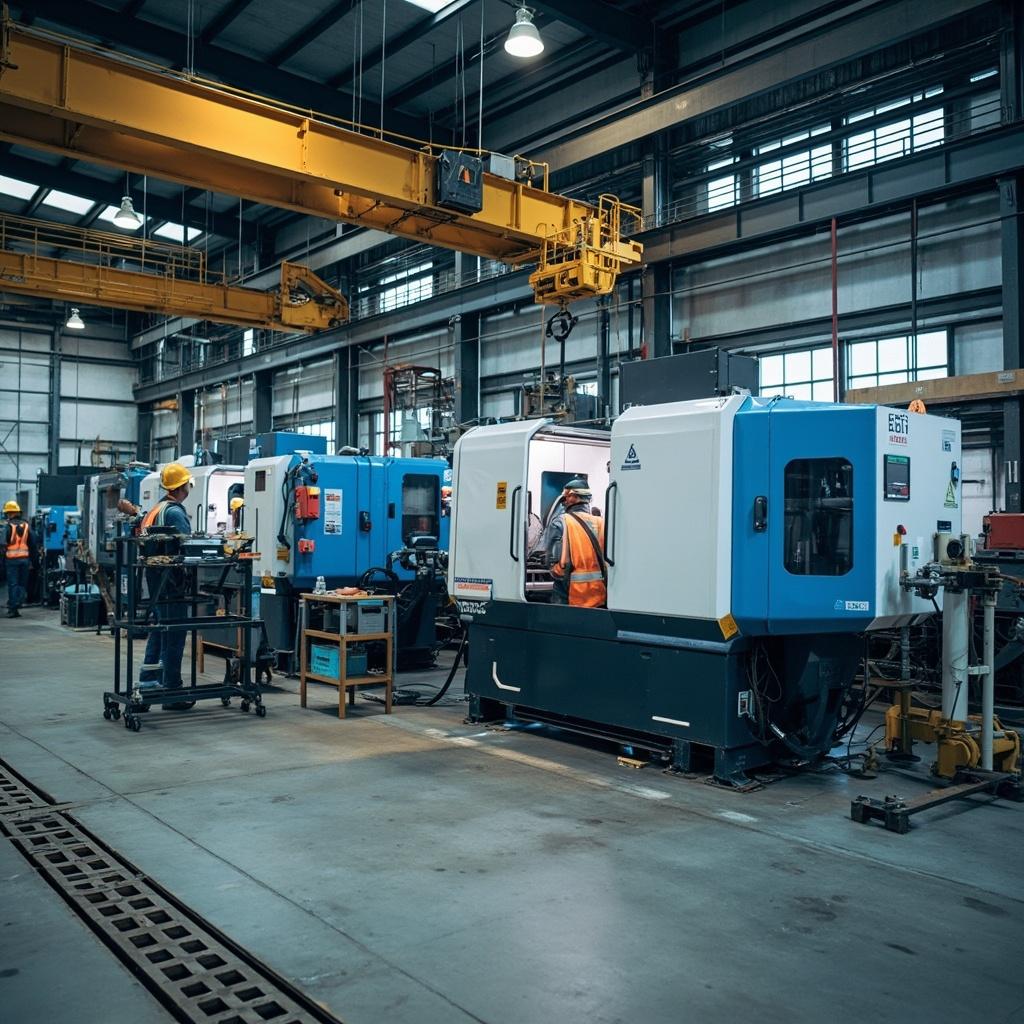
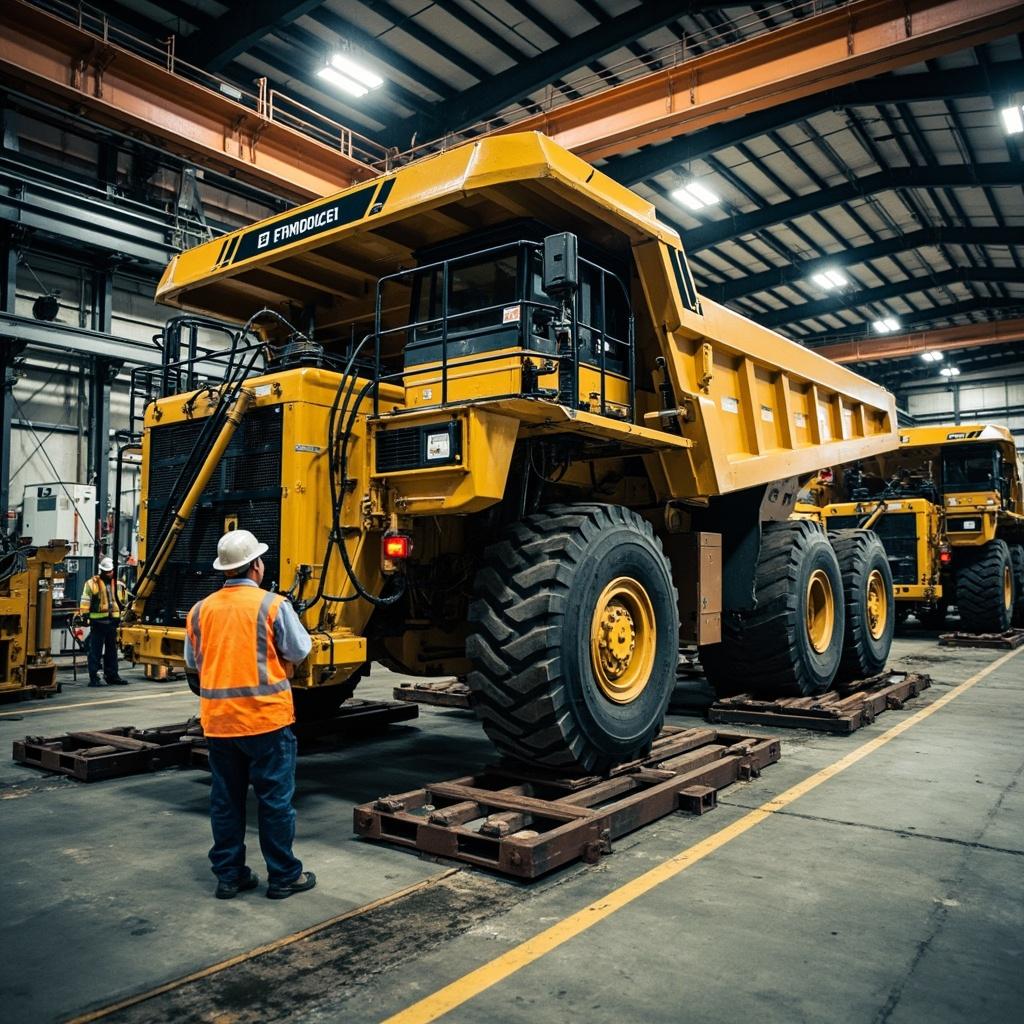
Third, machining and assembly capacity. SANY operates two WEF-certified Global Lighthouse Factories with unmanned heavy machining; XCMG's crane factory is a national smart-manufacturing benchmark; Hitachi builds ultra-large hydraulic excavators up to 800 tonnes and AC-driven mining dump trucks. The scale of CNC machine parks and assembly halls determines production capacity and quality consistency.

Fourth, component self-sufficiency. Komatsu produces its own hydraulic components, transmissions and engines; JCB manufactures Dieselmax and hydrogen engines in-house; Deere's captive engine and transmission plants ensure end-to-end powertrain control; Liebherr builds engines, hydraulic cylinders and gearboxes internally. The higher the component self-sufficiency, the more resilient the manufacturer against supply-chain shocks — a decisive advantage in the post-2020 tariff era.
How Are Tariffs and Near-Shoring Reshaping Machinery Manufacturing?
The US Section 122 tariff regime — a 10% across-the-board levy on all imports after the Supreme Court struck down IEEPA tariffs — has become the most disruptive supply-chain event for heavy machinery manufacturing since the industry globalized. Its effects are reshaping plant-location decisions and competitive dynamics worldwide.

The cost burden is enormous. Caterpillar faces an estimated $2.2-2.4 billion in additional 2026 tariff costs; Komatsu absorbed ¥81.6 billion in tariff-related expenses from US steel and aluminum duties. For an industry where machines weigh hundreds of tonnes and cross-border freight is already extreme, a flat 10% tariff changes the economics of every global production network.

The strategic response is forced near-shoring. Deere is investing $500 million in a 720,000 sq ft super factory in San Antonio, Texas, creating 1,500 jobs to anchor North American delivery; JCB is building its own $500 million, 400-acre facility in San Antonio — its largest-ever single investment — to serve the US market; XCMG and SANY are expanding European and American assembly operations; Volvo CE is deepening its European retail integration through the Swecon acquisition while exiting non-core Chinese joint ventures.

The competitive consequence favors diversified footprints. Brands with plants on multiple continents — Caterpillar, Komatsu, JCB, XCMG — can rebalance internal supply chains to absorb tariff shocks; single-country manufacturers cannot. The tariff era is also accelerating "equipment as a service," as manufacturers protect margins by monetizing software, parts and uptime rather than machine sales alone. For infrastructure buyers, supply-chain resilience is now a first-order purchase criterion — and the manufacturers with the deepest global footprints are the ones best positioned to deliver.
How Are Autonomous and Zero-Emission Technologies Changing Manufacturing?
Autonomous operation and zero-emission powertrains are transforming not only how machines work but how they are built — and the world's leading manufacturers are betting billions on both fronts.

Autonomy is moving from pilot to production. Komatsu's AHS (Autonomous Haulage System) operates across major global mines, and its "Driving value with ambition" mid-term strategy prioritizes automated construction sites; Caterpillar acquired drone-mapping firm Skycatch and extended its Trimble joint venture for autonomous excavating and intelligent grade control; Liebherr unveiled its Autonomous Operations wheel loader at Bauma and is developing battery-electric mining truck prototypes; Sandvik's AutoMine remains the most widely deployed autonomous drilling and haulage platform. Autonomous machines require fundamentally different manufacturing — more sensors, more software, more validation — favoring manufacturers with deep electronics integration capability.

Electrification is accelerating fastest in compact and urban segments. SANY's electric equipment sales doubled to RMB 8.64 billion in 2025; Volvo CE has committed to a fully electric compact line and is pioneering large battery-electric haulers; XCMG launched the world's first full-process zero-carbon smart mining solution and is shipping battery-powered machines into Europe; JCB allocates up to 35% of R&D to zero-emission technologies, betting on hydrogen combustion engines for heavy machinery. Liebherr is converting its Bulle headquarters into a hydrogen capability center, while Komatsu is partnering with Cummins on hydrogen fuel-cell solutions for ultra-class mining trucks.

The manufacturing implication is profound. Electric machines have fewer moving parts but far more electronics, software and battery integration — shifting value from the foundry to the codebase. Manufacturers that master both steel and silicon — Caterpillar's NVIDIA partnership, SANY's Lighthouse Factories, XCMG's smart manufacturing benchmark — will define the industry's next decade, while pure-mechanical incumbents risk obsolescence.
How Do Chinese Manufacturers Compare on the Global Stage?
China's engineering machinery manufacturers — led by XCMG and SANY — have transformed from domestic challengers to global top-6 players in under two decades, and their manufacturing model is now a benchmark the West studies as closely as the West's used to be studied.

On scale, China has won. XCMG is global #3 in the KHL Yellow Table with RMB 100.8 billion in 2025 revenue, overseas sales of RMB 48.6 billion (48.2% of total) and operating cash flow up 148% to RMB 14.14 billion; SANY generated RMB 89.7 billion in revenue with net profit surging 41.2% to RMB 8.41 billion and international revenue exceeding 64% of total for the first time. Both now outgrow most Western peers.

On manufacturing technology, China leads in smart factories. SANY operates two WEF-certified Global Lighthouse Factories — a level of unmanned heavy machining extraordinarily rare in traditional industry; XCMG's heavy crane factory is a national smart-manufacturing benchmark and its digital transformation has won industry acclaim. These factories combine Chinese scale economics with Industry 4.0 precision.

On electrification, China has a structural cost advantage. SANY's electric mixer trucks and excavators doubled to RMB 8.64 billion (+115%) on the strength of China's mature battery supply chain; XCMG launched the world's first full-process zero-carbon smart mining solution and leads in electric compact machines for European markets. Western manufacturers are building toward this capability from a diesel-centric base.

On premium engineering and service density, the West still leads. Caterpillar's 500+ dealer network in 190+ countries, Komatsu's remanufacturing system, Liebherr's €708 million R&D and custom engineering depth, and Sandvik's 40% aftermarket-and-software revenue share command premium pricing in mature markets. The next decade will determine whether China's scale and electrification advantages can overcome the West's service-network and brand moats — or whether the industry's center of gravity moves permanently to Asia.