



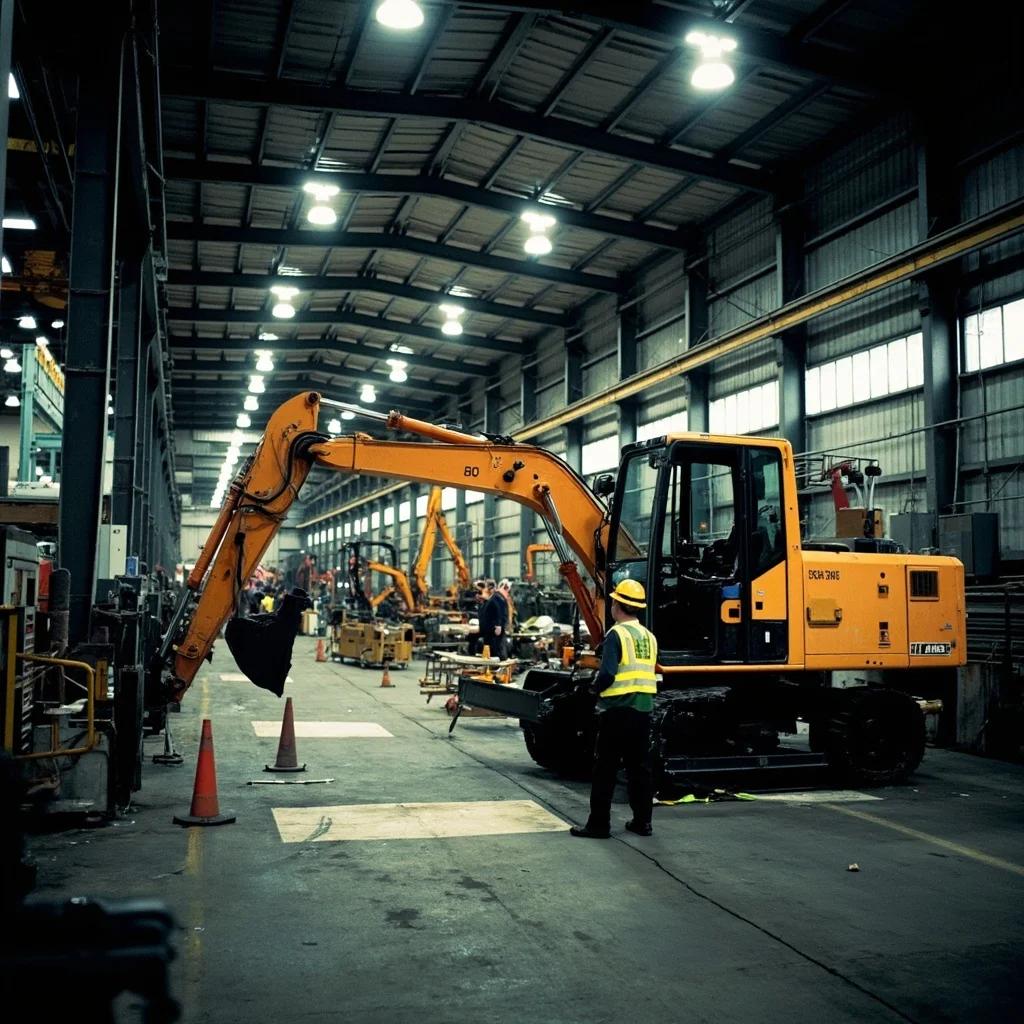

Siemens AG
With €78.9 billion in FY2025 revenue and roughly 318,000 employees across more than 170 production bases, Siemens AG stands as the defining force in industrial automation, electrification, and power electronics, headquartered in Munich, Germany. Founded in 1847, the company fuses heavy machinery with industry-leading control software (SIMATIC PLCs, SINAMICS drives, digital twins), operating over 170 production bases worldwide with ~318,000 employees. Reporting revenue of approximately €78.9 billion in FY2025
Brand
Siemens
Founded
1847
Workforce
~318,000
Presence
190+ countries
Facilities
170+ Production Base
Headquarters
Germany
Market
XETRA: SIE
Schneider Electric SE
Schneider Electric SE is a global leader in the digital transformation of energy management and industrial automation, headquartered in Rueil-Malmaison, France. Founded in 1836, the company has evolved from a steel and armaments manufacturer into a Fortune Global 500 powerhouse delivering end-to-end electrification and automation solutions across 115 countries. With record revenue of €40.152 billion in FY2025 (8.9% organic growth), an adjusted EBITA margin of 18.7%, and a workforce of approximately …
Brand
Schneider Electric
Founded
1836
Workforce
~160,000
Presence
115+ Countries
Facilities
200+ Production Base
Headquarters
France
Market
Euronext Paris : SU
ABB Ltd
ABB Ltd is the global engine of electrification and industrial automation, headquartered in Zurich, Switzerland. Founded in 1988 from the merger of Sweden's ASEA and Switzerland's Brown Boveri, ABB provides foundational power conversion, motion control, and energy distribution equipment across 160+ manufacturing bases with ~111,900 employees in 100+ countries. The company achieved record orders of $36.77 billion in FY2025 with $33.22 billion in revenue and a 19.0% operational EBITA margin, and generated $4.57 billion in free cash flow. ABB …
Brand
ABB
Founded
1988
Workforce
~111,900
Presence
100+ countries
Facilities
100+ Production Base
Headquarters
Switzerland
Market
SIX: ABBN
Emerson Electric Co.
Emerson Electric Co. is a global leader in industrial automation technology and fluid control components, founded in 1890 and headquartered in St. Louis, Missouri, United States. With annual revenue of $18.02 billion in fiscal 2025 and an adjusted EBITA margin of 27.6%, the company employs approximately 71,000 people across about 130 manufacturing plants worldwide, including 45 core facilities in the European Union. Emerson sets the global benchmark in process fluid control…
Brand
Emerson
Founded
1890
Workforce
71K+
Presence
150+ Countries
Facilities
200+ Production Base
Headquarters
United States
Market
NYSE: EMR
Rockwell Automation, Inc.
Rockwell Automation is the undisputed leader in discrete industrial automation across North America, headquartered in Milwaukee, Wisconsin. Founded in 1903, the company commands over 50% of the North American PLC market through its iconic Allen-Bradley hardware brand and FactoryTalk software ecosystem. With annual revenue of $8.342 billion in FY2025, approximately 27,000 employees, and a gross margin that surged to 48% driven by high-margin software and lifecycle services, Rockwell operates…
Brand
Rockwell Automation
Founded
1903
Workforce
27,000
Presence
100+ countries
Facilities
20 primary manufacturing plants across 15 countries
Headquarters
United States
Market
NYSE: ROK
FANUC Corporation
FANUC Corporation is the global gold standard in CNC (Computer Numerical Control) systems and heavy industrial robotics, headquartered at the foot of Mount Fuji in Yamanashi Prefecture, Japan. Founded in 1972 as a spin-off from Fujitsu, FANUC has built an unassailable fortress in the machine tool brain — its yellow-painted robots and CNC controllers are the beating heart of factories producing everything from automobiles to smartphones. In FY2026, the company achieved record revenue of ¥857.8 billion (~$5.36 billion) with operating profit s…
Brand
FANUC
Founded
1972
Workforce
9,901
Presence
100+ countries via 270+ service centers
Facilities
19 manufacturing plants, primarily in Japan, plus new $90M Michigan facility
Headquarters
Japan
Market
TSE: 6954
SMC Corporation
SMC Corporation is the world's dominant manufacturer of pneumatic and fluid control components for industrial automation, founded in 1959 and headquartered in Tokyo, Japan. With annual revenue of ¥792.1 billion in fiscal 2025 (+6.4%), the company employs 24,773 people across 36 large production bases and 500 sales offices spanning more than 80 countries. SMC holds close to 40% of the global pneumatic components market, offering an extraordinary catalog of 700,000+ S…
Brand
SMC
Founded
1959
Workforce
24,773
Presence
500 sales offices in 80+ countries and regions
Facilities
36 large production bases across Japan, China, Vietnam, India, Czech Republic and more
Headquarters
Japan
Market
TSE: 6273
Delta Electronics, Inc.
Delta Electronics, Inc. is a global powerhouse in power electronics, thermal management, and industrial automation hardware, headquartered in Taipei, Taiwan. Founded in 1971, Delta has evolved from a television component supplier into the world's largest provider of switching power supplies and a diversified industrial automation giant with annual consolidated revenue of NT$554.9 billion (~$17.9 billion) in 2025, a gross margin of 34.3%, and a workforce exceeding 83,000 employees across 40+ manufacturing si…
Brand
Delta Electronics
Founded
1971
Workforce
83,000+
Presence
100+ countries
Facilities
40+ manufacturing sites worldwide across 5 continents
Headquarters
Taiwan, China
Market
TWSE: 2308
Shenzhen Inovance Technology Co., Ltd.
Shenzhen Inovance Technology Co., Ltd. is the only Chinese company to break into the global top 10 of industrial automation, representing the vanguard of China's high-end manufacturing ascent. Founded in 2003 by former Huawei engineers and headquartered in Shenzhen, Inovance has executed a powerful dual-engine strategy combining industrial automation with new energy vehicle (NEV) electric drive systems. In FY2025, the company achieved ¥45.105 billion (~$6.25 billion) in revenue — a 21.77% year-over-year surge — with net pro…
Brand
Inovance
Founded
2003
Workforce
27,292
Presence
60+ countries with focus on China, Southeast Asia, and Europe
Facilities
Manufacturing bases in Shenzhen, Suzhou, Changzhou, and Hungary
Headquarters
China
Market
SZSE: 300124
Yaskawa Electric Corporation
Yaskawa Electric Corporation is the world's premier manufacturer of AC servo motors and industrial motion control systems, and a founding member of the Big Four industrial robot manufacturers. Headquartered in Kitakyushu, Japan, and founded in 1915, Yaskawa literally invented the term mechatronics in 1969 and commercialized the first all-electric industrial robot (MOTOMAN) in 1977. With FY2025 revenue of ¥542.1 billion (~$3.4 billion), approximately 16,303 employees, and 18 manufacturing plants worldwide, Yaskawa supplies the precision moti…
Brand
Yaskawa
Founded
1915
Workforce
16,303
Presence
30+ countries
Facilities
18 manufacturing plants across Japan, China, US, Europe, and India
Headquarters
Japan
Market
TSE: 6506Frequently Asked Questions
How Do We Rank Industrial Automation Systems Manufacturers?
Disclaimer: VerityRank rankings are based on independently verified public data and proprietary analysis. Rankings reflect our assessment of comparative manufacturing strength and do not constitute investment advice. Companies are not charged for inclusion or ranking position.
What Manufacturing Capabilities Define Top Industrial Automation Producers?
1. Precision Electromechanical Assembly at Scale: The ability to manufacture servo motors, spindle motors, and precision actuators in high volumes with micron-level tolerances. FANUC manufactures its own servo motors, amplifiers, and precision bearings across 19 plants, achieving mean-time-between-failure ratings exceeding 100,000 hours. Yaskawa Electric, the global leader in AC servo motors with 25%+ market share, performs in-house stator winding, magnet assembly, and encoder calibration across 18 plants globally. Siemens operates dedicated motor winding lines at its Nuremberg facilities, producing SIMOTICS motors spanning fractional to multi-megawatt applications.
2. Electronics Manufacturing (SMT PCB Assembly and Semiconductor Integration): Modern automation equipment is increasingly defined by its electronic content. Delta Electronics operates some of the world's largest in-house SMT assembly lines, producing over 100 million power supply units and millions of automation control boards annually. Siemens operates captive semiconductor fabrication for industrial control ICs — a capability shared by fewer than five industrial companies globally. Schneider Electric manufactures its own Modicon PLC processors and Altivar drive power electronics in specialized facilities. Inovance Technology has invested heavily in in-house SMT and semiconductor-level integration, with over 25% of its 27,292 employees dedicated to R&D spanning chip-level to system-level design.
3. Heavy Mechanical Manufacturing and Precision Machining: The physical infrastructure of automation — robot arms, CNC machine tool frames, valve bodies, actuator housings — requires foundry-scale casting, multi-axis CNC machining, and large-part precision assembly. FANUC produces its own ROBODRILL vertical machining centers and ROBOSHOT injection molding machines using FANUC CNC controllers and FANUC servo motors — a closed-loop quality ecosystem. Emerson Electric operates 130+ manufacturing plants producing Fisher control valves, Rosemount instrumentation, and Micro Motion Coriolis flow meters — heavy industrial equipment requiring foundry casting and precision machining to ANSI/ASME standards. SMC Corporation operates 36 production bases performing precision machining, surface treatment, and assembly of pneumatic cylinders and solenoid valves with tolerances measured in single-digit microns.
4. Automated Production ("Factory-Automation for Factory-Automation"): The most sophisticated manufacturers use their own automation products to build their own automation products. Siemens' Amberg Electronics Plant — a WEF Global Lighthouse Factory — produces 15 million SIMATIC products annually with 99.99885% quality using Siemens PLCs, Siemens drives, and Siemens MES software. FANUC operates lights-out manufacturing where FANUC robots assemble FANUC robots 24/7 with minimal human intervention. ABB uses its own ABB Ability digital platform for predictive maintenance across 160+ factories. This capability serves as a living product demonstration that validates the manufacturer's technology claims.
5. Global-Scale Quality Management and Certification Infrastructure: Manufacturers serving global OEM customers must maintain consistent quality across geographically distributed production sites. ABB operates under a single quality management system across 160+ factories in 100+ countries, maintaining ISO 9001, IATF 16949, and ISO 13485 certifications. Schneider Electric's 200+ facilities operate under a unified Schneider Production System (SPS). SMC Corporation maintains consistent sub-micron precision across 36 production bases through proprietary manufacturing equipment designed and built in-house.
How Do Manufacturers Ensure Consistent Product Quality Across Global Facilities?
1. Standardized Global Production Systems: The foundation of cross-site quality consistency is a unified manufacturing operating system that dictates process parameters identically across all factories. Schneider Electric's Schneider Production System (SPS) is deployed across all 200+ manufacturing sites, standardizing lean manufacturing workflows, digital quality gates, and sustainability metrics. ABB's ABB Way operating model pushes quality accountability to division-level P&L owners while maintaining a common quality management framework across all 160+ factories. Siemens' Digital Industries division applies the same SIMATIC-based MES software across its own factories that it sells to customers — using its own products as the quality infrastructure.
2. In-House Production Equipment Manufacturing: Several top manufacturers design and build their own production machinery rather than purchasing generic equipment. SMC Corporation designs and manufactures its own automated assembly, testing, and inspection equipment for its pneumatic component factories — SMC's quality is determined by machines that SMC itself designs to SMC's own specifications. FANUC produces the CNC controllers, servo motors, and industrial robots that power its own manufacturing lines — a closed-loop quality ecosystem. This "make the machine that makes the product" philosophy creates quality consistency that competitors reliant on third-party production equipment suppliers cannot replicate.
3. Digital Quality Twin and AI-Powered Defect Detection: Leading manufacturers are deploying AI-based quality inspection systems that operate identically across global sites. FANUC's AI Servo Monitor and AI Backlash Optimizer continuously self-tune machine performance, detecting micro-deviations before they produce defective parts. Siemens' Xcelerator digital twin platform enables process engineers to simulate manufacturing quality outcomes in a virtual environment before physical production begins. Rockwell Automation's FactoryTalk InnovationSuite applies machine learning to production line data, identifying quality drift patterns invisible to human operators.
4. Vertical Integration as Quality Control: The more of the value chain a manufacturer controls internally, the fewer external quality variables it must manage. Delta Electronics performs in-house SMT PCB assembly, magnetics winding, metal stamping, injection molding, and final assembly — eliminating quality variation introduced by multiple third-party suppliers. FANUC manufactures its own servo motors, amplifiers, control boards, and precision bearings rather than sourcing from external suppliers. Siemens operates captive semiconductor fabrication for industrial control ICs, ensuring that the computational heart of its PLCs meets Siemens' own quality specifications. Each internally manufactured component removes a potential quality failure point from the supply chain.
5. Certifications and Regulatory Compliance Infrastructure: All Top 10 manufacturers maintain multi-site certifications to ISO 9001:2015, IATF 16949 (automotive), ISO 14001 (environmental), and ISO 45001 (safety). For safety-critical products, certification to IEC 61508 at SIL 3 and ISO 13849 at PLe is mandatory — requiring periodic third-party audits of manufacturing processes, not just product testing. Rockwell Automation's GuardLogix safety PLCs, Siemens' SIMATIC Safety Integrated, and ABB's Pluto safety PLC all meet these standards across global manufacturing sites.
6. Supplier Quality Management and Incoming Inspection: Even the most vertically integrated manufacturers rely on external suppliers for raw materials and specialized sub-assemblies. Emerson Electric maintains a structured supplier quality program requiring suppliers to demonstrate process capability (Cpk ≥ 1.33) before qualification. Schneider Electric operates a "Responsible Supplier" program evaluating supplier quality, environmental, and ethical performance. ABB conducts supplier manufacturing process audits as part of procurement qualification, preventing quality issues at the source rather than detecting them at final inspection.
What Trends Are Shaping Industrial Automation Manufacturing in 2025-2026?
Trend 1: AI-Enabled "Lights-Out" Manufacturing Becomes a Competitive Imperative. The traditional debate over automation replacing human labor has been settled — the new frontier is fully autonomous production. FANUC operates factories where FANUC robots assemble FANUC robots in 24/7 lights-out production. Siemens' Amberg Lighthouse Factory achieves 99.99885% quality with 75%+ automation, and Siemens is now using the Altair AI simulation suite to digitally optimize production flows before physical implementation. ABB's decentralized model applies AI-driven production scheduling and predictive maintenance across 160+ factories. The strategic implication: manufacturers who master AI-integrated production achieve quality and cost levels that competitors using traditional manufacturing methods cannot match, creating a widening competitive gap.
Trend 2: Supply Chain Regionalization (Local-for-Local) Triggers a Global Factory Construction Wave. The era of concentrated "world factory" production is ending. FANUC is investing $90 million in a new Michigan robot factory. Schneider Electric is expanding 500,000 square feet of Indian capacity. Yaskawa Electric invested €32 million in a Slovenian robotics center. SMC Corporation has expanded to 36 global production bases. Delta Electronics operates 40+ manufacturing sites across five continents. This distributed manufacturing model increases short-term capital expenditure but provides long-term structural advantages: tariff resilience, shorter delivery lead times, and the ability to serve regulatory-localization requirements.
Trend 3: Hardware Commoditization vs. Software-Integrated Premium Manufacturing. A two-tier manufacturing landscape is emerging. Standard automation hardware faces relentless price competition, particularly from Chinese manufacturers. Premium, software-integrated manufacturing — where the physical product is inseparable from its digital twin, AI analytics, and cloud connectivity — commands expanding margins. Siemens' $10 billion Altair acquisition, Schneider Electric's $3.1 billion Cognite acquisition, and Emerson's AspenTech buyout represent a collective bet exceeding $15 billion that the future belongs to manufacturers who control both the physical product and the digital intelligence layer.
Trend 4: Strategic Portfolio Transformation — Divestiture as Manufacturing Strategy. The most significant industrial manufacturing deal of this cycle was ABB's $5.375 billion sale of its robotics division to SoftBank — exiting a business ABB itself built into a global leader. This was a strategic calculation that the ownership structure best suited to hardware robotics manufacturing differs from the structure needed for AI-integrated robotics. Simultaneously, Emerson Electric divested its Copeland stake to become a pure-play automation manufacturer. These portfolio transformations signal that manufacturing scale in one domain does not automatically translate to competitive advantage in another.
Trend 5: Power Electronics and Thermal Management Become Strategic Bottlenecks. The AI data center construction megatrend has transformed previously commodity manufacturing categories — power supplies, cooling fans, transformers, and UPS systems — into strategic bottlenecks. Delta Electronics and ABB (acquired transformer manufacturer Specialtrasfo) are emerging as critical infrastructure suppliers to the AI industry. Schneider Electric's Q1 2026 organic growth of 11.2% was driven predominantly by data center electrification and cooling demand. This creates a new competitive dimension: manufacturers whose product portfolios align with AI infrastructure requirements are experiencing structural demand growth decoupled from traditional industrial CapEx cycles.
How Often Are Industrial Automation Manufacturer Rankings Updated?
Quarterly Update Cycle: Our standard re-evaluation occurs every three months, aligned with the quarterly earnings reporting cycles of publicly listed manufacturers. Each quarterly update incorporates the latest reported financial data (revenue, operating margin, free cash flow), updated manufacturing facility counts (new factory openings, closures, or acquisitions), and any publicly disclosed changes to production capacity, R&D spending, or geographic manufacturing footprint.
Ad-Hoc Revisions for Material Events: Certain events trigger immediate ranking re-evaluation outside the quarterly cycle. These include: Major Mergers & Acquisitions (e.g., Siemens' $10 billion Altair acquisition, ABB's $5.375 billion robotics divestiture, Schneider Electric's $3.1 billion Cognite acquisition — all incorporated within 30 days of transaction close); Significant Manufacturing Capacity Changes (e.g., FANUC's $90 million Michigan factory investment, Yaskawa's €32 million Slovenian robotics center — incorporated when the facility reaches production-ready status); Major Supply Chain Disruptions or Force Majeure Events (affected companies are temporarily flagged with a disruption indicator and re-evaluated once production resumes).
Data Source Monitoring: VerityRank continuously monitors official corporate disclosures (annual reports, quarterly earnings releases, factory announcements), regulatory filings (SEC 10-K/10-Q, TSE timely disclosure, TWSE material event filings), independent industry analysis (Control Global Top 50, Interact Analysis, MarketsandMarkets), and trade publication reporting to identify ranking-relevant developments between formal update cycles.
Long-Term Tracking and Longitudinal Analysis: VerityRank maintains a historical ranking database tracking manufacturer position changes over multiple years, enabling trend analysis of competitive dynamics. Key longitudinal metrics tracked include: manufacturing footprint growth, vertical integration depth, R&D investment trajectory, geographic diversification index, and manufacturing quality metrics. This historical dataset enables manufacturers and their customers to understand not just current competitive positioning but the trajectory and velocity of competitive change.