

-36x36h.webp)
-36x36h.webp)
-450x250h.webp)











-150x150h.webp)



















































































































Beyond Indulgence: The 4.8% CAGR Driving Chocolate's $138.8 Billion Reinvention

Table of Contents

The global Chocolate Market Trends sector serves consumers worldwide with diverse solutions.
1. Industry Overview
Is chocolate still just a treat, or is it becoming a vehicle for health, global exploration, and even artificial intelligence? The global chocolate market, a cornerstone of the Bakery Ingredients & Ready-to-Eat Snacks sector, is undergoing a fundamental transformation that extends far beyond sweetness. Its distinctiveness lies in its dual role as a standalone indulgence and a critical functional ingredient, driving innovation in everything from artisanal pastries to mass-produced snack bars. The market's evolution is being dictated by a sophisticated consumer demanding more: more purpose, more experience, and more benefit from every bite. This shift is quantifiable. From a 2021 valuation of $119.5 billion, the global chocolate market is projected to reach $138.8 billion by the end of 2025, setting the stage for a new era of growth. The trajectory confirms that chocolate is no longer a static category but a dynamic landscape where sensory pleasure intersects with nutritional science and digital supply chains.
Industry Scope & Characteristics
Broad Product Portfolio
Products span dark chocolate, milk chocolate, cocoa powder, cocoa butter, chocolate chips, white chocolate, couverture, serving diverse consumer needs from everyday essentials to premium specialized offerings.
Complex Global Supply Chains
Integrated international networks spanning multiple continents ensure year-round product availability across diverse markets.
Quality & Compliance Standards
Rigorous regulatory frameworks and quality certifications ensure product safety, consistency, and consumer trust worldwide.
Continuous Innovation
Heavy R&D investment drives formulation breakthroughs, processing technologies, and novel product development cycles.

Industry application and market overview for Chocolate Market Trends.
2. Market Analysis
The chocolate confectionery market is on a steady growth path, with a projected Compound Annual Growth Rate (CAGR) of 4.8% from 2026 through 2033. This expansion from a $138.8 billion base in 2025 is fueled by several powerful, quantifiable drivers. Primary among them is the rising global demand for premium and healthier alternatives, which commands higher margins and fosters innovation. Digital transformation and AI adoption are emerging as critical accelerators, optimizing everything from cocoa bean yield predictions via satellite imagery to personalized consumer marketing and streamlined logistics. Another significant driver is the expansion into emerging economies, where growing middle-class populations are adopting confectionery and snack habits, creating vast new consumer bases. This growth is not uniform; it is strategically channeled into high-opportunity segments like functional chocolate with added vitamins or adaptogens, and plant-based offerings that cater to vegan and dairy-free diets, which are themselves growing at rates far exceeding the overall market average.
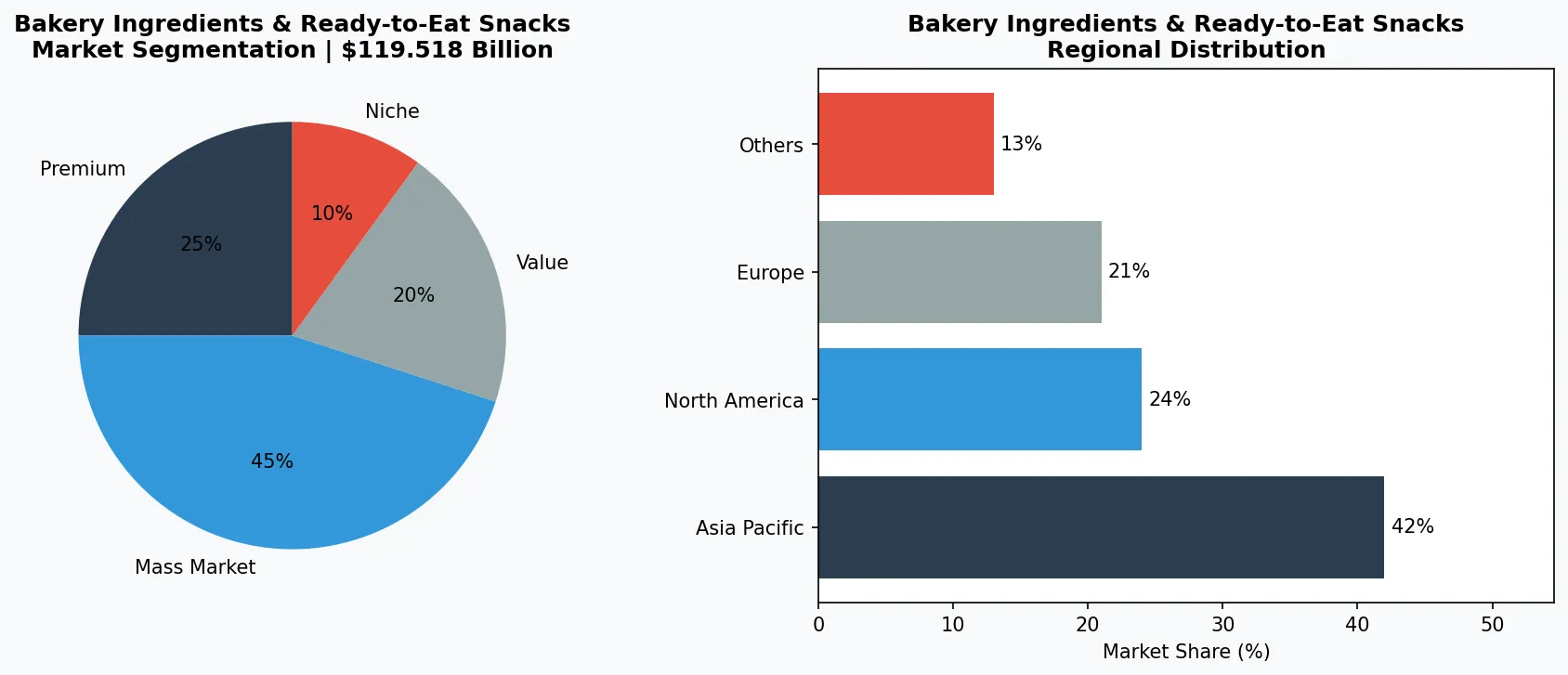
Market segmentation and regional distribution for Bakery Ingredients & Ready-to-Eat Snacks - Chocolate Market Trends.
3. Product Categories
The chocolate market within snacks and bakery is segmented into distinct product types, each with unique innovation vectors. First, **Solid Chocolate Tablets and Bars** remain the core, but are rapidly diversifying. Examples include ultra-high-cacao content bars (85% and above) for health-conscious consumers and bars infused with global flavors like yuzu or pink Himalayan salt. Second, **Chocolate as a Functional Ingredient** is crucial for the broader bakery and snacks industry. This includes chocolate chips and chunks engineered for perfect melt and stability in cookies and muffins, as well as cocoa powders with enhanced flavonoid content marketed for their antioxidant properties in protein bars and shakes. Third, **Coated and Enrobed Confections** represent a major segment for ready-to-eat snacks. This encompasses chocolate-covered nuts, fruits, and puffed rice clusters, where texture contrast is key. Products here are increasingly leveraging 'better-for-you' claims, using dark chocolate coatings and superfood inclusions like goji berries or chia seeds.
Premium & Artisanal Tier
High-margin specialty products targeting affluent consumers who prioritize quality, craftsmanship, and unique attributes.
Mass Market Mainstream
Volume-driven products serving price-conscious mainstream consumers with reliable quality at accessible price points.
Functional & Niche Segment
Targeted products addressing specific health concerns, dietary requirements, or lifestyle preferences beyond basic needs.
4. Leading Players
Leading companies are deploying distinct strategies to capture value in this evolving market. **Barry Callebaut**, the world's leading manufacturer of high-quality chocolate and cocoa products, is leveraging its scale and B2B focus to drive the 'health-forward' and plant-based trends. Its portfolio includes whole fruit chocolate and a range of dairy-free options, directly supplying innovators in the bakery and snack sector. **Mondelez International**, through its iconic Cadbury and Milka brands, focuses on digital transformation and premiumization. It utilizes AI for demand forecasting and consumer insights, while also expanding its premium dark chocolate and locally-inspired flavor lines to capture higher-margin occasions. **The Hershey Company** is strategically balancing its legacy in mass-market confectionery with aggressive forays into functional snacks and better-for-you ingredients. Its acquisitions in the snack bar category and development of products with added protein or reduced sugar exemplify a pivot towards the intersection of chocolate and daily nutrition.
Global Market Leader
Multinational player commanding significant market share. Revenue exceeding $50B with operations across 100+ countries, diversified portfolio spanning all major price tiers.
Regional Champion
Dominant force in Asia Pacific with deeply localized product lines, extensive distribution networks, and strong regional retailer relationships.
Innovation Disruptor
Fast-growing challenger disrupting incumbents through breakthrough product innovation, direct-to-consumer models, and data-driven marketing in the bakery ingredients & ready-to-eat snacks space.
5. Market Trends
1. Plant-Based & Cocoa Alternatives
Plant-Based & Cocoa Alternatives — This trend moves beyond dairy-free to include novel fats and proteins replacing cocoa butter and milk solids, addressing sustainability and allergy concerns. It matters as it opens entirely new product categories and caters to the expanding vegan demographic. Barry Callebaut is acting on this with its Vevan plant-based dairy alternative platform designed for confectionery use.
2. Functional & Health-Forward Chocolate
Functional & Health-Forward Chocolate — Chocolate is being fortified with probiotics, adaptogens, vitamins, and minerals, transforming it from a treat into a functional food. This matters as it justifies premium pricing and aligns with holistic wellness trends. Companies like Nestlé are exploring this space with products targeting specific health benefits like stress reduction or gut health.
3. Sensorial & 'Minorstone' Moments
Sensorial & 'Minorstone' Moments — This focuses on creating maximal sensory impact for small, affordable treats—the 'minorstone' moment—and exploring global, often spicy or savory, flavor inspirations. It matters as it drives impulse purchases and premiumization in everyday snacks. Lindt's creation of chili-infused dark chocolate bars or sea salt caramel thins are direct responses to this demand for complex, experiential indulgence.
6. Regional Markets
Asia Pacific — The Growth Engine
The world's largest and fastest-growing region, led by China, India, and Southeast Asia. Urbanization, rising middle class, and digital retail adoption are primary catalysts.
North America — Premium & Wellness Driven
A mature market with strong health-and-wellness orientation, sustainability commitments, and robust demand for premium and functional products.
Europe — Quality & Regulatory Leadership
A developed market with stringent quality, safety, and environmental regulations. Strong demand for organic, locally sourced, and ethically certified products.
7. Investment Outlook
Two specific opportunities stand out for industry players. First, leveraging AI and digital tools for hyper-efficient, sustainable sourcing and truly personalized product development presents a massive operational and marketing advantage. Second, the fusion of chocolate with functional benefits—creating snacks that deliver on taste, texture, and a measurable health payoff—remains a largely untapped frontier with high growth potential. However, a concrete and escalating risk is the volatility of cocoa supply chains, exacerbated by climate change and geopolitical instability. Price spikes and sourcing ethics will challenge cost structures and brand reputations, making sustainable and diversified sourcing not just a trend but a business imperative for long-term viability.
Strategic Considerations:
- Technology & AI Integration: Artificial intelligence and IoT are revolutionizing production efficiency, quality assurance, and demand forecasting across the supply chain.
- Sustainability as Business Strategy: Regulatory pressure and consumer expectations are making environmental commitments essential, not optional.
- Transparency & Traceability: Consumers demand increasingly granular information about product origins, ingredients, and production methods.
- Emerging Market Penetration: Africa, Latin America, and second-tier Asian cities represent the next wave of volume growth.
Make Informed Decisions in the Chocolate Market Trends Market
Product quality and sourcing integrity directly impact business outcomes. Discover how Verity Rank's verification platform helps industry participants source with greater confidence.
Contact Verity Rank TodayFurther Reading: Explore additional market intelligence from Grand View Research and Mordor Intelligence.
This article is for informational purposes only, based on publicly available industry data and market reports as of 2026-04-20. All market figures are estimates and may vary from actual results.