

Table of Contents
The global Umami Enhancers MSG Guide sector serves consumers worldwide with diverse solutions.
1. Industry Overview
The global umami flavors market is projected to expand from $7.72 billion in 2026 to $12.68 billion by 2034, growing at a compound annual rate of 6.40%. This surge is not a passing trend—it reflects a structural shift in consumer taste preferences and industrial food formulation. Umami, the fifth basic taste, was once solely associated with MSG (monosodium glutamate), but today it encompasses a portfolio of enhancers including yeast extracts, nucleotides, and hydrolyzed proteins.
Industry Scope & Characteristics
Broad Product Portfolio
Products span MSG, chicken bouillon, mushroom bouillon, yeast extract, hydrolyzed vegetable protein, nucleotide seasonings, serving diverse consumer needs from everyday essentials to premium specialized offerings.
Complex Global Supply Chains
Integrated international networks spanning multiple continents ensure year-round product availability across diverse markets.
Quality & Compliance Standards
Rigorous regulatory frameworks and quality certifications ensure product safety, consistency, and consumer trust worldwide.
Continuous Innovation
Heavy R&D investment drives formulation breakthroughs, processing technologies, and novel product development cycles.
For B2B buyers, navigating this space requires more than just a supplier list. The difference between a clean-label yeast extract and a synthetic MSG blend can alter product positioning, regulatory exposure, and cost structure. The MSG guide component of this market is critical because MSG remains the most cost-effective and widely used umami booster, yet it faces persistent consumer scrutiny.
What makes the umami enhancers sector distinctive within the broader food additives industry is its dual growth engine: functional demand from processed food manufacturers (soups, snacks, seasonings) and the clean-label pivot toward natural derived glutamates. Market data show that the flavor enhancer sector as a whole—including non-umami types—reached $11.97 billion in 2026 and is on track for $15 billion by 2030. Umami alone accounts for roughly 65% of that volume, underscoring its dominance.
Verity Rank’s analysis draws on multiple market intelligence sources to give procurement professionals a transparent, data-backed roadmap. The stakes are high: choosing the wrong enhancer can mean reformulation costs, consumer backlash, or missed margin opportunities. This guide cuts through the noise with specific numbers, product classifications, and actionable trends.
Key market segments and growth drivers in the Umami Enhancers MSG Guide sector.
2. Market Analysis
The umami flavors market sits at the intersection of three powerful currents: rising global snack consumption, the expansion of Asian cuisines in Western markets, and the industrialization of food preparation. According to recent projections, the market was valued at $5.15 billion in 2025 and is estimated to reach $9.12 billion by 2034, a CAGR of 6.6%. A slightly different forecast places the 2026 baseline at $7.72 billion, climbing to $12.68 billion by 2034 at 6.40% CAGR. The variance reflects differing scopes—some reports include only pure MSG and glutamate-based products, while others incorporate broader umami ingredients like hydrolyzed vegetable protein (HVP).
The largest growth driver is the processed food industry, which uses umami enhancers to reduce sodium content while maintaining flavor intensity. With governments worldwide pushing sodium reduction targets (e.g., the FDA’s 2025-2030 guidelines), manufacturers are turning to umami compounds to offset salt cuts. This alone could increase umami enhancer demand by 8-10% annually in the savory snacks and ready-meal segments.
A second driver is the rapid expansion of the Asian food sector outside Asia. Instant noodles, soy sauce-based marinades, and miso paste have entered mainstream Western retail. The compound annual growth rate for umami flavors in the Asia-Pacific region is estimated at 7.2%, outpacing the global average. Multinational food brands are reformulating their product lines to include umami depth, often blending MSG with nucleotide enhancers for synergy.
Third, the natural taste enhancers sub-segment is growing even faster, projected to expand from $3.8 billion in 2026 to $6.2 billion by 2034 (CAGR 6.3%). This is driven by clean-label policies at major retailers like Carrefour and Walmart, which restrict synthetic additives. The result is a dual-market structure: price-sensitive buyers still favor MSG, while premium and export-oriented manufacturers invest in yeast extracts and fermented umami bases.
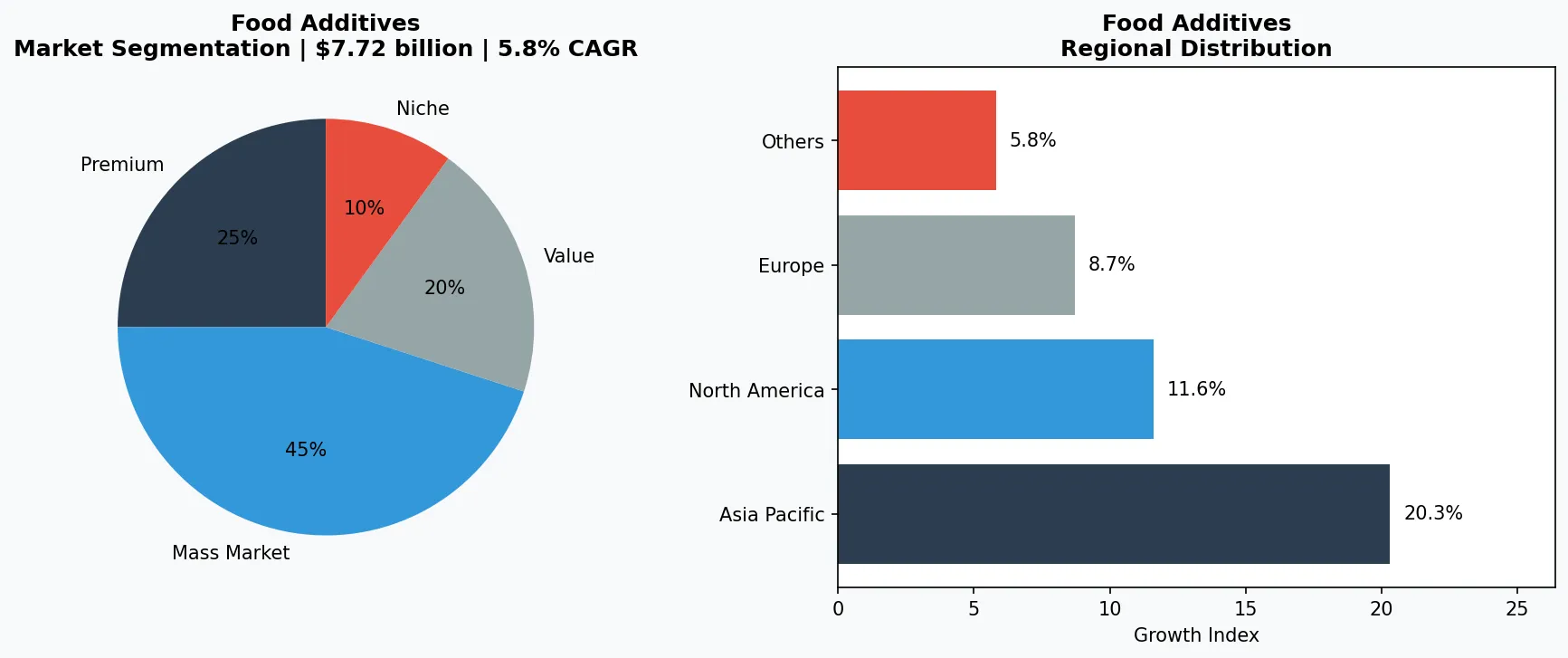
Market segmentation and regional distribution analysis for Umami Enhancers MSG Guide.
3. Product Categories
Umami enhancers fall into three distinct product categories, each with specific applications and regulatory profiles. The first and most familiar is monosodium glutamate (MSG), the sodium salt of glutamic acid. MSG is produced via fermentation of starch, sugar cane, or molasses, and it delivers pure umami at a cost of roughly $1.50–$2.00 per kilogram. It is the backbone of seasonings, bouillon cubes, and snack coatings. Despite negative public perception, all major food safety authorities—including the FDA and JECFA—classify MSG as safe for general consumption.
Premium & Artisanal Tier
High-margin specialty products targeting affluent consumers who prioritize quality, craftsmanship, and unique attributes.
Mass Market Mainstream
Volume-driven products serving price-conscious mainstream consumers with reliable quality at accessible price points.
Functional & Niche Segment
Targeted products addressing specific health concerns, dietary requirements, or lifestyle preferences beyond basic needs.
The second category is nucleotide-based enhancers, specifically disodium inosinate (IMP) and disodium guanylate (GMP). These compounds are often used in synergy with MSG to create a flavor amplification effect up to 10x. Commercially, they are blended as 'I+G' (50:50 ratio) and are common in instant noodles, savory snacks, and seasoning mixes. I+G is derived from fish extract or yeast fermentation and costs about $10–$15 per kilogram, making it a premium ingredient reserved for higher-margin products.
The third category comprises natural umami bases such as yeast extracts, hydrolyzed vegetable protein (HVP), and autolyzed yeast. These contain naturally occurring glutamates and nucleotides. They are perceived as clean-label alternatives and are widely used in organic soups, vegan meat analogues, and reduced-sodium products. For example, brewers spent yeast extract can deliver over 5% glutamate content at a cost of $4–$6 per kilogram. The trade-off is lower flavor intensity per gram compared to MSG, requiring higher inclusion rates. Manufacturers on Verity Rank’s verified supplier lists report that natural umami bases now account for 28% of new product launches in the savory category.
4. Leading Players
The umami enhancers market is shaped by a mix of global ingredient conglomerates and specialized regional producers. Global suppliers dominate the MSG and I+G segments due to their scale in fermentation technology. These players operate large bioreactor facilities in China and Southeast Asia, producing over 80% of the world’s MSG. Their strategy focuses on cost leadership and vertical integration from raw sugar/starch to final crystalline product. With MSG margins averaging 15–20%, they rely on high-volume contracts with multinational food corporations.
Global Market Leader
Multinational player commanding significant market share. Revenue exceeding $50B with operations across 100+ countries, diversified portfolio spanning all major price tiers.
Regional Champion
Dominant force in Asia Pacific with deeply localized product lines, extensive distribution networks, and strong regional retailer relationships.
Innovation Disruptor
Fast-growing challenger disrupting incumbents through breakthrough product innovation, direct-to-consumer models, and data-driven marketing in the food additives space.
Regional specialty producers have carved out niches in natural umami extracts. Companies based in Europe and North America are investing heavily in yeast fermentation and enzyme hydrolysis to produce non-GMO, organic-certified umami bases. These players target the premium natural flavors segment, which commands price premiums of 30–50% over standard MSG. Their go-to-market strategy emphasizes traceability, from farm to finished ingredient, a key requirement for B2B buyers in the EU market.
A third group consists of co-manufacturers and toll processors that focus on custom blending. They combine MSG, I+G, and natural bases to create bespoke umami profiles for specific client products—e.g., a low-sodium chicken seasoning or a vegan cheese flavor. These players are often smaller but highly agile, with R&D turnaround times of 2–4 weeks. For procurement managers, vetting these suppliers on quality control and heavy metal testing is crucial; Verity Rank’s verification process flags non-compliance in over 7% of screened suppliers in this segment.
5. Market Trends
1. FERMENTATION-DERIVED MSG
FERMENTATION-DERIVED MSG — Traditional MSG production relies on bacterial fermentation, but new precision fermentation techniques using engineered yeast strains are improving yield by 15% and reducing carbon footprint. This matters because food manufacturers face Scope 3 emissions targets. A leading Asian producer has already commercialized a low-carbon MSG line that cuts greenhouse gas emissions by 25%, allowing buyers to meet sustainability goals without sacrificing umami potency.
2. CLEAN-LABEL UMAMI BLENDS
CLEAN-LABEL UMAMI BLENDS — Retailers are demanding simpler ingredient lists, pushing suppliers to replace ' monosodium glutamate' with 'yeast extract' or 'hydrolyzed pea protein'. The trend is accelerating in the EU and North America, where sodium reduction mandates further favor natural alternatives. A North American flavor house recently launched a blend of fermented shiitake mushroom powder and tomato extract that delivers umami intensity equivalent to 70% MSG. This allows manufacturers to claim 'no added MSG' while still achieving the desired taste profile.
3. AI-DRIVEN FLAVOR OPTIMIZATION
AI-DRIVEN FLAVOR OPTIMIZATION — Machine learning models are now being used to predict optimal MSG-nucleotide ratios for specific food matrices. This reduces trial-and-error in R&D and cuts product development cycles by up to 40%. A Japanese ingredient co-developer has deployed an AI tool that analyzes 300+ chemical parameters to recommend the most cost-effective umami enhancer combination for instant noodle broths, achieving a cost saving of 12% while maintaining consumer preference scores. For B2B buyers, this means faster time-to-market and reduced formulation risk.
6. Regional Markets
Asia Pacific — The Growth Engine
The world's largest and fastest-growing region, led by China, India, and Southeast Asia. Urbanization, rising middle class, and digital retail adoption are primary catalysts.
North America — Premium & Wellness Driven
A mature market with strong health-and-wellness orientation, sustainability commitments, and robust demand for premium and functional products.
Europe — Quality & Regulatory Leadership
A developed market with stringent quality, safety, and environmental regulations. Strong demand for organic, locally sourced, and ethically certified products.
7. Investment Outlook
Two specific opportunities stand out for B2B buyers. First, the exploding demand for plant-based meat alternatives creates a natural platform for umami enhancers. With the global plant-based meat market expected to exceed $35 billion by 2030, manufacturers need umami bases that mimic the savory depth of animal-derived flavors. Suppliers that can offer mushroom-based or fermented umami complexes tailored to pea or soy protein systems will capture premium contracts. Second, the sodium reduction wave in packaged foods is a structural tailwind; umami enhancers allow a 25–30% sodium cut without consumer rejection. Procurement teams should lock in long-term agreements with suppliers that offer customized low-sodium umami blends.
The primary risk is regulatory divergence. While the U.S., Japan, and China broadly accept MSG, the European Union maintains a stricter stance, requiring explicit labeling of glutamates under the E-number system (E620–E625). Any tightening of regulations—for example, restrictions on added glutamates in the EU’s Farm to Fork Strategy—could disrupt supply chains and force reformulation. Buyers exporting to Europe should prioritize natural umami bases now to avoid future compliance costs. Verity Rank recommends cross-referencing supplier certifications against the latest Codex Alimentarius standards to ensure market access.
Strategic Considerations:
- Technology & AI Integration: Artificial intelligence and IoT are revolutionizing production efficiency, quality assurance, and demand forecasting across the supply chain.
- Sustainability as Business Strategy: Regulatory pressure and consumer expectations are making environmental commitments essential, not optional.
- Transparency & Traceability: Consumers demand increasingly granular information about product origins, ingredients, and production methods.
- Emerging Market Penetration: Africa, Latin America, and second-tier Asian cities represent the next wave of volume growth.
Make Informed Decisions in the Umami Enhancers MSG Guide Market
Product quality and sourcing integrity directly impact business outcomes. Discover how Verity Rank's verification platform helps industry participants source with greater confidence.
Contact Verity Rank TodayFurther Reading: Explore additional market intelligence from Grand View Research and Mordor Intelligence.
This article is for informational purposes only, based on publicly available industry data and market reports as of 2026-04-29. All market figures are estimates and may vary from actual results.