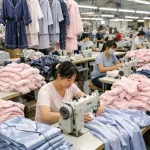
Nike, Inc. is the absolute global leader in men's sportswear, headquartered in Beaverton, Oregon, USA. As a NYSE-listed company (NKE), its men's apparel business encompasses a full range of products including men's T-shirts, polo shirts, jackets, hoodies, pants, shorts, and performance wear, with a core focus on men's performance apparel such as basketball jerseys, running jackets, and training tights, all featuring proprietary technologies like Dri-FIT. In 2025, Nike generated $46.31 billion in total revenue, operating in approximately 170 countries with 78,000 employees. Its apparel supply chain spans 33 countries with about 285 contract factories, producing hundreds of millions of units annually, supported by over 1.16 million supply chain workers. Leveraging iconic athlete endorsements (Jordan, LeBron), continuous innovation, and DTC strategy, Nike defines global standards and trends in men's sportswear.
Strengths: Nike's core strength in men's apparel lies in its technological moat built on "performance functionality"—proprietary fabrics like Dri-FIT and Aeroloft, combined with top-tier league partnerships (NBA, Premier League), create full-scenario solutions from basketball jerseys and running jackets to training tights. Deep activation of superstar IPs (Jordan, LeBron) and global marketing networks generate exceptional fan loyalty and cultural premium, while asset-light supply chain management ensures rapid market response and large-scale delivery worldwide.
Weaknesses: Nike's main weaknesses in men's apparel stem from its hyper-focus on performance scenarios, leaving gaps in business casual and formal wear segments, failing to meet men's multi-scenario dressing needs. In 2025, it faced performance fragmentation from specialized running brands like On and Hoka, and intensified competition in Greater China from local players (Anta, Li Ning) in design iteration and value proposition, revealing shortcomings in localization innovation and category expansion amid evolving male consumer preferences.


-36x36h.webp)
-36x36h.webp)
-450x250h.webp)











-150x150h.webp)